




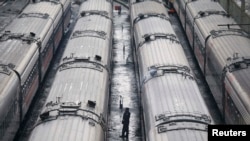
It oversees one of the world's biggest railroad networks, employing around 700,000 people and operating 85,000 kilometers of track that stitches together 11 time zones, carrying millions of passengers and millions of tons of cargo every year.
And it's on track for bankruptcy.
Russian Railways, the state-owned monopoly that is the country's marquee transportation company, a major economic engine, and an integral part of Russians' lives, is in deep financial trouble.
Things are such a mess that the government is scrambling to keep its problems from rippling further. Among the measures: a forced sale of a glassy, $2 billion modern Moscow skyscraper the company acquired two years ago -- spending an estimated one-eighth of its budget in the process.
The mess is due to a mix of factors, some external, some internal. The all-out war on Ukraine is a major cause, with cargo volumes and revenues dropping as the military sucks up traffic and schedules to ship men and material to the front. The company is also staggering under a massive debt load estimated at around $51 billion and exacerbated by high interest rates pushed by the Central Bank as it struggles to rein in inflation.
With the war heading toward its fifth year, the company's woes are also a symptom of Russia's larger economic problems.
"This crisis at Russian Railways is one of the factors [resulting from] accelerating inflation in the Russian economy," said Igor Lipsits, a Russian economist who now lives outside of the country.
"What does this mean? Revenues are lower, tariffs are higher, prices are rising, inflation is accelerating, and people are getting poorer," he told Current Time. "This is what we are seeing in the Russian Railways crisis."
'A Consequence Of The War'
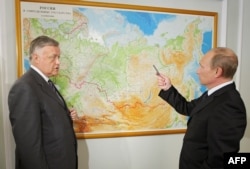
With the biggest part of the sprawling Soviet rail network as its inheritance, Russian Railways was created in 2003, during President Vladimir Putin's first term, as a state-owned joint stock company, and was granted a near monopoly of cargo and passenger traffic. The network is the world's longest after the United States and China.
Under company president Vladimir Yakunin, Russian Railways streamlined operations, shedding hundreds of thousands of employees, and investing in new locomotives and railcars.
A former KGB officer, diplomat, and St. Petersburg resident, Yakunin is known as a close friend of Putin's as well as a neighbor of the Russian president in a real-estate development of remote country homes known as the Ozero Collective.
During his leadership of the company, his son was the beneficiary of real estate deals that looked suspiciously like insider trading.
Yakunin was sanctioned by the West and designated as a member of Putin's inner circle after Russia seized Ukraine's Crimean Peninsula in 2014. A year later, he was ousted, possibly because of embarrassing revelations of posh real estate owned by offshore companies -- documented by anti-corruption crusader Aleksei Navalny -- or revelations of his son's investments, particularly in Britain.
Russian Railways continued expanding and taking on lots of debt after Yakunin's departure.
As it was for the entire Russian economy, the Ukraine invasion was a systemic shock to the railway giant. Western sanctions disrupted trade flows. Exports of raw materials to the West and elsewhere slowed. China stepped in to replace Western companies. Russian Railways took on more debt to help reorient its rail operations.
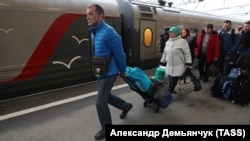
In 2024, the government ordered that military trains carrying men and materiel be given priority status on the rail network. That hurt cargo shipments and revenues for the company.
Compared with 2021, prior to the invasion, Russian Railways shipped 4 percent less cargo in 2024, according to Novaya Gazeta Europe -- the lowest volume of freight shipment since 2009 during the global economic crisis.
"Currently, military cargo accounts for a large share of Russian Railways' shipments. But beyond the fact that a significant share, and it's unclear how much, falls to Russian Railways, it certainly impacts the train schedule itself," said Andrey Yakovlev, a researcher at Harvard University's Davis Center.
"Quite a few [customers] are now complaining about Russian Railways' failure to deliver cargo on time. And the explanation for this is generally linked to the fact that military cargo is prioritized," he said. "This is all, naturally, a consequence of the war."
Given the company's importance to Russia's overall economy -- its operations account for 2.5 percent of Russia's GDP -- it's widely considered an entity that's "too big to fail": The government cannot, and will not, let it go bankrupt.
Keeping The Trains Running
Government officials are mulling several options to bail out the company, including hiking cargo tariffs, increasing subsidies, or cutting taxes, according to Reuters, which cited two people with knowledge of the discussions. Raising shipping rates would be problematic, however; it would increase costs for other cash-strapped, debt-laden companies, particularly in raw material sectors like coal or agriculture. Converting its debts to shares in the company is also under consideration.
But in the meantime, its problems are rippling elsewhere in the economy. Its main creditors, include other state-owned entities such as VTB, the country's second-largest bank.
"If Russian Railways can't pay interest on its loans and repay them, that spells trouble for VTB's financial stability," Yakovlev said. "And VTB is one of Russia's systemic banks. So, it's a chain where one link pulls the other."
"At its current rate of degradation, the Russian rail industry will continue to shamble along only as long as the state can prop it up through forced loans from state banks, direct cash infusions, or simple debt write-offs," Jeff Hawn, a researcher at the London School of Economics, said in an article published last month.