


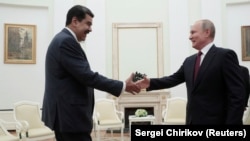
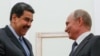
For the Kremlin, the most obvious takeaway from the US seizure of Venezuela's Nicolas Maduro may be that it's a blow to Russia's regional influence and to the pride of Vladimir Putin: A prominent ally who concluded a "strategic partnership" pact with the Russian president in May is suddenly out of power and sitting in jail in New York City.
Maduro's capture comes a little over a year after the fall of Bashar al-Assad, the Syrian leader who gave Russia a firm foothold in the Middle East in exchange for crucial support in the war against his opponents -- another big hit to Putin's efforts to revive Moscow's presence around the world after the retreat that followed the Soviet collapse.
Not only that, but the US raid in Venezuela on January 3 accomplished in a few hours something Russia has been unable to do in the nearly four years since Putin launched the full-scale invasion of Ukraine and that was seen as one of his key goals: Remove the leader of a country.
But Russia's focus on its war against Ukraine meant protecting Maduro would not have been realistic, even if Moscow had wanted to do so. Venezuela's usefulness for Russia had declined, at least in economic terms, because of sanctions and other factors that have driven down oil production, a sector in which Russia has major stakes.
And there are upsides for Russia. For one thing, Moscow can point to the US operation as evidence that Washington seeks to impose its will on other countries and flouts international law when it sees fit -- an argument that is convincing to some despite Moscow's war against Ukraine.
In statements on January 3, the Russian Foreign Ministry said it was "extremely concerned" about what it called an "act of armed aggression against Venezuela" and urged the United States to "release the legally elected president of a sovereign country and his wife."
But what's more important to the Kremlin than bolstering that portrayal of the United States, analysts say, is the hope that Washington's actions in Venezuela and US President Donald Trump's focus on the western hemisphere will give Moscow more latitude -- both morally and militarily -- to do as it desires in what it considers its own sphere of influence, particularly in Ukraine.
"Regardless of the decisions Vladimir Putin makes in Ukraine, it is becoming increasingly difficult to condemn certain actions on the basis of international law alone," Berlin-based political analyst Alexandra Sitenko, an expert on Russia's ties with Latin America and other regions, told RFE/RL.
'What Great Powers Do'
The widespread perception that the US operation violated international law "is no bad thing for the wider Russian narrative," Mark Galeotti, a Russia analyst and honorary professor at University College London's School of Slavonic and East European Studies, said on his podcast on January 4.
"After all, Putin's view is essentially that this is what great powers do, and great powers have spheres of influence. And if we are going to let America have its Latin American sphere of influence, then the corollary is, we should be allowed our Slavic one," Galeotti said.
Added Sam Greene, a professor at the Russia Institute at King's College London: "Any frustration over seeing Maduro removed by Washington will be tempered by the promise of a global condominium -- in which Moscow would win the right to do the same in its own neighborhood."
There's evidence that Russia has been seeking that kind of a quid pro quo since long before it launched its all-out war against Ukraine in February 2022.
During a standoff in which Russia helped protect Maduro amid an effort by a US-backed opposition leader to oust him, "the Russians…were signaling very strongly that they wanted to somehow make some very strange swap arrangement between Venezuela and Ukraine," Fiona Hill, who was the top Russia and Europe adviser on Trump's National Security Council from April 2017 to July 2019, told a Congressional committee in October 2019.
The thrust of the Russian messaging was, "You want us out of your backyard. Well, you know, we have our own version of this. You're in our backyard in Ukraine," Hill said.
The Ukraine Factor
This time around, Russia's approach and its relatively muted response to Maduro's capture -- Putin had not commented publicly as of January 5 -- are part of a series of developments that show "just to what extent Russia's desire to subjugate Ukraine dictates the rest of its foreign policy," Hanna Notte, director for Eurasia at the James Martin Center for Nonproliferation Studies, said on X.
"Putin shunned cooperation with [former US President Joe] Biden in an effort to force him to abandon Ukraine. Over the past year, he's tried to stay in Trump's good graces, only this time to lure him into taking Russia's side against Ukraine," Notte wrote.
"Whether in wielding pressure or praise vis-a-vis a US leader, Russia's end goal remained the same: Driving a wedge between the US and Ukraine."

While the tone and content of diplomacy on Ukraine can change fast, so far there's no been sign of a major shift in the US position since Maduro's capture, which came amid multiple rounds of talks involving the US, Ukraine, Europe, and Russia in various configurations as the Trump administration seeks to broker an end to the war.
At a news conference hours after the operation in Caracas, Trump said he was "not thrilled with Putin. He's killing too many people." And on January 4, he echoed a CIA conclusion and said he did not believe Ukraine targeted one of Putin's residences in a drone strike late last month -- after earlier seeming to accept the claim he said the Russian president relayed in a telephone conversation.
Does the focus on Venezuela and the western hemisphere "mean that the United States is going to be distracted?" Galeotti asked.
His answer: "Certainly one can wonder how the claim that it's going to run Venezuela can possibly be operationalized. But on the other hand, a superpower can indeed walk and chew gum at the same time. I don't think this is going to have any particular impact on what happens with Ukraine."
Greene suggested that if the Kremlin hopes for a broad understanding between major powers and free rein when it comes to Ukraine, it will be disappointed.
"[U]nless carte blanche to act in Ukraine is forthcoming in short order, Moscow will chalk this down as standard American hypocrisy, likely souring the putative coalition of global hegemony between Putin, Trump and [Chinese President] Xi [Jinping]," he wrote.

