




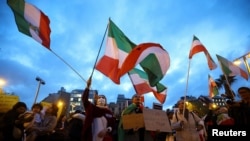
Weeks of nationwide protests have posed one of the gravest threats to Iran’s clerical rulers since the Islamic Revolution in 1979.
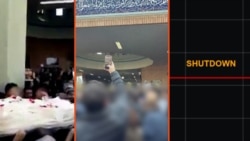
The authorities have responded by imposing a near-complete communications blackout and waging the deadliest-ever crackdown on street protesters, with rights groups verifying the deaths of at least 2,400 people.
US President Donald Trump has pledged to support protesters and threatened to take military action against Iran.
RFE/RL spoke with Gregory Brew, an Iran analyst at the New York-based Eurasia Group, about the trajectory of the protests and the implications of possible US military action in Iran.
RFE/RL: You have referred to the unrest in Iran as an “uprising” rather than a “protest movement.” Can you elaborate on that?
Gregory Brew: What has been surfacing over the last few days, as the Internet slowly comes back on, is evidence of extreme violence. The regime using not only police and Basij [paramilitary] units, but military units, the army, and the IRGC [Islamic Revolutionary Guards Corps] using heavy weaponry against crowds in the streets.
One of the features that has made this protest wave different...is that the protesters aren't really calling for anything specific, other than the collapse of the Islamic republic."Gregory Brew, Eurasia Group
There's also been reports and evidence surfacing of people fighting back -- of people shooting at government troops. Over 100 security personnel have been confirmed dead [by rights groups] as a result of this violence. That suggests quite a lot of fighting; not simply operations to clear demonstrations, but urban warfare.
Also, potentially quite a lot of violence in the rural parts of Iran or in the provinces, where very often security forces can't respond as quickly as they can in in major cities.
So, I think it's taking on the shape of an uprising against the regime more so than protests for political change, and that, I think, reflects the level of public discontent and anger inside Iran.
I mean, one of the features that has made this protest wave different from past protest waves is that the protesters aren't really calling for anything specific, other than the collapse of the Islamic republic. They really have had it with the regime, and the regime has responded with excessive force.
RFE/RL: If the Islamic republic survives this round of protests, how long can it continue for? Has it become unsustainable, given all the crises it is facing simultaneously?
Brew: I think for three reasons, the regime is likely to survive this protest wave. The first is, it has survived protest waves in the past. Now, granted, this one is different and more extreme, but the regime has a large and sophisticated repressive apparatus, not only police units and military but also surveillance technology -- technology that can be deployed to monitor and apprehend citizens. We've gotten reports of door-to-door raids, an excessive use of the various repressive instruments that the Islamic republic has developed over the course of the last 40 years. That's the first big reason they have a lot of tools to use against these protests, and they've used them in the past.
I think it has been generally acknowledged -- not only over the last week, but over the last year -- that the Islamic republic cannot continue on its present course."Gregory Brew, Eurasia Group
The second reason is that, while clearly very animated and very vocal, the opposition and the demonstrations in general remain fairly disorganized. There still really isn't a core that can organize and coalesce this movement, absent perhaps [Iran’s former Crown Prince] Reza Pahlavi, who has taken on a somewhat more prominent role than he has in the past. But these protests remain organic. They remain structural, emerging from Iran’s structural crises, but they lack leadership and organization, and that's one of the key constraints that can keep the protests from turning into a proper revolution.
The third reason is that the regime leadership remains united. There have been no cracks. No one has spoken out against the government line. In fact, many moderates like President Masud Pezeshkian and many on the more sort of moderate wing, have supported the crackdown and accepted the line that these are terrorists, that these are riots that threaten the nation's security. So, for all those reasons, I think the regime is likely to survive long term.
I think it has been generally acknowledged -- not only over the last week, but over the last year -- that the Islamic republic cannot continue on its present course. This collection of crises -- economic, social, political, foreign policy, internal pressures, external pressures, the lack of leadership at the top, corruption -- all of these issues mean that the gradual, if not collapse, then disintegration or degradation of the regime is likely. It may not happen in six months, it may not happen in a year, but it does appear to be coming.
RFE/RL: In the early days of the protests, Trump warned that the US would get involved in support of the protesters if security forces killed civilians. More recently, he threatened “very strong action” if Iran begins to hang protesters. Does this suggest a change in position?
Brew: I'm not sure if it really is a change in position. I think the president has a way of responding to immediate questions with immediate answers. For instance, Trump was responding to a question about his thoughts on Iran’s plans to hang an arrested protester. He has promised to intervene to support these protests. He's threatened military force. We know there are active discussions going on inside the United States about launching strikes on Iran, as well as providing support for the protesters or taking non-kinetic measures. I think the United States is likely to do something in response to this protest wave. I think the president has made that fairly clear. I think he wants to take action.


The issue they're running into is, what could be the best course of action? How, if at all, can the United States lend support for protesters? Would US action, particularly a military strike, backfire and provide the regime with even more support for its crackdown? The regime, of course, is pushing a narrative that the protests were backed by foreign powers, that they're the result of foreign subversion. So, a US military strike or US intervention could potentially play into the regime's hands. So, I think the US is still undergoing a deliberation over what to do.
The final point is that the number of assets the US has positioned in the Middle East is relatively small compared to what we've seen in the past. During last year’s [Israel-Iran] war, there was a carrier group in the region. There were multiple US surface vessels. There were additional fighter squadrons deployed in the region in 2023 and 2024 at the height of the crisis in Gaza and the missile exchanges between Iran and Israel, there was a very large US military presence in the Middle East. Right now, it has been significantly reduced. There is still enough for the US to take action against Iran, including military action, but there's a little bit less to fall back on in the event that Iran retaliates in a considerable way.
So, all of this is weighing on the US deliberations. And the other element, of course, is that this is meant to be an action in support of the protests. And the protests, as far as we can tell, do appear to have died down over the last 48 hours as a result of this very vigorous, very brutal crackdown from the regime. So, Trump risks running out of time. He risks missing a window to act in support of the protests, given that the protests themselves seem to be coming to an end, at least for now.
RFE/RL: What can be considered a strong enough US measure to help the protesters? It’s a tough question to answer, but it is one that is often asked.
Brew: This is a very difficult question. I would say, short of a military campaign to significantly weaken the regime's security apparatus, there's not a whole lot that the United States can do. To support bottom-up revolution inside Iran would require considerable outlay of military resources by the United States, as well as by neighboring states. I mean, you'd have to put together a regional coalition in support of regime change in Iran.
Right now, that coalition does not exist. I don't think it would have support from many states in the region. Perhaps it would have support from Israel. But I don't think the Arab states in the Persian Gulf would necessarily support a regime change operation. I don't know if Turkey would, either. All of these states are worried about blowback. They're all worried about instability in Iran spilling over into their own borders. So, the United States would be undertaking this alone, and it would be doing so without commitment of boots on the ground. The president has made it very clear that he's not sending US troops into Iran.

Also, Iran is a very, very large country. It would require a greater effort, even than the invasion of Iraq, to overthrow the Islamic republic as it currently exists. I don't know if there are measures that the United States can take in the short term. In the longer term? Perhaps via greater means of pressure on the Islamic republic, on its leadership, attempting to increase its diplomatic isolation, pushing states to sever ties with Iran. But this would all simply create more pressure, much of which would be felt by the Iranian people themselves, worsening their material conditions, which, of course, is one of the reasons why they're protesting against the regime in the first place.
RFE/RL: The Wall Street Journal recently reported that Arab states in the Persian Gulf, including Saudi Arabia, are lobbying Trump not to strike Iran. We're talking about countries that have suffered at the hands of Iran or its proxies. Why wouldn't they want the United States to hit Iran?
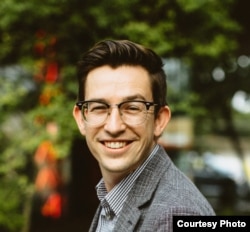
Brew: Their concern, first and foremost, is that Iran would retaliate against their own territory. They’re also concerned that an Iran that moves from a weakened state into a state of collapse risks their own stability, risks creating instability in the Gulf, and risks creating greater instability in Iraq or in southeast Turkey. No one is interested in seeing Iran turn into a Syria situation where you have refugee flows, where you have militant groups, where you have a breakdown in order.
The Islamic republic doesn't have many friends in the region, but no one is actively looking for its collapse in the short term. I think what regional states would like to see is a change in Iran's behavior. They would like to see Iran end its support for regional proxies. They would like to see Iran back away from more destabilizing behavior, make a deal with the United States over its nuclear program. All of that is desirable, more desirable than forcing regime change through military action.
RFE/RL: Do you think there's a desire in the United State to negotiate with the Islamic republic if it survives the protests?
Brew: Not in the short term. And I think there is a very simple reason for that, which is that Iran is still unlikely to make concessions to meet the US demands. The US position with Iran has actually been very clear for the last six months: Iran must surrender enrichment, must hand over its stockpile of highly enriched uranium, agree to terms that constrain its ability to enrich uranium for the foreseeable future, it must back away from its regional proxies, particularly Hezbollah in Lebanon, and it must constrain its development of ballistic missiles.
These are the US terms, and the US is essentially offering it to Iran on a take-it-or-leave-it basis. Iran has not made any move to make concessions to those terms. In fact, it has been defiant. So, absent even this violent episode, I still wouldn't see much scope for diplomacy between the United States and Iran -- certainly not while [Ayatollah Ali] Khamenei remains supreme leader. His departure could potentially create space for change in Iran's position, but that, to me, is the necessary prerequisite to seeing a shift in their negotiating position.