




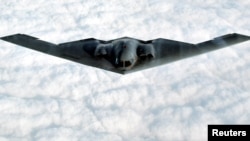
US military action against Iran appears to be back on the policy agenda in Washington amid the increasingly deadly crackdown on protesters in cities and towns across the country.
Unconfirmed reports say that more than 500 people have been killed -- some rights groups say the death toll may be several times higher -- in suppressing the uprising, one of the biggest challenges to clerical rule since the 1979 Islamic Revolution.
The demonstrations were sparked by spiraling inflation and a freefall of the currency, but have since turned into a broader protest against the country's authorities.
Both Washington and Tehran have signaled that they are open to talks. But US President Donald Trump has said action may be taken anyway given reports of the brutal actions against protesters.
“We might meet with them. A meeting is being set up, but we may have to act because of what is happening before the meeting,” Trump told reporters on Air Force One on January 11.
Iranian Foreign Minister Abbas Araqchi said on January 12: "The Islamic Republic of Iran is not seeking war but is fully prepared for war."
So, what are Washington’s options if diplomacy fails?

Limited Strikes
On the plus side, limited strikes against symbolic targets would entail less risk for the US armed forces and for hitting civilians.
They would also more easily fall within the US military capabilities in the region and beyond -- and could conceivably be carried out without involving US Gulf allies.
"It is the safest option. It doesn't have the same probability of blowback as...when you go and try to take out key military infrastructure," Marina Miron, a post-doctoral researcher in Defense Studies at Kings College London told RFE/RL on January 12.
Some analysts have said that this option carries multiple downsides, primarily enabling the regime to rally patriotic support and deflect attention from the grievances fueling the nationwide demonstrations -- while also causing little significant damage.
It could also signal to protesters that Washington is not riding to the rescue as Iranian security forces kill and arrest them.
An example of such a target would be a facility such as a barracks belonging to the police, Basij paramilitaries, or Islamic Revolutionary Guards Corps (IRGC).
A Sustained Campaign
A more concerted campaign of strikes against the IRGC could have more impact, especially if it went further and included strikes on Iranian missile facilities, command and control, and other security forces.
One problem is that US naval forces are not currently in the region in sufficient numbers and capacity. The nearest aircraft carrier, the USS Abraham Lincoln, is currently in the South China Sea, where it has been conducting live-fire exercises. This is several days voyage from the Persian Gulf.
US forces do have military bases in the region, in countries such as Kuwait, the United Arab Emirates, and Qatar. But these countries have reportedly asked Washington not to take military action.


Many will be wary of an Iranian counterattack. During the 12-day war in June, when Israel and the United States targeted Iran’s nuclear program, an Iranian missile strike on an air base in Qatar rattled nerves.
That attack was largely symbolic, but Iran has threatened retaliation for a new US attack and this time it could be more substantive. Fossil fuel exports from US Gulf allies, passing through the Straits of Hormuz, could be disrupted. Israel could also be attacked, raising the specter of a wider regional conflict.
“The current situation for the Islamic Republic is existential. This is a battle…that directly targets the very nature and essence of the regime,” Ali Mamouri, a research fellow at Deakin University in Australia, told RFE/RL’s Radio Farda. “If it is attacked, it will almost certainly retaliate with all its available capabilities.”
Special Forces, Assassination
After ousted Venezuelan leader Nicolas Maduro, is Iranian Supreme Leader Ali Khamenei next on the list for detention by US special forces?
A similar operation appears unlikely. US forces were massed around Venezuela in far greater numbers and were also helped by intelligence sources within the regime, according to media reports.
Another scenario might be assassination, decapitating the regime and sparking a power struggle within Iran. This would also depend greatly on having excellent intelligence.
King's analyst Miron said the "most logical option" would be "combining intelligence efforts on the ground, possibly arming the opposition...trying to take control of at least any big city, and then spreading from there."
A key downside to any such approach, even assuming it were possible in practice, would be that the outcome is unpredictable and may lead to greater chaos and bloodshed. But some observers believe a new regime, even one led by the IRGC, may be willing to do business with Washington.
“I think that’s likely,” Michael Rubin, a former Pentagon official who is a senior fellow at the Washington-based American Enterprise Institute, told Radio Farda on January 6.
Blockades, Cyberattacks, Sonic Weapons
Trump does have other options on the Resolute Desk.
“It’s quite likely that nonmilitary options are also being considered. These could include a complete economic blockade of Iran to prevent its oil exports to China or cyberattacks that disrupt the communication and decision-making systems of Iranian security agencies,” Ali Vaez, Iran project director for the International Crisis Group, told Radio Farda.
Cyberattacks have happened before.
In 2021, Iranian gas stations came under cyberattack, which Iran blamed on the United States and Israel without providing evidence. Similar attacks have happened since then.
In 2019, Iran claimed to have busted a CIA spy ring following a cyberattack on weapons systems. US media at the time reported that it was a US attack, citing unnamed government officials.
There may also be less conventional attack options.
Following the US operation in Venezuela, White House spokesperson Karoline Leavitt shared comments allegedly made by a man who survived an attack by sonic weapons.
“It was like a very intense sound wave. Suddenly I felt like my head was exploding from the inside. We all started bleeding from the nose. Some were vomiting blood. We fell to the ground, unable to move,” he was quoted as saying.
However, this report has not been independently or officially confirmed.



