




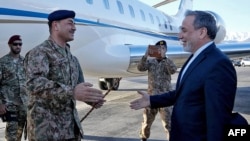
US President Donald Trump said the war with Iran could be over "very soon," and Pakistan's powerful army chief visited Tehran in a bid to bridge the gap between the United States and Iran and pave the way for a new round of talks.
"I think it can be over very soon. If they're smart, it will end soon," Trump said of Iranian negotiators in an interview with Fox Business News that was recorded on April 14 and broadcast on April 15.
"I think it's close to over…. I view it as very close to being over," Trump said. Earlier that day, he told the New York Post that negotiators, who ended April 11-12 talks in Islamabad without a deal, could meet again in the next couple of days.
Iranian Foreign Ministry spokesman Esmail Baqaei told a weekly press briefing in Tehran on April 15 that since the talks ended, Iran has been exchanging messages with the United States via Pakistan.

The clock is ticking on a two-week cease-fire agreed by the United States and Iran on April 7, and Trump said he has no plans to extend the truce after it expires on April 22, suggesting it would probably not be necessary.
Upon arriving in Tehran, Pakistani Army chief Asim Munir was greeted by Iranian Foreign Minister Abbas Araqchi. A senior Iranian source told Reuters that Munir, who had mediated the last round of talks, was heading to Iran "to narrow gaps" between the two sides.
In Washington on April 15, White House Press Secretary Karoline Leavitt said "conversations" about a second round of talks were "productive and ongoing" and that "we feel good about the prospects for a deal." She said any new talks would likely be held in Pakistan, which has emerged as the "only mediator."
Vice President JD Vance, who led the US delegation in the first round, raised the prospect of further talks by saying "a lot of progress" was made on April 11-12.
"The ball is in the Iranian court," Vance said on April 13. He said disagreements over Iran's nuclear program ultimately ended the talks without an accord.
Later that day, at an event in the southern US state of Georgia, Vance said Trump wanted to make a "grand bargain" with Iran but there was a lot of mistrust between the two countries.

Iranian President Masud Pezeshkian has blamed Washington for the failure of the talks, but he also has said that "diplomacy is the preferred path to resolving disputes."
One of the most contentious issues has been Iran's effective closure of the Strait of Hormuz, a conduit for about one-fifth of the world's oil and gas shipments before the war began.
After the Islamabad talks broke up without a deal, Trump announced a US blockade targeting ships bound to or from Iran. The strait connects Europe with Asia via the Suez Canal and is considered one of the most important maritime trade routes in the global economy.
The US military on April 15 said it successfully turned back 10 vessels that attempted to sail out of Iranian ports over the first 48 hours of the l blockade.
"Ten vessels have now been turned around and ZERO ships have broken through since the start of the US blockade on [April 12]," US Central Command (CENTCOM) said in a post on X.
CENTCOM had earlier put the number of ships turned back at nine but later included a 10th that it said was "redirected" back to Iran by a US guided missile destroyer.
While CENTCOM said no vessels had made it through the blockade, maritime tracking data appeared to contradict that assertion.

Citing tracking services, Reuters separately reported that three Iran-linked vessels that transited the strait were not headed for Iranian ports and were not affected by the blockade. Two of the three vessels are under US sanctions and one of them is Chinese-owned, Reuters reported.
Iran on April 15 threatened to resume attacks in the Gulf region if the blockade threatened the safety of Iranian cargo vessels and tankers, saying it would amount to a violation of the cease-fire agreement.
The war with Iran, which effectively closed the Strait of Hormuz, has wreaked havoc on world energy prices, while the halt in shipments of other commodities worth billions of dollars that flow through the narrow shipping lane has threatened economies around the globe.
One nation that has benefited from the restriction of oil shipments is Russia, which has seen sanctions over the Kremlin's full-scale invasion of Ukraine eased to help bolster supplies.
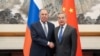
Foreign Minister Sergei Lavrov said during a trip to Beijing on April 15 that Russia is able to make up for an energy shortage in China caused by the blockade of the Strait of Hormuz.
"Russia can, without a doubt, compensate for the shortfall in resources that has arisen" for China and "other countries that are interested in working with us," Russia's top diplomat told a news conference.
Beijing, meanwhile, has been looking to play a more visible role in diplomacy around the war in the Middle East as tensions between Tehran and Washington evolve.
While some reports, including comments from Trump himself, have suggested China played a part in encouraging the recent cease-fire talks, it remains unclear how central a role Beijing played in pushing Tehran to the negotiating table.

