




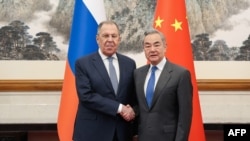
Russian Foreign Minister Sergei Lavrov arrived in Beijing as China steps up diplomatic efforts around the war in Iran amid a US blockade on vessels calling at Iranian ports that the Chinese Foreign Ministry has called "dangerous and irresponsible."
Lavrov held talks with Chinese Foreign Minister Wang Yi on April 15, which covered the wars in Iran and Ukraine, as well as Beijing and Moscow's deepening ties, according to Russia's Foreign Ministry.
Chinese leader Xi Jinping also met with Lavrov in the Great Hall of the People in Beijing, where he urged Russia and China to "firmly defend their legitimate interests and safeguard the unity of Global South countries."
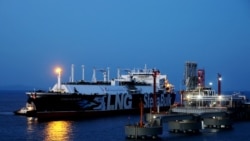


The Chinese readout of Xi’s remarks did not mention the war in Iran, but his comments appeared to reference growing fears that a long-term blockade of the Strait of Hormuz -- a strategic chokepoint for the world's fertilizer and energy supplies -- could trigger a economic and food crisis that hits countries in the Global South particularly hard.
Lavrov's two-day trip to China comes after peace talks in Islamabad between the United States and Iran failed to reach an agreement, prompting US President Donald Trump to call for a blockade on ships calling at Iranian ports as they transit the Strait. China's Foreign Ministry called that move "dangerous and irresponsible" during an April 14 press conference.
The visit also takes place as Xi has been looking to play a more visible role in diplomacy around the war in the Middle East as tensions between Tehran and Washington evolve.
Xi hosted Sheikh Khalid bin Mohammed Al Nahyan, the crown prince of Abu Dhabi, on April 14, where he "made proposals to maintain peace in the region," according to a Chinese readout of the meeting.

While some reports, including comments from Trump himself, have suggested China played a part in encouraging the recent cease-fire talks, it remains unclear how central a role Beijing played in pushing Tehran to the negotiating table.
Analysts say China is aiming to strengthen its global standing amid the war in Iran as it looks to portray the United States as a destabilizing force in international politics and trade.
"China will see this [conflict] as a huge opportunity, as a way to showcase that China is a stable force in international affairs, as being the adult in the room," said Yu Jie, a senior research fellow at Chatham House, a London-based think tank.
Beijing And Moscow Talk War In Iran
While part of regular engagement between Beijing and Moscow, Lavrov's visit occurs at a crucial moment in the Iran war and China's relationship with the United States.
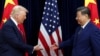
Trump is expected to travel to Beijing on May 14-15 for a summit with Xi, which is set to focus on a range of trade, technology, and military issues. The trip was originally scheduled for the end of March but was delayed due to the war in Iran.
The Russian visit also follows a series of reports in US media about growing potential support for Iran from China.
The Financial Times, citing leaked Iranian military documents, reported on April 15 that Iran secretly acquired a Chinese-built spy satellite, giving it new capabilities to monitor and potentially target US military bases across the Middle East.
Lin Jian, a spokesman for China's Foreign Ministry, said on April 15 that "media reports accusing China of providing military support to Iran are purely fabricated."
Earlier reports from CNN and The New York Times that say US intelligence agencies have information about possible shipments from China of shoulder-fired missiles to Iran.
The New York Times, citing US officials, said the shipment has already been sent, while CNN's reporting said China was preparing to send a shipment in the coming weeks.
Neither report offered definitive evidence, and China's embassy in the United States denied shipping missiles during the war.

Still, US intelligence agencies have assessed that China is weighing how to support Iran in the conflict, with reports that discussions are under way on whether to allow some Chinese companies to ship components, fuel, and chemicals to Iran that could be used in military production.
Evidence that Russia has provided the Iranian military with specific satellite intelligence to help Iran's Islamic Revolutionary Guards Corps target American ships, along with military and diplomatic installations throughout the Middle East, has also reportedly been obtained by US intelligence agencies.
Global Economic Headwinds Weigh On China
China experts have noted that Beijing's public rhetoric during the Iran war has been somewhat toned down since US-Israeli strikes on Iran began in late February.
This is seen partly due to China's deep political and economic ties with Arab nations in the Middle East that have faced Iranian attacks, but also Beijing's aim to balance relations with the United States ahead of the upcoming summit between Trump and Xi.
Huang Jing, director of Tsinghua University's Institute of American and Pacific Studies, wrote in Guancha, a popular Chinese news site, that Beijing's "commitment to maintaining stability in US-China relations is not only crucial for both countries but also holds profound and far-reaching significance for the stability and development of the entire world."
China is heavily dependent on oil that passes through the Strait of Hormuz and is anxious about how global economic fallout from the war in Iran could put its own economy at risk.
While China is better cushioned against energy shocks than many economies, rising commodity prices driven by Middle East supply disruptions could squeeze profit margins. The country has leaned heavily on exports to support growth, and although higher fossil fuel costs have boosted demand for Chinese solar panels and electric vehicles, sustained oil price increases could weaken global demand and slow orders for Chinese manufacturers.
In a sign of slumping global demand, data released on April 14 from China's customs bureau shows the country's export momentum slowed in March.
The figures show Chinese exports growing by 2.5 percent in March compared to the same period a year earlier. That marks a notable slowdown compared to January and February, which saw 22 percent growth compared to last year.