




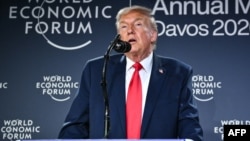
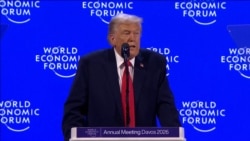
US President Donald Trump has ruled out military action to take control of Greenland while also saying he wants to hold more talks on the United States acquiring the island, which he described as “our territory” during a keynote speech at the World Economic Forum in Davos, Switzerland, on January 21.
Hours after his speech, Trump also walked back a plan to impose tariffs on some European countries for opposing his Greenland policy.
In Trump's highly anticipated speech on an issue that has caused acute alarm in other NATO countries, Trump said that US ownership of Greenland was a matter for both US and international security and that only Washington had the power to defend it against threats by other countries.
Trump did not name the countries but has, in recent comments, spoken of a Russian and Chinese threat to Greenland -- an autonomous territory belonging to NATO-member Denmark.
No Military Action
"I'm seeking immediate negotiations to once again discuss the acquisition of Greenland by the United States," Trump said.
“I don't have to use force. I don't want to use force. I won't use force,” he added, reversing earlier comments in which he had not ruled it out.
In early reaction to Trump’s comments, Danish Foreign Minister Lars Lokke Rasmussen said his country was open to talks.
"What is quite clear after this speech is that the president's ambition remains intact," he said, also noting that “what the president said about the military” was “positive.”
But Trump made it clear that his aim of taking control of Greenland remained firmly in place and appeared to link the issue to Washington’s commitment to NATO.
“We want a piece of ice for world protection, and they won't give it. We'd never ask for anything else…So they have a choice. You can say ‘yes’, and we will be very appreciative. Or you can say ‘no’, and we will remember. A strong and secure America means a strong NATO,” he said.
Other European leaders have vocally supported Denmark’s position in recent days, and diplomats from European Union countries told RFE/RL that Trump’s speech would not allay concerns in capitals across the continent.
"I don’t know if this quote is an implicit threat, but he said that NATO will be stronger if Greenland belongs to the US, and there is nothing Denmark or NATO can do...I think he gave the topic quite a bit of time," said an ambassador from one EU nation, who spoke to RFE/RL on condition of anonymity.
Bradley Bowman, senior director of the Center on Military and Political Power at the Foundation for Defense of Democracies (FDD) in Washington, told RFE/RL “it will be reasonably construed by many people as some form of a threat.”
“I will be surprised if Trump lets this go. I think he's going to stay on Greenland like a dog on the bone. At least for now, he appears to have taken the military option off the table,” he added.
Other EU diplomats told RFE/RL that Trump’s Davos speech “changed nothing” and was “nothing new.”
Tariff Plan Scrapped
Trump has also sought to apply pressure via nonmilitary means, announcing on January 17 that he would impose extra tariffs on eight European countries if they continued to oppose US ownership of Greenland. As Trump was speaking in Davos, the European Parliament announced it was freezing work on approval of the US-EU trade deal agreed in July.
But, hours after finishing his speech in Davos, Trump posted a statement online saying the tariffs would not be imposed based on a deal he had struck with NATO chief Mark Rutte.
"This solution, if consummated, will be a great one for the United States of America, and all NATO nations," he wrote.
In his Davos speech, Trump reiterated an earlier point that, although it already had a military base in Greenland, it needed control of the island for psychological reasons -- and that a lease or other arrangement was not enough.
“Who the hell wants to defend a license agreement?” he asked. Trump supporters have developed this point in recent days, suggesting major military investments are needed on Greenland. Trump mentioned it in his speech as a base for the planned Golden Dome missile defense system.
“If we’re going to spend a bunch of money…we need to have the legal control and the legal protections that justify building the place up and putting our people on the ground,” said Senator Lindsey Graham on January 8.
“The United States has particular concern about the ultimate security status of an independent Greenland,” Alexander Gray, chief executive officer of American Global Strategies LLC, an international strategic advisory firm, told RFE/RL.
“An independent Greenland would likely follow the path of other lightly populated, developing states and quickly have its sovereignty compromised by China and Russia, directly threatening US security interests,” added Gray, who served on the National Security Council (NSC) during Trump’s first term in the White House.

A Distraction From Ukraine?
As Washington has increased the pressure, Western leaders have responded that it is threatening to cause massive harm to NATO itself. Canadian Prime Minister Mark Carney warned at Davos on January 20 of a "rupture" to the US-led international system.
French President Emmanuel Macron has suggested the focus on Greenland risks undermining cooperation on countries such as Iran and Syria. Other NATO leaders have warned it is diverting attention from Ukraine.
“The situation with respect to Greenland is absolutely distracting time, attention, and resources from Ukraine. I mean, we have European allies talking about deploying forces to Greenland…I'd rather you send those to Eastern Europe,” said the FDD’s Bowman.

But another analyst, Daniel Hegedus from the German Marshall Fund think tank, said Ukraine may actually stand to benefit.
“This lack of attention does less harm for Ukraine than the intense attention and pushing the leadership of Ukraine into the direction of a very seriously unfavorable peace settlement or cease-fire with Russia,” he told RFE/RL.
Trump mentioned Ukraine briefly in his speech, before returning to the subject of stalled US-led peace efforts during a question-and-answer session afterwards.
“What happens is, oftentimes we’ll have a deal with Russia, Russia’s set, and [Ukrainian] President [Volodymyr] Zelenskyy will not do it. You saw that when he was in the Oval Office. I was not happy. And then, we’ll have President Zelenskyy wants to make a deal and [Russian President Vladimir] Putin doesn’t want to make a deal,” Trump said.
It emerged later that, before leaving Davos on January 22 to return to Washington, Trump will meet Zelenskyy. Trump’s envoy Steve Witkoff, meanwhile, would head for Moscow for talks with Putin the same day.
Also on January 22, Trump is set to formally announce the first charter of the Board of Peace, a body for resolving international conflicts with a $1 billion price tag for permanent membership.
Invitations to join have been sent to both Moscow and Kyiv. It was not immediately clear if either country would join, although Putin-ally Belarus has said it will take part in the project.
China has declined its invitation, while Israel, Hungary, and Azerbaijan are among those signing up so far.

