




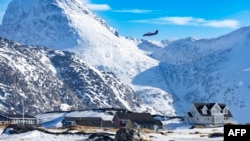
One potential way to diffuse the current political tension between Denmark and the United States regarding the future status of Greenland could be a NATO-led Arctic Sentry mission.
The idea was aired when the ambassadors of the military alliance met in Brussels on January 8 to discuss the White House's recent expression of interest in potentially taking over the autonomous Danish territory -- with Washington not ruling out a military intervention to achieve this goal.
It follows two similar NATO missions launched in 2025, first the Baltic Sentry operation, responding to numerous undersea sabotages in northern Europe, and then Eastern Sentry, which was launched shortly after a big Russian drone incursion into Poland.
Both "sentries" are still ongoing. They are also considered big successes, according to NATO officials RFE/RL has been in touch with on condition of anonymity.
But can something similar be repeated around -- and possibly in -- Greenland?
Belgian Defense Minister Theo Francken has publicly endorsed the idea and London and Berlin are also warming to it.
At the meeting in Brussels, everyone agreed that NATO needs to step up in the Arctic region.
"Canada has been screaming about the need to up the game in the High North for years, so Washington is hardly the first one to bring this up," is how one European diplomat put it.

Seven of the eight so-called Arctic countries are NATO members, with Russia being the glaring exception. And while the waters around Greenland aren't full of Russian and Chinese ships right now, that could change as Arctic ice melts and new sea lanes open up.
The NATO supreme allied commander (SACEUR) and the top US general in Europe, Alexus Grynkewich, recently noted at a military conference in Sweden that Russian and Chinese vessels "are not studying the seals and the polar bears," adding they are "out there doing bathymetric surveys and trying to figure out how they can counter NATO capabilities on and under the sea. So that's something that could grow very quickly, and we need to be mindful of it and ready."
At the same time Grynkewich added that any concrete NATO mission right now is "premature."
Speaking in Berlin earlier this week about a potential Arctic Sentry operation, German Defense Minister Boris Pistorius also noted that such an undertaking is still months away.
Yet, NATO Secretary-General Mark Rutte is busy discussing with Washington how the alliance can step up -- one way or another.
European diplomats have told RFE/RL that an Arctic Sentry initiative would potentially neutralize the argument that the United States needs to have Greenland and prove that Europe can handle two flanks at the same time: Russia in the east and potentially Russia and China in the Arctic.
"In many ways it's about burden-sharing here, as well," one of them said, adding one potential scenario could involve Europeans handling air and sea surveillance while the United States increases its troop presence in Greenland.
The United States has some 200 officers there on one base looking after ballistic missile early warnings and space surveillance. During the Cold War, however, there were up to 10,000 US troops on the island spread out across 17 bases.
A 'Loaded Pistol'
This was based on a 1951 deal between Copenhagen and Washington that allows the United States to have military assets, including bases, as long as NATO exists. This treaty remains valid and puts no limits on the US military presence, even though Denmark will have to consent -- something likely to be given.
This would also open up the possibility for the United States to use Greenland in its Golden Dome missile defense program, which US President Donald Trump has mentioned in his comments about the giant island.
What European countries would do instead is to guard the airspace but also the water of what is known as the "the GIUK gap," meaning the vast area between Greenland on one side and Ireland and the United Kingdom on the other.

This gap has been described as a "loaded pistol" in the face of the United States because it is an entry point for actors like Moscow and Beijing to do anything from underwater sabotage to seizing potential territory, according to a source familiar with military planning.
Nations likely to contribute could primarily be the United Kingdom and France but also countries like Denmark, Italy, Norway, the Netherlands, and Spain, which all have naval assets.
This would, of course, require several boats, notably cruisers and frigates but also submarines and especially icebreakers. Together the alliance only has about 40 of the latter, fewer than Russia even though there is a push to produce more.
Expect the alliance's defense chiefs to discuss this in more detail when they meet in Brussels on January 21-22 and then again when NATO defense ministers assemble in the Belgian capital on February 12.
Practical Obstacles
However, there is also hesitation within the alliance as to whether an Arctic Sentry operation is feasible. There are many practical obstacles. Hundreds of ships would be needed to cover such a vast area, for example, including vessels that supply military craft.
Apart from the Nordic countries and Canada, there are few troops that have the experience of operating in harsh Arctic conditions -- hence the current Danish-led Operation Arctic Endurance in and around Greenland in which troops from Canada, France, Germany, the Netherlands, and Norway are taking part.
While not everyone needs to contribute, everyone has to be on board to launch such a mission.
Will the Americans go along with this?
At the NATO meeting of ambassadors on January 8, Denmark and the United States agreed this is a bilateral issue for now.

This led to a meeting in Washington on January 14 of the foreign ministers of Denmark, Greenland, and the United States, hosted by US Vice President JD Vance.
The Danish foreign minister, Lars Lokke Rasmussen, noted after the meeting that the United States hadn't changed its position on Greenland but also that a high-level working group will be set up with US and Danish officials to discuss the issue in the coming weeks.
People in Brussels see this as a sign there could be "a deal" that suits all with an expanded NATO role.
While nervousness exists about a military intervention, most of those RFE/RL has spoken to still see this as "unlikely" and that the US president is using the same strong-armed business negotiating tactic he employed when he secured a 5 percent defense-spending commitment from all allies at The Hague summit last year.
Now, it's about the Europeans spending more and spending it faster -- and not just focusing on their eastern flank.