





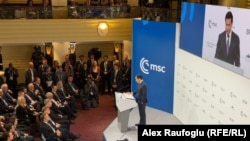
MUNICH -- In a hall packed with political and military leaders from across Europe and beyond, US Secretary of State Marco Rubio delivered a speech that managed to do two things at once: reassure anxious allies and issue a stark call for change.
After months of uncertainty over Washington’s course under President Donald Trump -- and lingering memories of last year’s more confrontational tone from JD Vance -- many in the room appeared visibly relieved.
“You could almost hear the exhale,” one senior European diplomat told RFE/RL afterward. “The substance is tough. But the tone? That matters.”
A 'Child of Europe'
Rubio repeatedly stressed America’s attachment to Europe, describing the United States as spiritually and culturally bound to the continent. “We will always be a child of Europe,” he said, pointing to shared history, language, faith, and sacrifice.
He framed disagreements not as rebukes but as expressions of concern. If the United States sometimes sounds “direct and urgent,” he said, it is because “we care deeply -- about your future and ours.” America wants Europe to be strong, he added, because Europe’s fate is inseparable from US national security.
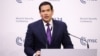
To drive home the civilizational bond, Rubio invoked a roll call of European cultural giants -- Mozart, Beethoven, Dante, Shakespeare, Michelangelo, Da Vinci -- alongside The Beatles and The Rolling Stones, and landmarks such as the Sistine Chapel and Cologne Cathedral. These, he said, testify not only to the greatness of the past but to the promise of the future.
Rubio's approach seemed to work. The secretary of state received sustained applause and a partial standing ovation -- a marked contrast, several attendees noted, with the reception that greeted Vance a year ago.
Speaking in a later question and answer session at the security conference, European Commission President Ursula von der Leyen said, "I was very much reassured by the secretary of state. We know him. He is a good friend and a strong ally. We know that some in the administration have a harsher tone on these topics."
'Dangerous Delusion'
Yet beneath the warmth was a hard-edged critique.
Drawing on the history of the conference, founded in 1963 at the height of the Cold War, Rubio recalled a time when “thousands of years of Western civilization hung in the balance.” The West prevailed, he said -- but misread its triumph.
“The euphoria of this triumph led us to a dangerous delusion,” he argued, that history had ended, that liberal democracy would inevitably spread, and that trade and global rules would replace national interest and borders.
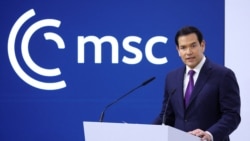

That vision, Rubio said, ignored “human nature” and the lessons of millennia. It led to deindustrialization, the outsourcing of sovereignty to international institutions, and what he called an “unprecedented wave of mass migration” threatening social cohesion.
The US secretary of state was careful to frame these not as uniquely European failings but as shared errors of the West. “We made these mistakes together,” he said, and “together, we owe it to our people to face those facts and to move forward.”
Migration, Industry, And Sovereignty
Rubio argued that deindustrialization was “not inevitable” but the product of policy choices rooted in what he termed a post-Cold War “delusion.” He criticized what he described as dogmatic free trade that hollowed out industries and handed leverage to rivals.
On migration, he rejected the idea that border control is xenophobic. Regaining control of national borders, he said, is “a fundamental act of national sovereignty.” Failure to do so, he warned, poses “an urgent threat to the fabric of our societies.”
He also took aim at certain green policies, saying efforts to “appease a climate cult” had impoverished Western societies while competitors continued exploiting fossil fuels.
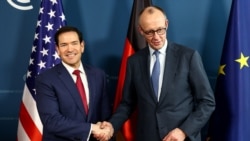
Several European officials privately bristled at that phrasing but acknowledged the broader point would resonate with parts of their domestic electorates.
“He’s describing debates we are already having at home,” a Western European diplomat said. “The difference is he’s saying: stop managing decline and start reversing it.”
No Interest In 'Managed Decline'
Rubio insisted Washington does not seek to weaken alliances but to “revitalize an old friendship.” The US does not want allies who “rationalize the broken status quo,” he said, but partners willing to rebuild strength.
Decline, he argued, is a choice. Just as the West rejected fatalism after World War II, it must reject it now. The United States has “no interest in being polite and orderly caretakers of the West’s managed decline.”
That line drew one of the strongest reactions in the room.
“He’s challenging us,” said a senior diplomat from northern Europe. “But he’s also including himself in that challenge. That’s the difference.”
UN, Ukraine, And Hard Questions
Rubio also called for reform -- not dismantling -- of international institutions, including the United Nations, which he said has “tremendous potential” but has been unable to resolve conflicts such as Ukraine and Gaza.
“In a perfect world,” he said, diplomats and resolutions would suffice. “But we do not live in a perfect world.”
On Ukraine, Rubio said the issues required to end the war have “narrowed” -- but to “the hardest questions to answer.” He said Washington would continue to test whether Moscow is serious about negotiations, while maintaining sanctions and military support for Kyiv. A just and sustainable negotiated settlement remains the goal, he added.
Pressed in a brief question and answer session after his speech on whether Russia is genuinely interested in peace, Rubio was cautious: “They say they are.” The US, he said, will continue probing what terms might be acceptable to both sides.
On China, he acknowledged that US and Chinese interests “will often not align,” but stressed the need to manage differences and avoid conflict.
Rubio’s address was followed by remarks from Chinese Foreign Minister Wang Yi, who defended multilateralism and warned against bloc confrontation -- underscoring the geopolitical stakes of the debate.
But it was Rubio’s performance that dominated hallway conversations.
The message -- on sovereignty, borders, industry, and reform -- echoed themes long associated with Trump’s political movement.
Yet by wrapping them in affirmations of shared heritage and mutual sacrifice, Rubio struck a markedly different tone from previous US interventions.
“He didn’t soften the substance,” one senior EU official said. “But he softened the delivery. And that makes it easier to listen.”
For now, at least, Washington’s allies appeared reassured that blunt talk need not mean broken ties.

