




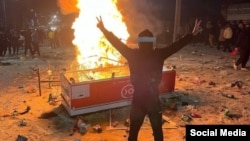
Iran has been rocked by nearly two weeks of nationwide protests, in the most serious challenge to the clerical establishment in several years.
The demonstrations erupted on December 28 in the bazaars of the capital, Tehran -- key commercial and political hubs -- and have since spread to most of the country of around 92 million people.
RFE/RL's Radio Farda spoke to Michael Rubin, a former Pentagon official who is a senior fellow at the Washington-based American Enterprise Institute, on January 6 about the significance of the protests and whether the United States might intervene militarily in Iran.
RFE/RL: You recently wrote an op-ed in which you said that "democracy is likely not around the corner" in Iran. Why is that?
Michael Rubin: The reason why democracy is not around the corner is simply [because] there remain too many forces inside Iran which want to stymie it. And the forces which want to stymie democracy tend to be much better resourced right now and will likely be much better armed.
History is also a factor. When we look at the periods of Iranian history that perhaps are analogous to the first and foremost of which is the Constitutional Revolution during the [early 20th century], we have a situation where it took years for the forces of democracy to come out on top. And before they were able to do so, they had to face an organized counter revolution.

RFE/RL: Are we currently witnessing a revolution in Iran?
Rubin: It may very well be. Whenever the Tehran Bazaar closes, [it] differentiates a normal protest [from] something far more important.
The important thing to understand about the Tehran Bazaar [which was a hub during the Islamic Revolution in 1979] is that it's very conservative and it's very religious. So, what we see now really is a protest which arguably is being sparked, if not led, by people that the Supreme Leader [Ayatollah Ali Khamenei] once believed he had in his own pocket.
RFE/RL: US President Donald Trump has threatened to intervene militarily if the authorities in Iran continue their brutal crackdown on demonstrators. What's the thinking in Washington?
Rubin: I'm not sure whether there's as much thinking as there is off-the-cuff reacting. And that's what is scary. Donald Trump differs from other presidents in that Donald Trump doesn't feel beholden to his own rhetoric. And I worry about Trump encouraging Iranians to stick their neck out only to decide that the Americans aren't going to do anything to help.
There's a parallel here to George HW Bush [who] in February 1991…called upon the people of Iraq to rise up and throw off the dictator Saddam [Hussein]. The Iraqi people rose up, and then the Americans didn't come to their aid. That's when Saddam Hussein used helicopter gunships to mow down the Iraqi people.
I wonder whether something similar could happen in Iran. The only difference being that if the Islamic Revolutionary Guard Corps aren't the ones doing it because they don't want to fire on their family members, their peers and so forth, whether it could be [Iranian-backed foreign militias like] Hashd al-Shaabi or the Fatemiyoun Brigade.
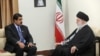
RFE/RL: Do you think we could see a scenario like in Venezuela, where US forces deposed Venezuelan leader Nicolas Maduro but have not toppled his regime?
Rubin: Yes, I think that's likely. And I need to make clear: I want the Iranians to have a democracy. I want the regime to fall. So, I'm speaking as an analyst rather than an advocate. But I don't believe that Reza Pahlavi [the former crown prince of Iran and a prominent opposition figure] has stepped up effectively. He was on vacation when this happened, and I guess he arrived in Washington, D.C. yesterday. But that's not where he needs to be.
RFE/RL: Where do you think Pahlavi should be right now? For obvious reasons he can't be in Iran.
Rubin: No, he obviously can't be inside Iran. But I wonder about some of the Gulf states, and they may not initially welcome him. But, for example, if he were in Dubai, that's where he could connect with the Iranian youth who are going there and with some of the apolitical elites who may not remember him.
You can't underestimate the cachet of Pahlavi's image. I just don't think he's been organized enough or been able to transform his own operation into an effective machine. I think Reza Pahlavi has perhaps 35 percent of support inside Iran and has the best opportunity to try to be a unifying figure. Let me put that aside.
What I worry about is a Venezuela-like situation where Trump will try to hand off power, transfer power to someone like [former moderate Iranian President Hassan] Rohani, who has been putting his finger into the wind as I interpret it, as someone who [Trump] believes could handle a transition but might not want an end to the Islamic republic.
It goes back to this old debate which we've had in the United States about whether the reformists are truly reformist. Personally, I tend to look at the reformist as good cop to the [Islamic Revolutionary Guards Corps'] bad cop. I don't see the reformists as sincere, and I don't believe that's what the Iranians want, but I'm not sure whether Donald Trump recognizes that or cares.

