




Another US Assault Ship Arrived In 'US Central Command Area Of Responsibility'
Ukraine Shares Drone-Defense Experience With Gulf States Through New Deals
Ukrainian President Volodymyr Zelenskyy has secured defense cooperation agreements with the United Arab Emirates and Qatar during his Gulf visit, amid the ongoing conflict with Iran.
Qatar’s Defense Ministry announced that Doha and Kyiv signed a defense cooperation agreement which focuses on sharing expertise in countering missiles and unmanned aerial systems.
Earlier in the United Arab Emirates, Zelenskyy met President Sheikh Mohammed bin Zayed Al Nahyan, with both countries agreeing to cooperate in security and defense.
The deals permit Ukraine to share its extensive experience in shooting down Russian drones and missiles with Gulf partners now confronting similar Iranian attacks.
Zelenskyy also signed a defense cooperation agreement with Saudi Arabia on March 26.
Ukraine Denies Iranian Claim It Destroyed Anti-Drone Depot In Dubai
Ukraine has flatly denied an Iranian claim that the Islamic Revolutionary Guards Corps (IRGC) destroyed a Ukrainian anti-drone weapons depot in Dubai, calling it disinformation.
"This is a lie. We officially refute this information," Foreign Ministry spokesman Heorhii Tykhyi told reporters on March 28, adding that the Islamic republic "frequently carries out such disinformation campaigns."
The IRGC's Khatam al-Anbiya Central Headquarters -- Iran's military central command -- had claimed its aerospace and naval forces carried out a combined operation destroying the facility, which it said was supporting the US military. It also claimed 21 Ukrainian nationals were present at the site at the time. The United Arab Emirates and United States did not immediately comment.
The UAE has borne the brunt of Iran's retaliation in the Persian Gulf, with Emirati air defenses engaging nearly 2,200 drones and missiles since Tehran launched its campaign in response to the US-Israeli operation on February 28, according to local officials.
Reports: Russia About To Deliver Drone Shipment To Iran

European intelligence agencies have made an assessment that Russia "is in the final stages of preparing to supply drones to Iran for use in its war with the US and Israel," according to a report in The Guardian, citing an unnamed senior European official.
This follows a recent report by the Financial Times that Russia is completing a "multi-phase delivery of drones, medicine, and food" to Iran.
Iran has previously supplied thousands of Shahed-series kamikaze drones for Russia's war on Ukraine.
According to The Guardian, if this shipment reaches Iran, it "would mark the first evidence of lethal support since the start of the war."
US officials, Ukrainian President Volodymyr Zelenskyy, and others have said that Russia has shared intelligence with Iran since the beginning of the war, including satellite imagery and targeting data.
The Financial Times reported that the delivery of the drone shipment to Iran would "likely take place by the middle of this week."
Kremlin spokesman Dmitry Peskov said that the reports of Russia sending drones to Iran were "fake news."
Pakistan To Host 4-Way Regional Meeting On Iran War

Foreign ministers of Egypt, Saudi Arabia, and Turkey will meet in Islamabad on March 29-30 to discuss efforts to end the US-Israeli war with Iran, Pakistani Foreign Minister Ishaq Dar wrote on X.
"During the visit, the foreign ministers will hold in-depth discussions on a range of issues, including efforts to de-escalate tensions in the region," a statement posted by Dar said.
Separately, Pakistan’s Prime Minister Shehbaz Sharif said he had spoken on the phone with Iranian President Masud Pezeshkian for “over an hour.”
“I apprised him of Pakistan’s ongoing diplomatic outreach -- engaging the United States and brotherly Gulf and Islamic countries -- to facilitate dialogue and de-escalation,” he wrote on X.
Islamabad has emerged as an unlikely diplomatic go-between in the Iran war, facilitating indirect communication between Tehran and Washington as both sides feel out the possibility of a deal.
White House special envoy Steve Witkoff said on March 27 that Washington had a "15-point deal on the table" awaiting a response from Tehran. Senior Iranian officials have denied that any negotiations are under way, though Iran said on March 25 that it was reviewing the US proposal and put forward five conditions for ending the conflict.
Israeli Military Reports First Missile Launch In Current War From Yemen
Israel's military reported the first missile launch from Yemen since the beginning of the current Middle East war, a potentially troubling development following a threat by the Iran-backed Houthi rebels to join the conflict.
The military said Israeli forces had "identified the launch of a missile from Yemen toward Israeli territory, aerial defense systems are operating to intercept the threat."
There were no immediate reports of injuries or damages in Israel. Local media suggested that the missile may have been intercepted.

The Houthi rebels in Yemen on March 27 warned they would join the war if US-Israeli attacks continue to hit Iran or if more countries join the conflict.
"We affirm that our fingers are on the trigger for direct military intervention," the group said in a statement.
A US-designated terrorist organization that has previously attacked international ships in the Bab al-Mandab Strait and the Red Sea, the Houthis -- one of Tehran's most potent allies -- have so far stayed out of the war.
But should they enter the fray, it could be a troubling development, especially for global energy markets dependent on regional shipping lanes.
With reporting by AFP
Iran Reports Bushehr Nuclear Plant Hit For Third Time In 10 Days
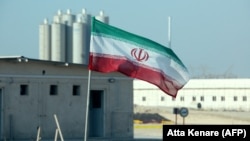
An Israeli air strike hit near Iran's Bushehr nuclear power plant late on March 27 but caused no radiation leak or damage to the reactor, Iranian authorities said, the third such incident in 10 days.
Iran told the International Atomic Energy Agency (IAEA) that the facility was continuing to operate normally, the UN watchdog reported on X.
The Israeli military said earlier that it had struck a uranium processing plant and a heavy water reactor and in central Iran but did not mention Bushehr.
Bushehr was also a target of the Israeli military during the 12-day war in June 2025.
IAEA chief Rafael Grossi urged "maximum military restraint."
Grossi "again expresses deep concern about recent reports of military activity in the vicinity of a nuclear power plant, says it could cause major radiological incident if reactor were to be damaged...Grossi reiterates call for maximum military restraint to avoid risk of a nuclear accident," the IAEA said.
The Fars state news agency said a projectile hit the plant's compound just before midnight on March 27 and blamed the "American-Zionist enemy."
Fars said there were no immediate reports of injuries or damage to the Russia-designed facility.
Bushehr, Iran's only nuclear power station, is located some 760 kilometers south of Tehran on the Gulf.
With reporting by Reuters and dpa
Trump Suggests US May Not Support NATO Amid Anger Over Refusal To Join Iran War
US President Donald Trump again expressed his disdain for NATO, saying that "I guess we don't have to be there" for the alliance if needed following his complaints that it didn't support the US war with Iran, comments likely to send shockwaves through member nations.
"They just weren't there," he said on March 27 at an economic forum in Miami.
"We spend hundreds of billions of dollars a year on NATO, hundreds, protecting them, and we would have always been there for them, but now, based on their actions, I guess we don't have to be, do we?"

"Why would we be there for them if they're not there for us? They weren't there for us."
"That sounds like a breaking story? Yes, sir. Is that breaking news? I think we just have breaking news, but that's the fact. I've been saying that. Why would we be there for them if they're not there for us? They weren't there for us."
Trump said it was a “tremendous mistake” for NATO members to remain out of the Middle East conflict.
“It’s going to make a lot of money for the United States, because we spend hundreds of billions of dollars a year on NATO. But now, based on their actions, I guess we don’t have to.”
NATO listed its military budget in 2025 at about $5.3 billion and said the United States contributes about 15.9 percent of it, or $842 million. However, the US government has said the Defense Department will spend more than $882 billion in the current fiscal year.
The comments are likely to raise concerns among US allies in the alliance and also among Democratic leaders in the United States. They may also worry some members of Trump's Republican Party, including members of Congress.
Trump has reacted angrily to NATO members' refusal to become involved in the US-Israeli war with Iran and their reluctance to help provide security to the Strait of Hormuz shipping lanes until a cease-fire is in place.
Trump, who has long questioned the viability of NATO, has often cast doubt on his willingness to support the alliance, saying he would not come to members aid if they didn’t pay enough for their own defense.

Trump insisted that NATO members raise their military spending to 2 percent of GDP, a level pledged in 2014 to be met over the next decade.
At least 24 have met that requirement, although Trump has since suggested the threshold may have to rise to 5 percent of GDP, a level many member nations said would not be economically viable.
Only Poland comes close to 5 percent, although Latvia, Estonia, and Lithuania have signaled they will raise spending to this level as well.
NATO was established by the United States and 11 other countries to counter Soviet aggression following World War II. It has grown to 32 members and now includes many nations formerly part of the Soviet Union or under its sphere of influence. The United States has been the dominant member of NATO since its inception.
Trump has previously claimed that other countries would not come to the defense of the United States, although the only time Article 5 has been invoked is when it was determined the United States was attacked on September 11, 2001.
Article 5 is one of the main pillars of the alliance's collective defense framework, setting that an armed attack against one member is considered an attack against all members.
Trump has also suggested using the US commitment to NATO as leverage in his trade war in his effort to target what he has labeled as unfair trade policies by European nations.
With reporting by Reuters
Read more here.
Merz Says Germany Could Help Clear Mines In Strait Of Hormuz Once War Is Over
German Chancellor Friedrich Merz said he could see the country's armed forces being deployed to clear mines in the Strait of Hormuz once the war in Iran has ended. "We can do that. And if we are asked to do so and it takes place within the framework of a genuine collective security mandate -- that is, the United Nations, NATO, the European Union -- with a resolution from the [German parliament], that is an option," he said at a event organized by the Frankfurter Allgemeine Zeitung newspaper on March 27. Merz said the strait is currently "obviously not mined at all." Nor does he know whether Tehran is planning to mine it.
Iranian Projectiles Damage US Refueling Craft At Saudi Base
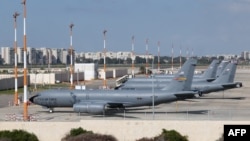
An Iranian missile struck the Prince Sultan Airbase in Saudi Arabia on March 27, damaging several US refueling aircraft, The Wall Street Journal reported, citing US and Saudi officials familiar with the strike.
The officials said the strike also involved drones.
The missile is at least the second to strike the base during the war against Iran, which began on February 28 with US and Israeli air strikes against Iran. Tehran has retaliated by launching missiles and drones against US assets based on the territory of Washington's Arab allies in the Gulf and elsewhere in the region.
The Pentagon did not immediately comment.
In an earlier strike at the base, five US refueling aircraft were damaged, most only superficially.
On March 13, six US Air Force members were killed in a midair crash of two KC-135 refueling aircraft over western Iraq. The Pentagon said no friendly or hostile fire was involved.