




Trump Indicates Australia Will Grant Asylum To Iranian Women’s Soccer Players
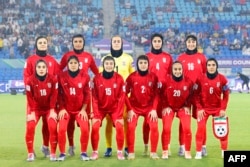
Five members of Iran's women's national soccer team have reportedly been granted asylum in Australia after leaving their team hotel during the Women’s Asian Cup, fearing reprisals if they return home.
The team's players had drawn attention earlier by not singing the country's national anthem during the tournament, prompting accusations of treason from state media and raising fears for their safety.
US President Donald Trump seemed to suggest in a social media post that the players had been granted asylum, praising Australian Prime Minister Anthony Albanese and saying some athletes were “being taken care of,” though others felt compelled to return because of threats to their families.
Australian authorities are said to have placed the five players under police protection while their asylum claims are being processed.
EU Leaders Condemn Iran's 'Indiscriminate Attacks' On Regional Countries
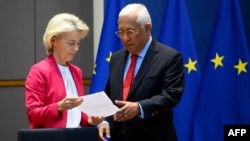
European Council President Antonio Costa and European Commission President Ursula von der Leyen have condemned what they called Iran’s “unacceptable attacks” on countries in the Middle East during a video conference with regional leaders to discuss the war involving Iran.
Leaders from Jordan, Egypt, Bahrain, Lebanon, Syria, Turkey, Armenia, Iraq, Qatar, Kuwait, the United Arab Emirates, Saudi Arabia, and Oman joined the talks, which addressed the strikes and their impact on regional and global energy security.
In a joint statement, the EU leaders said they “condemned the indiscriminate attacks by Iran in the strongest terms” and expressed “full solidarity with the people of the region.”
They also reaffirmed support for EU naval missions, including Operation Aspides and Operation Atalanta, aimed at protecting key waterways and supply chains, while voicing concern over civilian displacement in Lebanon.
Additionally, they thanked leaders in the region "for their assistance and support in repatriating tens of thousands of European citizens who were stranded in their countries when the war started."
Iranian Official Says Historic Sites Damaged In Israeli Attack On Isfahan
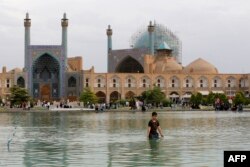
The deputy head of cultural heritage for Iran’s Isfahan Province said that several of the city’s most famous historic buildings have been damaged in attacks carried out by Israel.
Speaking to the reformist Sharq newspaper, Ruhollah Seyedoleskari claimed the strikes on March 9 damaged the Chehel Sotoun Palace, one of Isfahan’s most prominent monuments and part of a UNESCO-listed complex of Persian gardens.
He added that the Rakibkhaneh building, a Safavid-era royal stables complex dating back to the early 17th century, as well as Ashraf Hall and Timurid Hall, dating to the 14th–15th-century Timurid period, were also damaged. Windows at the nearby Ali Qapu Palace overlooking Isfahan’s Naqsh-e Jahan Square – also a UNESCO World Heritage Site -- were reportedly shattered as well.
The Israeli military earlier said Tehran, Isfahan, and southern Iran were among its targets on March 9. It appears the Isfahan governor’s office complex may have been the main target of the strikes there.
Last week, Golestan Palace in central Tehran, a UNESCO World Heritage site largely dating to the Qajar era, when a royal dynasty ruled Iran from 1789 until 1925, was also damaged in air strikes.
Rubio Says Iran Wants To 'Hold The World Hostage'
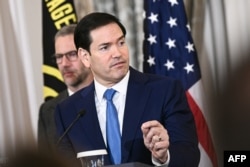
US Secretary of State Marco Rubio has accused Iran of trying to “hold the world hostage” through retaliatory strikes across the Middle East, saying US military operations aimed at curbing Tehran’s capabilities were progressing as planned.
Rubio was speaking at an event on March 9 honoring wrongfully detained Americans, including Robert Levinson, a former FBI agent who disappeared in Iran in 2007 and who US officials believe died in Iranian custody.
Macron Orders Naval Deployment To Protect Shipping Routes

France will deploy about a dozen naval vessels, including the aircraft carrier group built around the French aircraft carrier Charles de Gaulle, to the eastern Mediterranean, Red Sea, and possibly the Strait of Hormuz to support allies and protect shipping as tensions rise in the Middle East, President Emmanuel Macron said on March 9.
Speaking in Paphos in western Cyprus alongside Cypriot President Nikos Christodoulides and Greek Prime Minister Kyriakos Mitsotakis, Macron said the deployment would remain “strictly defensive, standing alongside all countries attacked by Iran in its retaliation." He also said the move was intended "to ensure our credibility, and to contribute to regional de-escalation. "
"Ultimately, we aim to guarantee freedom of navigation and maritime security," Macron added.
Europe has been largely sidelined in the escalating confrontation involving the United States, Israel and Iran, but growing threats to regional shipping and surging oil prices have increased pressure on European governments to protect maritime routes.
With reporting by Reuters
Iran Sends Message Of 'Defiance' By Picking Mojtaba Khamenei As New Supreme Leader
- By Kian Sharifi
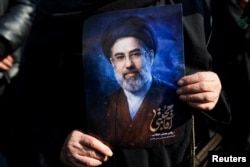
Iran’s choice of Mojtaba Khamenei as the country’s new supreme leader sends an explicit message to the United States and Israel: External pressure, including decapitation, will harden rather than reshape the Islamic republic's leadership, experts say.
Mojtaba Khamenei is the second-oldest son of former Supreme Leader Ayatollah Ali Khamenei, who was assassinated in an air strike on February 28 as the United States and Israel launched an aerial bombardment of Iran. The younger Khamenei is known as a hard-line cleric and his selection by the Assembly of Experts, a clerical body, on March 8 represents continuity.
"The message from Tehran is one of defiance: you kill one Khamenei, we give you another," Ali Alfoneh, a senior fellow at the Arab Gulf States Institute in Washington, told RFE/RL.
At the same time, the choice also revealed a system under acute internal strain, one in which the powerful Islamic Revolutionary Guards Corps (IRGC), the elite branch of Iran’s armed forces and the backbone of the country’s theocracy, has displaced the clerically dominated political establishment as kingmakers in the country of some 90 million people, experts say.
Read more here.
Zelenskyy Says Ukraine Received 11 Requests For Help In Countering Iranian Drones
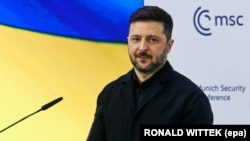
Ukrainian President Volodymyr Zelenskyy said in a post on social media that 11 countries had contacted Kyiv for help in countering Iranian drones as Tehran sends waves of them across the Middle East in retaliation against US-Israeli strikes.
"As of now, there are 11 requests from countries neighboring Iran, European states, and the US," Zelenskyy wrote. "There is clear interest in Ukraine’s experience in protecting lives, relevant interceptors, electronic warfare systems, and training."U
He added that Ukraine was "ready to respond positively to requests from those who help us protect the lives of Ukrainians and the independence of Ukraine" and that some requests had "already been met with concrete decisions and specific support."
NATO Intercepts Iranian Missile Over Turkey; US Orders Adana Consulate Evacuation
NATO has shot down a ballistic missile over Turkish airspace for the second time since the United States and Israeli began their air strikes against Iran at the end of last month.
"NATO has again intercepted a missile heading to Turkey. NATO stands firm in its readiness to defend all Allies against any threat," the alliance said in a social media post on March 9.
It gave no further details.
The Turkish Defense Ministry confirmed the incident, adding that some ammunition fragments landed in empty fields in Gaziantep, a city in southern Turkey near the border with Syria. There were no casualties or injuries in the incident, it added.
Five days earlier, a similar incident occurred with NATO shooting down a missile launched from Iran.
Tehran did not immediately comment on the March 9 incident. It has said previously that it has not explicitly targeted Turkey.
A NATO official, who asked not to be named, told RFE/RL that there was “no indication that Article 4 is being discussed so far” in response to the incident. NATO's Article 4 allows any member state to request consultations with allies if it believes its territorial integrity, political independence, or security is threatened, often serving as an early step for coordinating a response to potential security risks.
Separately on March 9, the US Department of State ordered nonemergency staff and family members to leave the US Consulate General in the city of Adana in southern Turkey due to security risks.
Americans in southeast Turkey have been strongly encouraged to depart the region immediately.
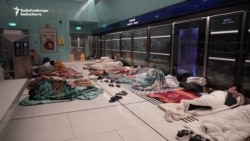
Sleeping In A Tel Aviv Subway Station Takes Its Toll

EU Sees No 'Imminent' Oil Shortage As Crude Prices Soar
The European Union said on March 9 it is in no danger of an oil supply shortage amid possible cuts in production and soaring prices due to the growing conflict in the Middle East.
The benchmark price for crude oil jumped beyond $100 for the first time since Russia launched its invasion of neighboring Ukraine in 2022.
"There is no imminent oil supply shortage in Europe. Per our rules, all member states must have the 90 days emergency stocks," European Commission spokeswoman Anna-Kaisa Itkonen said.