



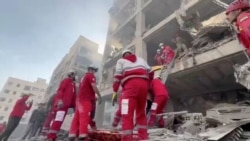
Taking Cover In Tel Aviv
Our correspondent, Ray Furlong, is currently in Tel Aviv. Out reporting this morning, he saw a line of parents with baby strollers entering a public shelter after an alert of an incoming Iranian ballistic missile strike.


Ukrainian Foreign Minister: Ukraine And Iran Are 'Two Theaters Of One War'
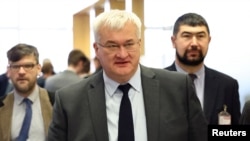
Ukrainian Foreign Minister Andriy Sybiha has warned that "developments in Europe and the Middle East are not isolated from each other."
"The war against the Iranian regime and Ukraine's defense against Russian aggression are two theaters of one war," he wrote on X on March 9.
"The regimes in Moscow and Tehran are inseparable: They are working together, sharing resources, weapons, and technologies. They represent the same threat to Ukraine, Europe, the United States, and Gulf states," he said. "One thing that unites regimes in Moscow and Tehran is that they only understand the language of strength."
Meanwhile, Ukrainian President Volodymyr Zelenskyy announced that Kyiv had sent interceptor drones and a team of experts to the Middle East in response to a US request for support against Iranian drones in the region.
According to The New York Times, citing an interview with Zelenskyy, a Ukrainian team of drone experts traveled to the region to protect US military bases in Jordan.
"As of now, it is too early to speak in detail. Next week, when the experts are on the ground, assess the situation and provide assistance -- since they are coming with the capabilities to assist right away -- we will proceed accordingly. Let us wait for the initial meetings," Zelenskyy wrote on X on March 8.
Azerbaijan-Iran Border Reopens After Drone Incident
According to an Azerbaijani government statement, all types of vehicle traffic across the border between Azerbaijan and Iran resumed in the morning of March 9.
The border is one of the shortest land routes connecting Iran to its ally Russia, and crossings were closed last week after Baku said that an Iranian drone hit the Nakhchivan exclave on March 5.
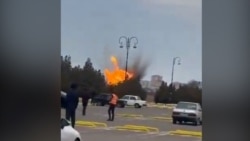
Iranian President Masud Pezeshkian denied the drone strike during a phone call with Azerbaijani President Ilham Aliyev, saying Iran was not responsible for the strike that hit a school and an airport in the autonomous Nakhchivan region.
In a statement released on March 8, Azerbaijan's presidential office said Pezeshkian insisted that "the incident involving the air strike on Nakhchivan had no connection with Iran."
China Says It 'Opposes' Targeting Of New Iranian Leader
China has said that it opposes the targeting of Mojtaba Khamenei, the new supreme leader of the Islamic Republic, by the United States and Israel.
Gao Jiaqun, a spokesman for the Chinese Foreign Ministry, said: "Beijing opposes interference in the internal affairs of other countries under any pretext, and Iran's sovereignty, security, and territorial integrity must be respected."
Posting on X on March 8, the Israeli military said that it would continue pursuing every successor of Iran's slain Supreme Leader Ayatollah Ali Khamenei, who was killed in a US and Israeli attack on February 28.
The same day, US President Donald Trump told ABC News that if the new supreme leader "doesn’t get approval from us, he’s not going to last long."
New Supreme Leader Celebrated, Decried In Tehran
Supporters of the Iranian regime shouted "Allahu Akbar" after Mojtaba Khamenei was named supreme leader, with the cry broadcast from loudspeakers in some parts of Tehran.
At the same time, in areas of Tehran such as the Ekbatan neighborhood, there were shouts and chants decrying the announcement, including "Death to Mojtaba."
Shortly after midnight on March 9, Iran named hard-liner Khamenei to replace his father, the late Ayatollah Ali Khamenei, as supreme leader. Khamenei was killed in a February 28 attack by the United States and Israel.
Mojtaba Khamenei is the third supreme leader in the 47-year history of the Islamic republic.
Trump Declines Statement On Supreme Leader, Says Only: 'We'll See What Happens'
US President Donald Trump declined to comment on the election of Mojtaba Khamenei as Iran's new supreme leader after previously saying the 56-year-old ayatollah was a "lightweight" and an "unacceptable" choice.
When asked in an interview with the Times of Israel conducted shortly after Iran announced Khamenei's appointment, Trump said only, "We'll see what happens."
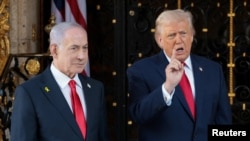
Khamenei succeeded his father, Ali Khamenei, who was killed during the first day of joint US and Israeli air strikes on Iran on February 28.
Before Mojtaba Khamenei's appointment, Trump suggested the United States would demand a role in naming the new supreme leader and appeared to suggest the new ruler could meet the same fate as the previous one.
Trump told ABC News that “if he [the next supreme leader] doesn’t get approval from us, he’s not going to last long.”
In the Times interview, Trump also said the decision on when to end the war would be done in consultation with Israeli Prime Minister Benjamin Netanyahu but that he will make the final decision "at the right time."
“I think [the decision] is mutual… a little bit. We’ve been talking. I’ll make a decision at the right time, but everything’s going to be taken into account,” he said.
He also said that had he and Netanyahu not been in power, Iran would have destroyed Israel.
“Iran was going to destroy Israel and everything else around it…We’ve worked together. We’ve destroyed a country that wanted to destroy Israel,” he was quoted as saying.
Trump declined to answer a hypothetical question as to whether Israel could continue the war against Iran even after the US decided to halt its attacks, but he added, “I don’t think it’s going to be necessary."
The White House has said the war is likely to last four to six weeks following the February launch, although no specific deadline has been set.
Iran Fires Missiles Toward Israel, Gulf States To Mark Supreme Leader Election
Iran said it fired off a series of missiles toward Israel to mark the election of Mojtaba Khamenei as the country's new supreme leader, according to state media, with additional firings launched toward US Arab allies in the Gulf.
"Iran fires first wave of missiles under the leadership of Ayatollah Seyyed Mojtaba Khamenei toward occupied territories," state broadcaster IRIB said on its Telegram channel on March 9.
The posting carried a photo showing a projectile with the words: "At Your Command, Sayyid Mojtaba."
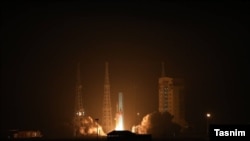
"Massive explosions heard in the center of the occupied territories," it said, although there was no immediate confirmation from Israel.
Iran's Assembly of Experts announced earlier that Khamenei had succeeded his father, Ali Khamenei, as the country's supreme leader. The elder Khamenei had been killed during the first day of US and Israeli air strikes on February 28.
As supreme leader, the 56-year-old Mojtaba Khamenei will have final say in all political and military matters and hold near-dictatorial powers.
Elsewhere, several explosions were heard on March 9 in the Qatari capital, Doha, according to AFP journalists.
The Saudi Defense Ministry, meanwhile, said it had intercepted Iranian drones headed to the massive Shaybah oilfield.
The Kuwaiti Defense Ministry on March 9 also said the country's air defenses were working to intercept a new missile and drone attack on the small Gulf nation.
To read the full story, click here.
US Orders Nonessential Diplomatic Personnel To Leave Saudi Arabia
The US State Department late on March 8 said it ordered nonessential diplomatic personnel and families to leave Saudi Arabia due to safety risks in the face of continued Iranian retaliatory strikes in the Gulf region.
The US Embassy in Riyadh approved voluntary departures for personnel on March 3, the day the facility was struck by Iranian drones, causing a fire that damaged some buildings at the site.
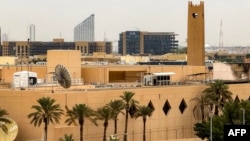
The State Department said in the latest advisory that it had "ordered nonemergency US government employees and US government employee family members to leave Saudi Arabia due to safety risks."
Following the launch of US and Israeli air strikes against Iran on February 28, Tehran has been firing back at Gulf Arab allies of the United States that host US military assets, often hitting airports, diplomatic sites, and commercial buildings.
As the State Department announced the advisory, the Saudi Defense Ministry separately said it intercepted a drone heading to the Shaybah oil field near the border with the United Arab Emirates.
Earlier in the day, the Saudi Civil Defense agency said two people were killed when an Iranian missile struck a residential building in the al-Kharj Governorate southeast of Riyadh.
Trump Says Spike In Oil Prices 'Small Price To Pay' To Remove Iran's Nuclear Threat
US President Donald Trump on March 8 said the surge in oil prices as a result of the war on Iran is "small price to pay" for removing the threat of Tehran's nuclear program.
"Short term oil prices, which will drop rapidly when the destruction of the Iran nuclear threat is over, is a very small price to pay for U.S.A., and World, Safety and Peace. ONLY FOOLS WOULD THINK DIFFERENTLY!" he wrote on his Truth Social platform.
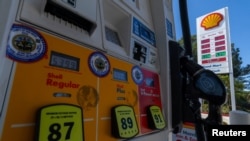
The spike in oil prices threaten to raise the cost of living for throughout the world. A rise in inflationary pressures in the United States could be a political liability for Trump, who had criticized rising prices during the term of predecessor Joe Biden.
The benchmark Brent crude price jumped 17 percent to $108.73 a barrel early on March 9, after already surging 28 percent last week. US crude rose 19 percent to $108.33 a barrel.
Traffic in the Strait of Hormuz -- through which 20 percent of global crude and gas passes -- has been nearly halted since the war began on February 28. Shipping insurance rates have soared, although Trump has vowed to provide assistance to the industry.
"The global economy remains dependent on the concentrated flow of Mideast oil and natural gas through the Strait of Hormuz," Bruce Kasman, chief economist at JPMorgan, was quoted by Reuters as saying.
"The near-term scenario is a near-term spike toward $120 a barrel followed by moderation as the conflict soon subsides. But absent a clear and decisive political resolution, Brent crude oil prices are expected to settle at an elevated $80 barrel through mid-year," he added.
Mojtaba Khamenei Follows In Father's Footsteps As Iran's New Supreme Leader
The March 8 election of Mojtaba Khamenei as the new leader by Iran's Assembly of Experts following the killing of Ayatollah Ali Khamenei in a US-Israeli attack marks the first time the son of a supreme leader is succeeding his father in the Islamic republic.
Mojtaba Khamenei has rarely appeared in public and has never addressed an audience beyond seminary classrooms, yet he is widely seen as a shadowy behind-the-scenes force with influence over those closest to the supreme leader's office and Iran's security institutions.
But who is Mojtaba Khamenei, and how did his name become one of the most controversial options for his father's succession?
To read the full story, click here.