



After 36 days following the Iranian protests and subsequent regime crackdown, we are pausing the live blog for now. But if the situation changes -- domestically in Iran or internationally -- we will be back.
Iran Security Chief Heading To Oman After US Talks
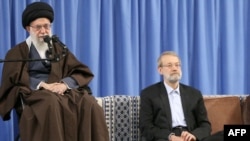
Ali Larijani, the secretary of Iran’s Supreme National Security Council -- the top state body that coordinates defense, intelligence and foreign policy decisions -- will travel with a delegation to the Omani capital, Muscat, on February 10.
A senior conservative politician who has long held key national security roles, Larijani is expected to discuss “the latest regional and international developments and bilateral cooperation at various levels” with Omani officials, Iranian media reported.
The trip comes after the first round of the latest negotiations between Iran and the United States was held on February 6 in Muscat, though domestic media reports about Larijani’s visit made no reference to those talks.
US President Donald Trump has said these bilateral discussions would resume in the middle of this week, but Iranian Foreign Minister Abbas Araqchi said the timing and date would be determined after further consultations in Washington and Tehran and through Omani mediation.
'Severe Sexual Violence' Used Against Protest Detainees, Says Rights Group
The Hengaw Organization for Human Rights says Iranian authorities subjected detainees arrested during recent protests to systematic "coercion, threats of death and execution, and severe sexual and psychological abuse."
Based on interviews with former detainees from different cities and facilities, Hengaw reports that female interrogators were deliberately used to humiliate and abuse young male detainees, while women described what the group called "severe sexual violence." Hengaw also said some detainees faced threats of execution and mock hangings.
Many said they were beaten, threatened with death, and forced to record written and video confessions in summary court proceedings without lawyers or due process.
Some were held in military sites or private houses rather than formal prisons.
Hengaw said detainees were often released only after posting heavy bail, with cases still pending.
The group, a Norway-based Kurdish human rights organization that documents arrests and abuses in Iran through on-the-ground networks, says more than 40,000 people have been detained since the protests began and warns that torture is being used systematically and with impunity.
RFE/RL's Radio Farda has not been able to independently verify these accounts, though other rights advocates have similarly reported unusually harsh treatment of protesters both on the streets and in detention.
Khamenei Skips Symbolic Meeting With Air Force Commanders
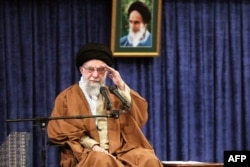
A review of reports and images released from Iran shows that the country's supreme leader, Ayatollah Ali Khamenei, did not attend an annual February 8 ceremony with Air Force and air defense commanders held to mark the 1979 Islamic Revolution.
The supreme leader, who typically appears at the event, was represented instead by the armed forces' chief of staff, Abdolrahim Musavi.
In a speech at the gathering, Musavi referred to the possibility of a US attack on Iran and indirectly warned countries in the region that “although the targets of a regional war’s fire would be the aggressors, in any case, a regional war would set the region’s progress and development back by years.”
The annual meeting commemorates a decisive moment in the 1979 revolution, when Air Force personnel declared their loyalty to Ayatollah Ruhollah Khomeini, the cleric who led the revolution and later founded the Islamic republic -- signaling that parts of the armed forces were abandoning the shah and helping pave the way for the monarchy’s collapse.
Since the start of the conflict between Iran and Israel, Khamenei has been absent from public view for long periods and has only appeared at limited number of official events.
We are now closing the live blog for today, but we'll be back again tomorrow morning at 9:30am Central European time to follow all the latest developments in Iran.
Head and Members of Iran’s Left-Leaning Reform Front Arrested Or Summoned
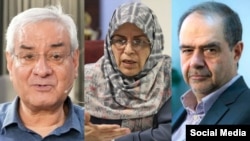
Head of the Reform Front of Iran, Azar Mansouri, and at least two other members of the Front have been arrested on February 8, according to Iranian state media . Mansouri’s lawyer said that the reason of her arrest and her whereabouts were not immediately clear.
Iranian judiciary accused the arrested of acting in the interests of Israel and the United States. "They took steps to incite the internal atmosphere of the country" and "worked to destroy national cohesion by making accusations and spreading untrue statements against the country,” the statement by the Judiciary Media Center says suggesting more arrests will follow.
A few days after the bloody suppression of the January protests, the Reform Front issued a statement saying that "a large segment of Iranian citizens have lost their trust in all the institutions, and government agencies that were supposed to protect, represent, and pursue people’s demands.”
Azar Mansouri is the first woman to head a major political movement in Iran. The Front unites 31 parties and groups and until recently had been seen as a “loyal” opposition group – one that does not seek a regime change in Iran, but is advocating structural reforms from within, such as suspension of uranium enrichment, lifting of social restrictions, and an end of censorship.
The harsh suppression of mass protests in January, however, deepened fractures within the Front with many of its members denouncing one of its own, President Masud Pezeshkian, for siding with the regime's conservative wing and not acting to reform it and save the lives of protestors.
Iranian Nobel Prize Winner Mohammadi Sentenced To 7 Years In Prison

Narges Mohammadi -- the Nobel Peace Prize laureate who has been detained since December -- has been sentenced to seven and a half years in prison, along with a travel ban and internal exile, according to one of her lawyers.
Writing on X, defense attorney Mostafa Nili announced on February 8 that Mohammadi had been sentenced to six years in prison on conspiracy and collusion against national security and to one and a half years in prison for propaganda activities.
He added that she was also additionally handed a two-year travel ban and two years of internal exile in the northeastern city of Khusf.
Nili said Mohammadi called from detention in Mashhad to say she had been taken to court, where the verdict was delivered. She also told him she had recently been hospitalized due to poor health before being returned to custody, and the call was cut off as she began describing the situation.
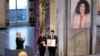
The 53-year-old, who was awarded the 2023 Nobel Peace Prize for more than two decades of fighting for women's rights in Iran, was detained along with several other activists in December by Iranian security forces during a memorial ceremony in Mashhad for Khosrow Alikordi, a lawyer and human rights activist whose death sparked controversy and allegations of foul play.
It was announced earlier this month that she had begun a hunger strike “to protest her unlawful detention and the dire conditions in which she is being held, realities faced by numerous political prisoners currently held in Iran.”
Jailed Iranian Reporter 'Severely Beaten' In Custody, Husband Says

The husband of jailed Iranian journalist Vida Rabbani says that she has been assaulted while in detention.
Hamidreza Amiri wrote on Instagram that while visiting Rabbani at a prison in the northern Caspian city of Tonekabon on February 7, he had seen “numerous and clearly visible” bruises on his wife’s body.
“They had severely beaten her,” he said. “Because she refused to comply with the compulsory hijab, he hair had been pulled out.”
Rabbani, who had previously been imprisoned in 2022 following the Woman, Life, Freedom movement protests, was detained again two weeks ago after signing a statement, along with 16 others, calling for the peaceful removal of the Tehran government.

Several other signatories, including political activists Mehdi Mahmudian and Abdollah Momeni, have also been arrested.
Iran Insistent On Uranium Enrichment
- By RFE/RL
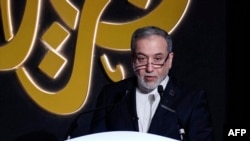
Iran's foreign minister insisted on his country's right to enrich uranium, striking a defiant note as a US naval strike force sailed in regional waters amid weeks of unprecedented domestic turmoil inside Iran.
Abbas Araqchi's comments followed talks between US and Iranian officials in Oman over the fate of Iran's nuclear programs. Tehran says its programs are peaceful in nature, aimed at generating electricity; Washington and other countries suspect Tehran is striving to build an atomic weapon.
"Zero enrichment can never be accepted by us," Araqchi was quoted as saying on February 8. "Hence, we need to focus on discussions that accept enrichment inside Iran while building trust that enrichment is and will stay for peaceful purposes."
"Iran's insistence on enrichment is not merely technical or economic [...] it is rooted in a desire for independence and dignity," he said. "No one has the right to tell the Iranian nation what it should or should not have."
The talks, which took place in Oman, came amid an American military buildup in the Middle East.
Tensions have spiked in recent weeks as Iran has been roiled by unprecedented street protests in Tehran and other cities.
Read more here
Here's a short clip of White House envoy Steve Witkoff, who headed the negotiations in Oman, visiting the USS Abraham Lincoln yesterday along with the head of US Central Command, Admiral Brad Cooper.
“Today [we] met with the brave sailors and Marines aboard the USS Abraham Lincoln, her strike group, and Carrier Air Wing 9 who are keeping us safe and upholding President Trump’s message of peace through strength,” Witkoff said on social media.
He was joined by Trump's son-in-law Jared Kushner, who has played a central role in negotiations as well.