


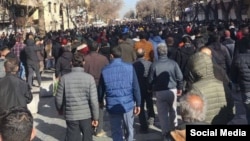
Protests against Iran’s clerical establishment are spreading, drawing in new cities and towns, social groups, and symbols in what activists describe as a new phase of confrontation with the authorities.
What began as scattered demonstrations over soaring inflation and the collapse of the national currency on December 28 is now visible on the streets and in shuttered bazaars across the country of some 92 million people, in scenes that echo the Islamic Revolution in 1979. Only this time, they want the Islamic establishment gone.
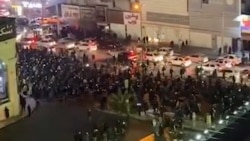
Over the past 48 hours, protests have spread to more parts of the capital, Tehran, and the northeastern city of Mashhad, the country’s second-largest, as well as to a growing list of provincial centers and small cities, including Abadan in the southwest and Borujen in central Iran.

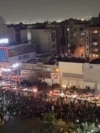
One of the largest protests occurred in the western town of Abdanan, where the main street was packed with demonstrators on January 7. Towns in western Iran, home to ethnic minorities, have been the scene of some of the biggest protests and hardest government crackdowns.
Alongside the street protests, merchants in a growing number of bazaars -- key commercial hubs in Iran -- have closed their shops and gone on strike in solidarity with the protesters. Many Iranians have explicitly compared the scenes to the decisive market walkouts that helped bring about the downfall of the shah of Iran in 1979.
Economic Free Fall Fuels Anger
The trigger for the protests was Iran’s worsening economic crisis. The sharp fall in the value of the rial, the national currency, has translated into what people describe as hourly price hikes for staples like eggs and cooking oil, reinforcing a perception that the country is on the brink of collapse.
As unrest has widened, there have been more frequent and increasingly violent confrontations in towns where security forces have used batons, tear gas, and live ammunition.
Speaking to RFE/RL’s Radio Farda on January 8, a protester in the western town of Qorveh said the streets in the town of some 87,000 people are “filled with security forces.”
The protester, speaking on condition of anonymity for fear of retribution, said security forces have been unable to stop the protests because of the sheer number of people participating.

Symbols, Strikes, And The Risk Of Escalation
In several cities, including Kerman in the southeast and Kashan in central Iran, demonstrators have toppled or defaced statues of Qasem Soleimani, the top Iranian general who was killed in a US air strike in 2020. The acts signal a direct challenge to one of the clerical system’s central martyrs.
Protesters in Mashhad tore down the national flag and ripped it to shreds on January 7. Iran's current national flag was adopted after 1979, and critics of the Islamic republic refer to this flag as the regime's flag, not the country's.
Anxiety is visible in the streets across Iran and has spilled into family WhatsApp and Telegram groups, where arguments over “what comes next” and whom to support have become a daily and often heated ritual.
Questions of leadership, strategy, and alternatives are no longer confined to activist channels and have entered everyday conversations among relatives and colleagues.
That debate is sharpened by overt international messaging. The US State Department’s Persian-language account has repeatedly voiced support for the demonstrators. US President Donald Trump has threatened to intervene if the violent government crackdown continues.
As demonstrations entered a 12th day on January 8, social media users in major cities like Tehran, Karaj, Isfahan, Shiraz, Mashhad, and Tabriz reported slow Internet connections. Experts have noted a marked decline in the speed of broadband and mobile Internet.
Amir Rashidi, head of digital rights and security at the US-based Miaan Group, told Radio Farda that the authorities are preparing to shut down the Internet entirely.
The connectivity squeeze coincides with fresh calls by opposition groups for nationwide strikes and street actions on January 8 and 9, raising the prospect that the protests -- already the most serious challenge the Islamic republic has faced in years -- could spread even further.