




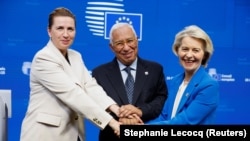
The European Union will provide a 90 billion-euro ($106 billion) interest-free loan to Kyiv to help fund the war-torn country after failing to agree on a proposal to use frozen Russian assets to support Ukraine's economic and military needs in the coming years.
European Council President Antonio Costa said in a post on X on December 19 that the funds will be for 2026 and 2027.
"We committed, we delivered," he said.
Ukrainian President Volodymyr Zelenskyy thanked EU leaders for approving the loan in support for Ukraine, calling it vital as Russia's full-scale invasion nears its four-year anniversary.
"This is significant support that truly strengthens our resilience," he said in post on X.
"It is important that Russian assets remain immobilized and that Ukraine has received a financial security guarantee for the coming years," he added.
Ukrainian Prime Minister Yulia Svyrydenko called the European Council's decision "a decisive step for economic resilience and fiscal stability under wartime conditions."
"Russia's aggression carries a financial cost," Svyrydenko wrote on X, adding that the loan would provide Ukraine with financial predictability and bolster confidence among international partners.
"Economic stability is a prerequisite for security, for Ukraine and for Europe," she stated.
EU officials began meeting on December 18 to agree on a solution for funding. The talks focused on a proposal to use tens of billions of euros in frozen Russian state assets to cover Ukraine's financing needs.
But legal concerns kept some EU members from signing on to the proposal. Instead, agreement was found for the loan, which will be based on borrowing on the capital markets backed by "EU budget headroom," a term used to describe extra borrowing capacity.
"After lengthy discussions, it is clear that the reparations loans will require more work as leaders need more time to go through the details," one EU official told RFE/RL.
The initial Russia proposal met with withering criticism from Moscow, and Russia had threatened massive legal action over any usage of its frozen assets.
Speaking at his nationally televised call-in show, hours after the EU decision was announced, President Vladimir Putin lashed out at the Russia proposal -- even though it was not initially adopted.
"Theft is not the right term. Theft is the secret taking of property, whereas here they are trying to do it openly — that is, robbery," Putin said. And this is not easy to carry out. After all, they have announced that they will not simply rob and seize assets, but that one of the ideas is to issue loans secured by our assets"
In the conclusions adopted following its meeting, the European Council stated that "subject to EU law, Russia's assets should remain immobilized until Russia ceases its war of aggression against Ukraine and compensates Ukraine for the damage caused by the war."
The Council also stated that it would continue working on the legal and technical details necessary for creating a reparations loan using funds from Russia's frozen assets.

Funding for Ukraine has become a major issue for the 27-member bloc, with the United States choking off its financial support while countries such as Hungary push for curbs on funding as well.
On the other side, Poland likened the situation to a choice between "money today or blood tomorrow."
The EU summit came days after Putin crudely criticized the bloc's leaders, using a word that can be translated as "young swine," and reiterated assertions that Moscow will achieve the goals of its war on Ukraine by force if a US push for peace does not produce a deal that meets its demands.
Ukrainian President Volodymyr Zelenskyy attended the summit, telling leaders the proposal of a loan backed by the frozen Russia assets currently held in the EU is preferable, but that ultimately it doesn't matter how the funds are utilized, just as long as a solution is found.
“If in the spring, Ukraine does not receive the corresponding tranche -- which, in the event of peace, will be used for the country’s reconstruction, and in the event of continued war, for other priorities, above all drone production -- Ukraine’s drone production will be reduced several fold,” he told reporters at a press conference after addressing the summit behind closed doors.
Ukraine currently faces a foreign aid shortfall of some $53 billion to $59 billion next year, he added.
Western countries have supported the war-torn country with both direct budgetary support and military aid since Russia’s full-scale invasion nearly four years ago, but the upcoming period may be different.
The United States has signaled that it most likely won’t send more cash, putting the onus on the EU and other G7 countries to step up -- and to do so soon.

Some 140 billion euros ($165 billion) of Russian state assets are held in the Belgian-based financial markets company Euroclear, while an additional 25 billion euros of Russian state assets are held in banks across the EU, mainly in France but also in a Belgian private bank, Cyprus, and Germany.
The reparations loan is part of a wider financial package that is worth up to 210 billion euros, according to the European Commission. This also includes 45 billion euros that will be used to repay a G7 loan to Ukraine from 2024.
While most of the EU's 27 members are in favor of using the assets to back the loan, Belgium fears the plan could leave it legally vulnerable, and other countries including Italy have also expressed doubts.
European Commission chief Ursula von der Leyen said she would not leave the summit without agreement on how to finance Ukraine over the next two years.
German Chancellor Friedrich Merz issued a stark warning earlier this week, saying failure would mean "the European Union's ability to act will be severely damaged for years, if not longer, and we will show the world that we are incapable of standing together and acting at such a crucial moment in our history."
In a combative speech at an annual Defense Ministry event on December 17, Putin sought to blame Europe and Ukraine in advance for any failure of the peace efforts, saying that Russia will take more land by force if Kyiv and European leaders he described as "young swine" do not take the right approach to US proposals.
Moscow currently controls nearly one-fifth of Ukraine, and Russian officials have repeatedly said they won't compromise on the five Ukrainian regions that Putin baselessly claims are Russian.
A particular sticking point in the weeks-long flurry of negotiations involving the US, Ukraine, Europe, and Russia has been the portion of the Donetsk region that Ukrainian forces still hold.