Zamira Eshanova is a correspondent for RFE/RL's Uzbek Service.
As the war in Ukraine drags on, the Kremlin is looking beyond its borders for help sustaining its military machine. Russian President Vladimir Putin has recently ordered negotiations to revise military cooperation agreements with Kazakhstan and Uzbekistan.
Prominent ethnic Kazakh writer Zhengis Reskhan faces a closed-door trial in China on an allegation of “undermining ethnic unity,” his family says, weeks after a controversial new law governing minority affairs took effect.
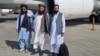
Three officials from Afghanistan’s Taliban government are visiting Moldova after they were granted visas. The move has triggered an uproar in the European country.
China’s expanding role in Kyrgyzstan has become increasingly hard to ignore. The situation has fueled concerns over jobs, land, natural resources, and national sovereignty, with many ordinary Kyrgyz expressing concerns that the nation's leaders are not taking their interests into account.
Ukraine's sustained attacks on Russia's oil refineries immediately plunged Central Asian countries into energy chaos, highlighting years of short-term policy decisions that have left the region without a coordinated energy strategy and sufficient diversification to withstand major disruptions.
The question now confronting negotiators is what should happen to that stockpile as part of a broader agreement between Tehran and Washington. In recent weeks, Kazakhstan has been mentioned as a possible third-party custodian.
With the Iran war disrupting traditional energy supply routes and the West seeking to lessen reliance on Russian transit networks, Trans-Caspian corridors have again emerged as a focus of international diplomacy and investment.
When Kazakhstan launched Central Asia’s first large-scale cloud-seeding program on May 17, it called it a high-tech response to drought, water scarcity, and accelerating desertification.
Russia, Belarus, Kazakhstan, and Kyrgyzstan have issued an ultimatum to Armenia, threatening to suspend its membership in the Moscow-led Eurasian Economic Union (EAEU) amid tensions over Armenia’s push to join the European Union.
The coup trial of former security chief Kamchybek Tashiev signals a major shift in Kyrgyzstan’s political system. More than a criminal case, it reflects President Sadyr Japarov’s effort to eliminate his last major rival within the ruling elite and consolidate centralized presidential power.
Kyrgyzstan has taken sweeping action to clamp down on companies suspected of circumventing Western sanctions imposed on Russia following its full-scale invasion of Ukraine in 2022.
The entire international jury of the Venice Biennale has resigned ahead of the opening of the 2026 exhibition, following controversy linked to Russia’s return to the event for the first time since the Ukraine war began.
While diplomatic efforts struggle to stabilize access to the Strait of Hormuz amid tensions between the United States and Iran, Eurasian trade is increasingly being redirected toward overland alternatives, with the Middle Corridor emerging as a key diversification route in Eurasian logistics.
A court in Kazakhstan convicted all 19 defendants in a politically sensitive case heard behind that was linked to an anti-China protest last year near the border between the two countries.
Marking the 1,500th day of the full-scale invasion, Russia launched a massive wave of air strikes across Ukraine during the night of April 3–4.
After publicly calling for the release of the Kazakh rights movement Atazhurt, Bagdat Togysbayev was detained for five days by police. But what struck him as odd wasn't being behind bars, it was how his phone worked afterward.
Nearly four years after Iran unveiled a drone factory in Dushanbe, Tajikistan, its operations -- and even its existence -- remain shrouded in uncertainty. Experts and officials question whether the facility ever produced drones or served more as a symbolic gesture of Iranian military influence.
In light of the unprecedented market uncertainty stemming from Iran's effective closure of the Strait of Hormuz, the strategic importance of Kazakhstan and Turkmenistan's energy reserves has never been greater.
Kazakh voters appear to have approved a controversial new constitution in a March 15 referendum that critics say could further concentrate power in the presidency.
Two weeks of US-Israeli air strikes have displaced millions inside Iran, raising fears in neighboring countries about a possible refugee spillover that could potentially turn into a humanitarian crisis.
Load more