




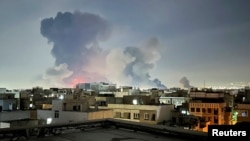
WASHINGTON -- The US-Israeli military campaign against Iran has focused world attention on the Middle East.
It has also fueled debate in Washington over whether the conflict could divert resources and political attention away from Ukraine more than four years into Russia's full-scale invasion.
Ukrainian President Volodymyr Zelenskyy voiced those concerns earlier this week, telling the Italian newspaper Corriere della Sera he that he hopes "the Iranian crisis remains a limited operation," though there's a "risk" it won't.
But US officials and lawmakers told RFE/RL they believe the Iran campaign will remain limited in scope and pledged to keep the needs of Kyiv on the front burner, as well.
Representative Jake Ellzey of Texas, a member of the House Appropriations Committee and commissioner of the Helsinki Commission, said the United States can address both Iran and Ukraine simultaneously.
In an interview with RFE/RL, he said the world often requires juggling multiple security challenges at once. "Yes, Iran has gotten the attention right now…. However, back there, there is Ukraine," he added.
Ellzey emphasized that the international community remains united in supporting Ukraine and that logistical strains from multiple fronts are being carefully managed.
"Our job has been to take out Iran's offensive capability, and the Israelis are handling other elements. I think this is going to be over fairly quickly," he said.
Republicans See Strategic Link to Ukraine
Other Republican lawmakers emphasized that strikes on Iran could have knock-on effects on the battlefield in Ukraine.
Senator John Curtis of Utah noted that US attacks targeting Iranian military facilities could disrupt drone production that Russia has relied on heavily in its air strikes against Ukrainian cities and energy infrastructure.
"The operations targeting sites in Iran are actively destroying Iranian-made drones that Russia uses to kill Ukrainians," Curtis said.
Since Russia's invasion began in 2022, it has deployed Iranian-designed drones such as the Shahed-136 against Ukrainian cities and energy infrastructure.
Representative Joe Wilson of South Carolina echoed that view during a Helsinki Commission hearing early this week, arguing the degrading of Tehran's military capabilities could ease pressure on Ukraine's defenses since it will impact Iran's military support to Moscow.
Analysts contend that such effects will be limited because Russia now makes most of the Shahed-type drones itself, no longer relying on Iranian supplies.
That said, the Trump administration has sent mixed signals on how long, and and how limited, the Iran campaign will be. Trump has said it could last around 100 days, but he also hasn't ruled out putting US troops on Iranian soil.
That uncertainty prompted some lawmakers to caution that sustained operations could stretch US military resources to a point that impacts overall operations.
Representative August Pfluger, a Republican from Texas, warned that continued combat could draw down munitions stockpiles, requiring careful planning to ensure readiness for other global contingencies.
"This engagement in Iran is going to deplete some of our stockpile of munitions…and we're going to have to replace that in order to continue to deter our enemies around the world," Pfluger told an audience at the Heritage Foundation on March 4.
Democrats Raise Concerns Over Strategic Tradeoffs
Democrats have voiced similar skepticism, warning the Iran campaign could complicate US efforts to address simultaneous global threats.
Senator Chris Coons said in a statement this week that while Tehran's record of supporting terrorism is well documented, the administration has not sufficiently demonstrated that Iran posed an imminent threat to the United States.
He added that launching military action at a time when Washington already faces "significant threats from an aggressive China and Russia" risks stretching US strategic focus and military capacity.

Other Democrats have also questioned whether resources used in the Iran campaign could instead have been directed toward Ukraine.
Senator Richard Blumenthal of Connecticut told reporters on March 5 that some of the weapons used in Operation Epic Fury, the code name for the US campaign, might have been better deployed to support Kyiv.
He added that US officials have repeatedly cited limited stockpiles as a reason for not providing additional Patriot interceptors and other munitions to Ukraine. The US military and Trump himself have rejected such claims, saying there is sufficient ordnance for operations in Iran.
Pentagon Emphasizes Targeted Objectives
Pentagon policy chief Elbridge Colby, speaking at the Council on Foreign Relations on March 4, described the Iran operation as a targeted effort to degrade Tehran's ability to project military power.
He also acknowledged the broader challenge facing US planners: preparing for scenarios in which multiple adversaries act simultaneously.
"The core military problem is the potential for possible foes to operate on simultaneous or roughly concurrent timelines," he said.
Colby highlighted the need for European allies to increase defense spending and capabilities to support Ukraine's long-term security, whether through negotiations or continued fighting.
"The implications are the same," he concluded. "There needs to be a European buildup."

Allies Say Conflicts Reflect Wider Struggle
For some US allies, the crises in Iran and Ukraine are not competing priorities but part of a broader confrontation between democratic countries and authoritarian regimes.
Vidmantas Verbickas, Lithuania's vice minister of foreign affairs who was in Washington this week to highlight regional challenges and transatlantic relations, said the developments should be viewed in that broader context.
Speaking with RFE/RL in Washington, he argued that the turmoil surrounding Iran should not be seen as diverting attention from Russia's war against Ukraine.
"What is happening in Ukraine is Russia's war of aggression," Verbickas said. "What we see in Iran is also a humanitarian disaster. These are regimes that are not looking for peaceful solutions. They seek to coerce, oppress, and disregard international law."
From that perspective, he said, the democratic world is confronting related challenges rather than shifting focus from one crisis to another.
"This is not a shifting of the focus," Verbickas said. "This is the democratic world dealing with dictatorships."
Asked about potential implications of the Middle East escalation for Ukraine, Verbickas said it was too early to draw firm conclusions.
"There is a lot of speculation -- about weapons supplies, about oil prices," he said. "Some volatility in energy markets might temporarily help Russia, but supply chains may also be affected."

