


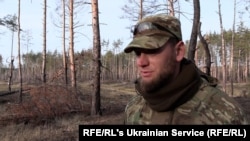
A Ukrainian man who spent years exhuming and identifying soldiers killed in the war is getting a final send-off in his hometown of Slovyansk after being killed during one of his missions to exhume bodies near the front line.
Oleksiy Yukov organized a small volunteer group in 2014, when conflict broke out with Kremlin-backed separatists in eastern Ukraine. Its work helped families recover the bodies of fallen loved ones and provide them with dignified burials.
Since Russia's fall-scale invasion began in 2022, the group's workload has increased exponentially -- as have the dangers from booby-trapped bodies, unexploded ordinance, shelling, and drones.
"For us, it's very important that every guy and girl comes home," Yukov told RFE/RL's Ukrainian Service in April last year.
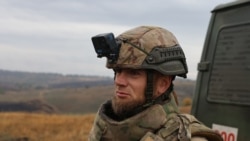

A Grisly Job
Yukov's interest in his field began during peacetime. As a teenager, he was involved in searching and exhuming the remains of Soviet and German soldiers killed during World War I and II. He later recalled seeing the bones of unidentified bodies in forests near his home and feeling an intense emotional response.
But in 2014, war ceased to be a subject of historical interest as Slovyansk became an epicenter of intense fighting in the new conflict. Yukov, who had been working as a Thai boxing coach, quickly started to recover unidentified bodies of recently killed soldiers and civilians from both sides of the lines.
Amid ongoing fighting and fluid front lines, this was dangerous work. At one point, he was captured and nearly executed by armed separatists. At another, his vehicle came under fire, according to Ukrainian media reports.
Some 13,000 people were killed in the conflict between 2014-22. The war that has followed since then has been on a massively larger scale with hundreds of thousands of fatalities. Yukov was busier than ever and RFE/RL frequently documented his work.
In November 2022, RFE/RL filmed him and fellow volunteers exhuming Russian war dead in a rain-soaked Ukrainian forest near the village of Dovhenke in the Kharkiv region.
"Russia has caused tremendous grief for us. It started a war against us; it is ruining our cities and killing our people. But we remain human even in these circumstances and gather their military's dead bodies," he said at the time.
The bodies would be included in periodic exchanges of the dead between Russia and Ukraine.
Growing Dangers
A month later, the team was dealing with potential booby traps. After attaching cords to a body in a hole, they lay prone on the ground, pulled, and waited 10 seconds -- trying to stay clear of any potential explosion. Only then would they climb back down and retrieve the body.
"We are checking the neck for an ID tag, a cross on a chain, or anything else. Here's a big cross," said Yukov as he worked.
In January 2023, in Zarichne, in the Donetsk region, he found a watch on a corpse that was still running. "Clocking time from life to death," he noted.
By 2025, Yukov's teams were facing increased threats from drones.
"It's almost impossible to work now," a volunteer named Artur said during a mission in April of that year. "Before, we could move under cloud cover or rain. Now it's too risky. We've been hit before."
Yukov explained that the changing conditions had affected the way they worked.
"You take whoever you see first," he said. "There's no time to figure out if they're ours or theirs. You grab the body and run."
Last Words
In February 2026, RFE/RL produced a documentary film about the ongoing work to recover the bodies of fallen soldiers. Yukov's words at the time were prophetic.
"My lifetime will not be enough to bring back every soldier from this war," he said.
In the following months, the work continued.
Yukov's final Facebook post, on August 3, was a poignant reflection on his experiences and the nature of war.
"As a seeker, I see the war in all its manifestations, encountering both the causes and the consequences. Here, human life is worth nothing," he wrote. "We gather bodies and souls to return them from the war. And those who touched the war remain with it and in it, because it no longer lets go of anyone."
Two days later, his death was announced on the same social media by Serhiy Gnezdilov, a Ukrainian soldier.
"He suffered a fatal injury during the exhumation of bodies on the line of contact," he wrote.
Slovyansk residents are bidding a final farewell to Yukov on August 7, with a funeral to follow in Kyiv at a later date.



