




And here's another item from our news desk:
Ukrainian Navy Says Moscow Returned Three Ships To Kyiv In Bad Condition
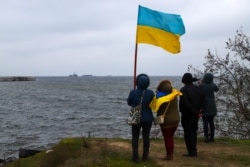
Ukraine's navy says that the three ships captured by Russia almost a year ago and released on November 19 have been returned in very poor condition and are not able to make it back to port under their own power.
Navy chief Vice Admiral Ihor Voronchenko said on November 20 that, because of their condition, the ships -- two small Ukrainian armored artillery vessels and a tug boat -- are being moved slowly by other vessels.
"They cannot sail on their own. The Russians ruined them -- even took lamps, power outlets, and toilets. We will show the whole world the Russian barbarism towards them," Voronchenko said.
Ukrainian President Volodymyr Zelenskiy is expected to meet the ships at the port of Ochakiv in the southern Mykolaiv region later on November 20.
On November 25, 2018, Russian Coast Guard vessels fired on and seized the three ships and their crews, consisting of 24 sailors, in the Kerch Strait, while they were on their way from the Black Sea to the Ukrainian port of Mariupol, on the Sea of Azov.
Running between Russia and the Ukrainian peninsula of Crimea that was forcibly seized by Russia in 2014, the Kerch Strait is the sole passageway from the Black Sea to the Sea of Azov.
The takeover of the peninsula, and Russian support for separatist militants who seized parts of eastern Ukraine at the start of a conflict that has now killed more than 13,000 people, came after pro-European protests pushed Moscow-friendly Ukrainian President Viktor Yanukovych from power in Kyiv.
Ukraine called the attack and subsequent capture of the 24 crewmen a violation of international maritime law.
On May 25, the UN's maritime tribunal ordered Russia to immediately release the crewmen and impounded boats, a ruling that Moscow ignored.
The Ukrainian crewmen were released on September 7 as part of a prisoner exchange between Russia and Ukraine, during which each side swapped 35 captives.
Since his election this spring, Zelenskiy has moved quickly to find a way to try to end the conflict with Moscow.
The release of the ships comes less than a month before a December 9 summit between Ukraine, Russia, France and Germany.
The so-called Normandy Format talks are aimed at ending the conflict. The summit will be the highest-level negotiations on the conflict since 2016.
Envoys from Kyiv and Moscow in early October reached a breakthrough after both sides agreed to have forces withdrawn from two flash points in the Luhansk region and one in Donetsk as conditions for the four-way talks to resume.
Ukrainian government and Russia-backed forces withdrew from the Luhansk settlements and disengagement is underway near the town of Petrivske in the Donetsk region.
With reporting by Reuters and UNIAN
U.S. Ambassador to the European Union Gordon Sondland is now testifying before the impeachment inquiry in Washington. Here's an update to our earlier story on this subject from our news desk in D.C.:
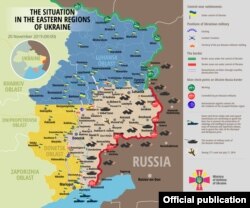
Here is today's map of the security situation in eastern Ukraine, according to the National Security and Defense Council (click to enlarge):
Crimean court orders demolition of Ukrainian Orthodox Church:
By RFE/RL's Ukrainian Service
A Russian-controlled court in annexed Crimea has ordered the Orthodox Church of Ukraine (OCU) to demolish its chapel in Yevpatoria.
The decision can be appealed within a month.
The Russian administration had been trying to vacate the territory on which the place of worship stands over allegations that the OCU didn't have the proper building permits from when construction began in 2014.
Metropolitan Epifaniy, the head of the recently formed, independent OCU, said on Facebook that the court decision "grossly violates one of the fundamental human rights: freedom of conscience and religion."
When Russia sent in masked soldiers without military insignia to take over Ukraine's Crimean Peninsula in early 2014, there were 46 parishes affiliated with the Kyiv Patriarchate of the Orthodox Church.
After the first year of annexation, eight OCU parishes remained in Crimea.
"All faiths, except the Orthodox Church under the Moscow Patriarchate, have come under fire in occupied Crimea," the Kharkiv Human Rights Protection Group said in September regarding the clampdown on the peninsula.
The last major OCU congregation was evicted from its church in September by court order in the peninsula's capital of Simferopol.
The same month, the Russian Justice Ministry in Crimea for the third time since 2014 denied registration to the OCU on the peninsula.
In October 2018, Ukraine secured approval from Ecumenical Patriarch Bartholomew of Constantinople -- the spiritual head of Orthodoxy -- to set up an independent Orthodox church.
Three months later, the OCU was granted independence, or autocephaly, ending more than 330 years of Russian religious control of Ukraine.
Moscow long opposed such efforts by the Ukrainians for an independent church, which intensified after Russia annexed Crimea and threw support to separatists in parts of Ukraine's eastern regions of Donetsk and Luhansk.