




Denis Voronenkov, the former Russian lawmaker who fled in October and has since taken Ukrainian citizenship, and his wife, Maria Maksakova,who is also a former Russian lawmaker, have been speaking to RFE/RL's Christopher Miller:
Seen As Turncoats By Moscow, Exiled Duma Pair Blasts Kremlin From Kyiv
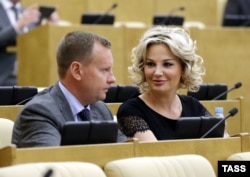
KYIV -- Denis Voronenkov, the former Russian lawmaker who fled in October and has since taken Ukrainian citizenship, has come ready to chastise President Vladimir Putin, who he once supported, and his native Russia.
When I arrive at this Georgian restaurant down the street from the Ukrainian parliament building, Voronenkov and his wife, Maria Maksakova, a renowned opera singer who is also a former Russian lawmaker, have already started in on beer, eggplant wraps, and a vegetable salad dressed with walnut paste.
In his first interview with a foreign journalist since fleeing to Ukraine, Voronenkov fires off talking points while tearing through a fluffy, racket-shaped piece of bread. Dressed in a sportcoat and turtleneck sweater with a luxury watch on his wrist, he compares present-day Russia with "Nazi Germany," says its 2014 annexation of Ukraine's Crimea region was "a mistake" and "illegal," claims Russian security services "hounded" him out of the country, and calls charges brought against him back home "fake" and "political."
A former Communist Party legislator elected in the 2011 Russian vote viewed by many as rigged, Voronenkov is perhaps best known for co-authoring the 2014 bill in the State Duma that banned the foreign ownership of Russian media, a move Bloomberg View columnist Leonid Bershidsky called "perhaps the single worst thing that happened to press freedom as an institution in Putin's Russia."
Now, though, Voronenkov appears to have flipped, becoming a fiery critic of most everything he once supported in Russia and a citizen of Ukraine, to boot.
The way Maksakova tells it, she and Voronenkov left Moscow and most of their possessions behind and flew to Kyiv in October with no clear agenda but to escape pressure from the Federal Security Service (FSB), Russia's successor agency to the KGB.
Read the entire article here.
We are now closing the live blog for today, but we'll be back again tomorrow morning to cover all the latest developments. Until then, you can keep up with all our other Ukraine coverage here.
Kyiv to renew search for remains at MH17 crash site after bone found:
Ukraine this spring will renew its search for human remains at the crash site of Malaysia Airlines flight MH17, Dutch Security and Justice Minister Stef Blok has said.
The passenger jet was shot down over eastern Ukraine in mid-2014 on a routine flight between Amsterdam and Kuala Lumpur. All 298 people on board died, the majority of them Dutch citizens.
"Contacts in the region have indicated they will renew the search for human remains and personal belongings in the spring, once the snow has disappeared," Blok told parliament on February 16.
His statement comes after journalists last month discovered a bone fragment belonging to one of the victims in Ukraine's Donbas region.
Members of the victims' families said they might push for a new official search in light of the discovery to ensure no remains are left behind,
But Blok denied claims by the journalists that "there was much more to be found."
"Many hours of filming made at the spot and shown to the investigating team failed to reveal any trace of human remains or personal belongings," he said. (AFP, TASS)
CPJ wants separatism charges against Crimean journalist be dropped:
By RFE/RL
The Committee to Protect Journalists (CPJ) has urged Russia-imposed authorities to drop all charges against journalist Mykola Semena, an RFE/RL contributor accused of separatism in the Moscow-controlled Ukrainian region of Crimea.
In a February 16 statement, CPJ Europe and Central Asia Program Coordinator Nina Ognianova said that "criticizing authorities is not a crime" and called on Russian-imposed authorities to "stop harassing journalists in Crimea."
A preliminary hearing in the case against Semena starts in Simferopol on February 17.
Semena was charged with separatism in spring 2016 after he wrote an article on his blog that was critical of Moscow's seizure of Crimea from Ukraine in 2014. He denies the charges.
If convicted, he may face up to five years in prison.
RFE/RL President Thomas Kent said in January that the charges against Semena were "part of a concerted effort by Russian and Russian-backed authorities to obstruct RFE/RL's journalistic mission to provide an independent press to residents of Crimea."