





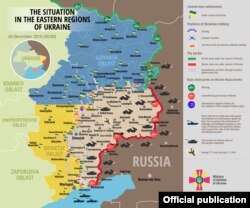
Judging by this map of the latest situation in the Donbas conflict zone according to the Ukrainian Defense Ministry, the current cease-fire still seems pretty shaky:
Here's some more details on how the latest cease-fire is holding up, courtesy of RFE/RL's news desk:
Ukraine's Fragile Cease-Fire Holds For Third Day Despite Violations
A new cease-fire negotiated between Ukraine's government and Russia-backed separatists in the east held by a thread for a third day as both sides reported clashes near the strategic town of Debaltseve.
The two sides agreed to the so-called "indefinite" cease-fire last week, with the help of mediation from the Organization for Security and Cooperation in Europe (OSCE).
Ukrainian President Petro Poroshenko said the agreement reached on December 21 was a sign that his war-weary nation is on a road to lasting peace after nine previously negotiated cease-fires came unraveled.
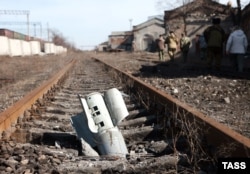
Mortar and artillery fire has continued without any casualties.
"Our positions have come under attack 33 times since early Sunday," the Ukrainian military said in a statement.
Russian-backed separatists said their side had come under fire from Ukrainian grenade launchers 62 times in the past day.
The truce came after a battle for control of Debaltseve, which sits on a key rail link between the regions of Donetsk and Luhansk.
The two sides agreed to a similar holiday truce last year. It lasted for several weeks before fighting slowly resumed.
As of December 1, the UN's "conservative estimate" of the death toll among civilians and combatants since the conflict erupted in April 2014 is 9,758, with another 22,779 people injured.
Based on reporting by AFP and Interfax
Here's a taster of the article that's being tweeted:
Ukrainians have lost billions of hryvnias in uninsured bank deposits over the past two years as the government has taken over and liquidated dozens of banks whose main business model was embezzlement and fraud.
But for some, the resulting chaos is a lucrative opportunity.
Ukraine’s Deposit Guarantee Fund is tasked with selling the assets of liquidated banks back into the market. The juiciest assets are the bank’s loan portfolios, which can include collateral for businesses around the world.
Not only is the DGF overwhelmed with its caseload of hundreds of millions of dollars worth of assets to sell, but it lacks control over the exchanges it uses to sell them. This opens up an opportunity for fraud in the buying of the assets. Some of the best assets are sold at cut-rate prices to the former owners of the banks, managers of the exchanges, and assistants of members of parliament.
Read more here