




Here's an item from Mike Eckel, who works in RFE/RL's Washington bureau, on some legislation passed in the U.S. Congress that has some ramifications for Ukraine (the parts relevant to Ukraine have been italicized in bold):
U.S. Congress Passes Massive Defense Bill, Including Global Magnitsky Rights Measure

The U.S. Congress has backed legislation giving the president new, broader authority to impose sanctions on human rights abusers worldwide, building on an earlier law that has infuriated the Kremlin.
The measure, formally known as the Global Magnitsky Human Rights Accountability Act, passed the Senate in a 92-7 vote on December 8 as part of a larger bill that sets guidance for U.S. defense priorities for the coming year.
The new measure is modeled after the Magnitsky Act, a law passed in 2012 that punishes Russians deemed by Washington to be rights violators by barring them from the United States and freezing any assets they hold there.
That law is named for Sergei Magnitsky, a whistle-blowing Russian lawyer who helped uncover evidence of a massive tax fraud. He was jailed and later died in a notorious Moscow jail. His supporters, Western governments, and international rights groups say he was tortured and denied medical treatment.
Most of the 39 Russians hit by the 2012 law were accused of being connected either to Magnitsky's death in 2009, or the $230 million tax scam that he identified while working with the investment firm Hermitage Capital Management.
Incensed by the U.S. law, the Kremlin retaliated in 2012 by banning the adoption of Russian children by U.S. citizens and barring some Americans from entering Russia.
'Gross Rights Violators'
Тhe new legislation authorizes the president to impose visa bans, to freeze financial assets, or other punitive measures against anyone who targets whistle-blowers exposing corruption or citizens exercising basic rights like freedom of speech, religion, or assembly.
It also targets foreign government officials engaged in "significant corruption," such as illegally acquiring state assets or hiding ill-gotten gains offshore.
The Senate had passed a stand-alone version of the amendment last year, but its fate in the House was uncertain. So its backers, led by Senator Ben Cardin (Democrat-Maryland), attached it to the defense bill as a backup, according to one congressional official familiar with the procedure.
Because the larger defense policy bill, formally known as the National Defense Authorization Act, is a must-pass piece of legislation -- since it affects U.S. military operations worldwide -- outgoing President Barack Obama is expected to sign it into law. The House passed the bill earlier this month.
"Gross violators of human rights and those who engage in serious acts of corruption cannot escape the consequences of their actions even when their home country fails to act," Cardin said in a statement. "Visiting the United States and using our financial institutions are privileges that should not be extended to the worst actors in the international system."
Vigorous Lobbying
The new measure does not single out Russians for special scrutiny, but as it made its way through congressional committees, it faced what Magnitsky's family and allies said was a vigorous lobbying campaign, quietly backed by the Kremlin, to undermine the widely accepted narrative surrounding the tax fraud and Magnitsky's death.
The legislation, either as a stand-alone bill or as amendment to the defense bill, encountered little opposition.
The most prominent skeptic in Congress has been Representative Dana Rohrabacher (Republican-California), who has traveled to Moscow and reportedly met with representatives of the Russian prosecutor-general's office, and with a close ally of President Vladimir Putin.
At a House Foreign Affairs subcommittee hearing held a day before the vote, Rohrabacher repeated his argument that such human rights legislation should not bear Magnitsky's name, suggesting that might needlessly offend or provoke Russia.
"I think the Russians were mistreated in the Magnitsky case because that title of that bill is maybe suggesting that something was done that has not been proven yet," he told the subcommittee on Europe, Eurasia, and Emerging Threats, of which he is the chairman.
If the measure does make it into law, it is also unclear whether Obama's successor, Donald Trump, will use the authority once he assumes office on January 20.
Trump has signaled he wants a more conciliatory approach toward Russia, and has shown little interest publicly in global human rights issues.
Ukraine Military Assistance
The defense bill contains other provisions likely to irritate the Kremlin, including a ban on funds for military-to-military contact between the Pentagon and the Russian Defense Ministry -- a response to Russia's annexation of Crimea and its involvement in the conflict in eastern Ukraine.
A related spending measure earmarks $350 million in military and security assistance for Ukraine, but half of those funds are contingent on Ukraine doing more to clean up corruption and waste in its armed forces. The measure also authorizes the supply of lethal weaponry, which Ukraine has demanded for months to help its forces battling Russia-backed fighters in eastern regions.
The Obama administration has repeatedly rebuffed calls in Congress, and elsewhere, to supply lethal weaponry, which would include antitank missile systems, fearing that it would provoke Russia and escalate the fighting in eastern Ukraine further.
The legislation also withholds funding from the Defense Department for matters related to Russian surveillance flights over the United States. Those flights are authorized under a 2002 agreement known as the Open Skies Treaty, but some officials in Washington voiced fear that the Russian flights were using a high-tech camera with sensors to significantly boost surveillance capabilities.
The bill requires defense officials to report to Congress that the Russian flights wouldn't violate the treaty before funding is released.
Here's another item from our Washington bureau that also touches on the wider ramifications of the Ukraine crisis:
White House: U.S. To Examine $11 Billion Rosneft Deal For Sanctions 'Impact'

WASHINGTON -- The White House says U.S. authorities will examine the around $11 billion privatization of a stake in Russian state oil giant Rosneft to determine how U.S. sanctions may impact the deal.
The deal announced this week would give a 19.5 percent stake in Rosneft to a consortium of Swiss commodities giant Glencore and the Qatari sovereign wealth fund.
Washington hit Rosneft with sanctions in response to Russia's annexation of Ukraine’s Crimea Peninsula in 2014 and its backing of armed separatists in eastern Ukraine.
The sanctions place restrictions on long-term lending and the transfer of some U.S. drilling and exploration technology to Rosneft but do not bar trading in its equity.
White House spokesman Josh Earnest told reporters in Washington on December 8 that experts from the U.S. Treasury Department who are "responsible for constructing and enforcing the sanctions regime [against Russia] will carefully look at a transaction like this."
"They'll look at the terms of the deal and evaluate what impact sanctions would have on it," Earnest said.
We are now closing the live blog for today, but we'll be back again tomorrow morning to follow all the latest developments. Until then, you can catch up with all our other Ukraine coverage here.
Good morning. We'll start our live blog today with this item that RFE/RL's Washington bureau posted overnight:
More Than Two Dozen U.S. Senators Urge Trump To Stay Firm On Russia Sanctions
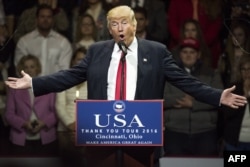
WASHINGTON -- More than two dozen U.S. senators have urged U.S. President-elect Donald Trump not to weaken sanctions targeting Russia for its actions in Crimea and elsewhere in Ukraine.
In a December 8 letter signed by 27 Democrats and Republicans, the senators also called on Trump to authorize the supply of lethal weaponry to Ukraine, something that outgoing President Barack Obama's administration has refused to do.
"In light of Russia's continued aggression and repeated refusal to respect Ukraine's territorial integrity and sovereign right to choose its own destiny, we also renew our call for the United States to increase political, economic, and military support for Ukraine," they wrote.
The letter was issued hours after Congress finalized a massive defense bill that includes millions of dollars in military assistance and support for Ukraine.
Trump, who takes office on January 20, has signaled he wants a more conciliatory approach toward Russia and cast doubt on the necessity of NATO.
Russia annexed Ukraine's Crimea peninsula in March 2014 after mass demonstrations forced Ukrainian President Viktor Yanukovych to flee.
Moscow later backed separatists in eastern Ukraine with support that Kyiv and the West say includes heavy weaponry and military personnel.
At least 9,700 people have been killed the conflict between Kyiv's forces and the separatists since April 2014, according to the UN.