



That concludes our live-blogging of the Ukraine situation for August 5, 2019. Check back here tomorrow for more of our continuing coverage.
Good morning. We'll get the live blog up and running today with a few news stories that our Washington desk posted overnight:
Ukraine's Zelenskiy Names New Commander In Donbas Conflict Zone
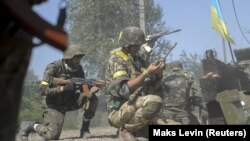
Ukrainian President Volodymyr Zelenskiy has appointed Lieutenant-General Volodymyr Kravchenko to lead the Joint Forces Operation (JFO) in eastern Ukraine where Kyiv has been fighting Moscow-backed separatists since 2014.
Kravchenko previously was commander of the "North" operational and tactical group composed of six regions and the city of Kyiv.
Issued on August 5, the presidential decree replaces General Oleksandr Syrsky who was made commander of the army's ground forces.
Sysrsky first headed Sector C when the armed conflict started in the easternmost regions of Donetsk and Luhansk in April 2014. Kyiv first called the deployment an Anti-Terrorist Operation (ATO) and changed it to the JFO in the spring of 2018.
He was one of the main commanders during the battle of Debaltseve in the winter of 2015 when Russia-backed separatists launched an offensive to take over the vital railroad hub city in the Donetsk region.
Ex-President Petro Poroshenko appointed Syrsky the head of the ATO in 2017 and JFO commander in May.
More than 13,000 people have been killed in the Donbas conflict and 1.5 million more have been internally displaced.
Based on reporting by RFE/RL’s Ukrainian service
Stoltenberg: Annexation Of Crimea Is Consequence Of Increased Great Power Competition
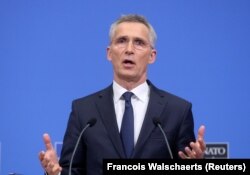
Russia's annexation of Ukraine’s Crimean Peninsula in 2014 was the result of increased "great power competition," NATO Secretary-General Jens Stoltenberg said on August 5.
Speaking at the Center for Strategic Studies at New Zealand's Victoria University, Stoltenberg said that, along with competition between great powers, terrorism and cybersecurity are the other main challenges facing NATO.
He specifically mentioned Russia and China as being "more assertive." He observed that Moscow is significantly building up "military capabilities," which is putting the "rules based order under pressure."
The latest example is the collapse of the Intermediate-Range Nuclear Forces (INF) Treaty on August 2.
Stoltenberg blamed Russia for violating the 1987 treaty by deploying new missiles, an allegation that Moscow denies.
Russia said the United States abandoned the pact so it can start a new arms race.
The treaty banned the Soviet Union and United States from developing, producing, or deploying ground-launched cruise or ballistic missiles with ranges between 500 and 5,500 kilometers.
Regarding Crimea, Stoltenberg said its "illegal annexation" was the "first time in Europe that one country has taken a part of another country since the end of Second World War."
Russia's increased presence in the Middle East and Syria was noted, while he said Moscow was "trying to meddle in and undermining the trust of democratic institutions in several NATO allied countries and also elsewhere.”
Stoltenberg justified the alliance's presence in Afghanistan to ensure the country "doesn’t once again become a safe haven for international terrorists."
He voiced concern over Turkey’s decision to purchase a Russian air defense system because it "will not be integrated into the integrated air and missile defense system we already have in Europe."
Stoltenberg also said cyberrelated issues were "now changing the nature of conflict as fundamentally as the Industrial Revolution changed the nature of conflict before the First World War.”
Toward the end of his speech, Stoltenberg said, we were now living in "a more unpredictable, uncertain world."
Ukraine President Zelenskiy Congratulates U.K. Prime Minister Johnson Ahead of Turkey Trip
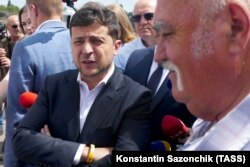
Ukrainian President Volodymyr Zelenskiy has congratulated Boris Johnson on becoming the United Kingdom's new prime minister in a phone conversation, which took place on August 5.
In a statement on the presidential website, Zelenskiy said he had thanked the British government "for its continued support of Ukraine's territorial integrity and sovereignty" and for helping the country "implement reforms and strengthen its defense capabilities."
Britain follows EU-level sanctions policy on Russia relating to its annexation of Ukraine’s Crimean peninsula and other activity in the region.
Britain also has a 2018-2019 technical assistance program in Ukraine worth 35.2 million pounds ($42.8 million) in areas of governance, anti-corruption, accountability, security, humanitarian aid, human rights, and education.
The U.K Defense Ministry’s Operational Orbital program has also trained more than 10,000 Ukrainian servicemen, including marines and special forces. Training mostly takes place in the southern region of Mykolayiv.
At any one time, about 120 British soldiers are in Ukraine.
Trade turnover between the two countries is at around $2.5 billion, former British Ambassador to Ukraine Judith Gough said in April.
Johnson and Zelenskiy also discussed bilateral relations after the U.K. withdraws from the EU and "stressed the need to intensify contacts at the highest level."
On August 7-8, Zelenskiy will make an official visit to Turkey.
He will meet Turkish President Recep Tayyip Erdogan, members of the Ukrainian and Crimean-Tatar community, as well as Ecumenical Patriarch Bartholomew, the spiritual head of Orthodox Christianity.
Based on reporting by RFE/RL’s Ukrainian service
Kyiv says four Ukrainian soldiers have lost their lives in the latest clashes with Russia-backed separatists in the country's east.
The Defense Ministry said in a statement that the pro-Russian separatists opened fire at Ukrainian military positions in the Donetsk region on July 6, using grenade launchers, machine guns, and assault rifles.
"We say with sadness that, as a result of the enemy's attacks today, according to the information in our possession, four of our heroes sustained injuries, to which they succumbed," the statement says.
Since April 2014, more than 13,000 people have been killed in fighting between Ukrainian forces and the separatists, who control parts of the Donetsk and Luhansk regions.
A new cease-fire agreement was supposed to go into effect on July 22 in accordance with an agreement reached in Minsk on July 17 by Ukrainian and Russian envoys as well as members of the Organization for Security and Cooperation in Europe (OSCE).
But the sides have been accusing each other of violating the agreement since then.
Cease-fire road maps announced as part of the Minsk accords -- September 2014 and February 2015 pacts aimed at resolving the conflict -- have contributed to a decrease in fighting but have failed to hold.