





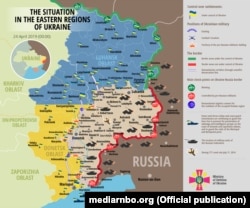
Here is today's map of the security situation in eastern Ukraine, according to the National Security and Defense Council (CLICK TO ENLARGE):
Ukraine Cries Foul As Russia Offers Citizenship In Separatist Areas
By RFE/RL
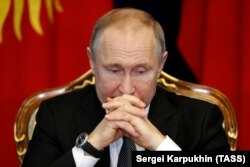
Russian President Vladimir Putin has signed a decree simplifying the procedure for people living in parts of eastern Ukraine held by Russia-backed separatists to obtain Russian citizenship, drawing a swift and angry response from Kyiv and criticism from the West.
Shortly after Putin's decree was published on the Kremlin website on April 24, Ukraine's foreign minister called it "aggression and interference" in Kyiv's affairs and a Western diplomat told RFE/RL it was a "highly provocative step" that would undermine the situation in the war-ravaged region known as the Donbas.
President Petro Poroshenko said that, with this decree, "Russia is torpedoing the peace process in Donbas."
The U.S. Embassy in Kyiv posted on Twitter that the decree was "absurd and destabilizing" and reaffirmed "our strong support for Ukraine's sovereignty and territorial integrity."
The order and its timing seemed designed to put pressure on Kyiv just three days after Ukraine elected a new president, opening the door to potential changes in a relationship severely damaged for the past five years by Russia's seizure of Crimea and support for the forces who hold parts of the Donetsk and Luhansk provinces in eastern Ukraine.
The decree says its goal is "to protect human and civil rights" and that the move was "based on universal principles and norms of the international law."
Putin aide Vladislav Surkov called it "extremely important" and said that Russia was carrying out its "duty to Russian-speaking and Russian-thinking people who have found themselves in a very grave situation" due to what he called "the repressive actions of the Kyiv regime."
Speaking hours after the decree was published, Putin said that Moscow has "no desire to create problems for the new Ukrainian authorities" and called it "a purely humanitarian matter," contending that people in the Donetsk and Luhansk regions "are deprived of all possible civil rights."
But Kyiv rejects such claims, blaming Russia for the problems faced by residents of the war-ravaged regions.
Oleksandr Turchynov, secretary of Ukraine's National Security Council, issued a statement saying that "Putin is creating legal conditions for an official application of armed forces against Ukraine."
"This is related to Russian legislation allowing the use of armed forces for protecting Russian citizens outside of Russia," he added.
Turchnyov called for "increasing sanctions pressure on the aggressor state."
Shortly after the decree was published, Ukrainian Foreign Minister Pavlo Klimkin tweeted that "Russia's decision to issue passports in the occupied Ukrainian territories is the continuation of aggression and interference in our internal affairs," adding: "This is a new 'passport' stage of the occupation of the Donbas."
Speaking on condition of anonymity because of the sensitivity of the subject, a Western diplomat involved in negotiations related to the conflict in eastern Ukraine told RFE/RL that Putin's decree is "a highly provocative step that undermines efforts to deescalate the situation" in the Donbas.
According to the decree, permanent residents of "certain districts of Ukraine's Donetsk and Luhansk regions" -- wording apparently referring to territory held by the Russia-backed separatists, which includes the two provincial capitals -- "have the right to apply for citizenship of the Russian Federation [and obtain it] in a simplified way."
The decree states that decisions on citizenship for people from the areas in question must be made by Russian authorities within three months after their applications are filed and all necessary documents are collected, and that citizenship must be granted immediately after the decision to do so is made.
Putin's order came after amendments to the Russian law on citizenship allowing a president to grant citizenship to foreigners "in a simplified way" were approved by lawmakers in both houses of the Russian parliament in December and came into force on March 29.
Russia's moves to grant citizenship to residents of other former Soviet republics, and especially breakaway regions that are supported by Moscow, have often been described by critics as a way to increase the size of Moscow's footprint and gain additional levers of influence in those countries.
In 2002, during Putin's first term, Moscow began issuing Russian passports to residents of Georgia’s breakaway regions of Abkhazia and South Ossetia -- first laying groundwork for the move by adopting a law allowing Russian citizenship to be granted to people who did not receive citizenship of any country after the 1991 Soviet collapse.
When Russian troops rolled into Georgia in August 2008, at the start of a five-day war that strengthened Moscow's grip over South Ossetia and Abkhazia, the number of Russian passport holders in the two separatist regions was 85 and 90 percent, respectively.
Russia recognized South Ossetia and Abkhazia as independent countries after the war, leaving large numbers of troops in both regions. Pro-Kremlin analysts and other defenders of Moscow's actions say that Russia was protecting its citizens when it launched the military operation. Meanwhile, Russian media reports have said that almost half the residents of Moldova's Moscow-backed breakaway region of Transdniester are Russian passport holders.
Putin's decree came three days after Volodymyr Zelenskiy, a comedian and political novice who critics doubt will be able to stand up to Putin, defeated Poroshenko by a massive margin in a presidential runoff. He is to be inaugurated in early June.
Putin and other Russian officials had repeatedly denounced Poroshenko, who made a stronger army and resistance to Russian interference major parts of his policy and his reelection campaign.
Poroshenko was elected in May 2014, after Moscow-friendly President Viktor Yanukovych was pushed from power that February by a protest movement known as the Maidan after he scrapped plans for closer ties with the European Union and vowed to boost trade with Russia.
Shortly after Yanukovych stepped down and fled to Russia, Moscow seized control of Ukraine's Crimean Peninsula and fomented unrest in the Donbas, where it has backed separatist forces in a war that has killed some 13,000 people and continues despite a cease-fire and peace deal known as the Minsk Accords.
Russia denies involvement in the conflict despite evidence Kyiv and Western governments say is incontrovertible that it has provided weapons, troops, and other support.
With reporting by RFE/RL correspondent Christopher Miller in Kyiv, Reuters, TASS, and RBK
Just in from our News Desk:
U.S. Embassy in Kyiv says on Twitter that Russia's executive decree on easing citizenship for residents of parts of eastern Ukraine is "absurd and destabilizing." Affirms U.S. support for Ukraine's territorial integrity.
From Ukraine's ambassador to Belgium:
Latest from our News Desk:
A top Western diplomat says Putin decree easing procedure for people in areas of eastern Ukraine held by Russia-backed separatists to obtain Russian citizenship is "a highly provocative step that undermines efforts to deescalate the situation."
Ukrainian Foreign Minister Pavlo Klimkin says Putin's decree on citizenship procedure is "the continuation of aggression and interference in our internal affairs," urges Ukrainian citizens in areas held by Russia-backed separatists "not to accept Russian passports."