



In case you missed some of our previous coverage:
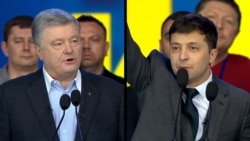
Ukrainian President, Challenger Face Off In Preelection Debate
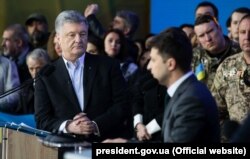
The candidates for the presidency of Ukraine held a debate in front of thousands of supporters at a stadium in Kyiv on April 19, two days before the second round of voting. The incumbent, President Petro Poroshenko, attacked his rival, actor Volodymyr Zelenskiy, for his lack of experience, a point Zelenskiy has used to cast himself as an outsider willing to take on the establishment.
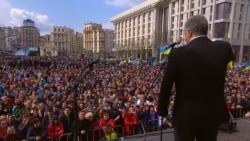
Poroshenko Rallies Supporters Ahead Of Presidential Debate
Trailing far behind in the polls, Ukrainian President Petro Poroshenko rallied his supporters in Kyiv's Independence Square ahead of a debate with rival candidate Volodymyr Zelenskiy. The April 19 gathering came hours before Poroshenko was to face Zelenskiy in a 70,000-seat stadium. Zelenskiy is a comedic actor with no political experience but has a big lead over Poroshenko in opinion surveys just two days before Ukrainians cast ballots in the April 21 presidential runoff vote.
Zelenskiy's Oligarch Connection
Ukrainian presidential candidate Volodymyr Zelenskiy is campaigning as an outsider who will clean up politics, but he's backed by one of the country's richest men. (With reporting by AP, AFP, and Reuters)

Poroshenko Faces Tough Test As Ukraine Votes In Presidential Runoff
By RFE/RL's Ukrainian Service
KYIV -- Voters in Ukraine are going to the polls on April 21 in a second-round presidential election that could seal the political fate of incumbent President Petro Poroshenko.
Polls showed Poroshenko's rival, 41-year-old comedian Volodymyr Zelenskiy, with a substantial lead as campaigning wound down.
A survey released on April 18 by the Reiting research group found that 57.9 percent of voters say they will definitely vote to support Zelenskiy, with 21.7 percent saying they plan to vote for Poroshenko.
Zelenskiy, who has run his campaign mostly on social media and has largely avoided substantial policy discussions, has benefited from Ukraine's slumping economy, endemic corruption, and fatigue over Kyiv's five-year-long war against Russia-backed separatists in parts of eastern Ukraine.
"I'm not a politician," Zelenskiy said during a sometimes-heated debate between the two candidates at Kyiv's Olimpiyskiy Stadium on April 19. "I'm just an ordinary person who has come to break the system."
For his part, Poroshenko, 53, has tried to play up Zelenskiy's lack of experience, saying he would be unable to stand up to Russian President Vladimir Putin.
"You'd be a weak head of state," Poroshenko told his rival at the April 19 debate, "who would be unable to defend himself from Putin's blows. I don't believe [Zelenskiy] dreams of surrendering Ukraine, of dragging Ukraine back into the Russian Empire, but Putin has such a dream."
Zelenskiy won the first round of the election on March 31, picking up 30 percent. Poroshenko polled 16 percent to come in second.
Zelenskiy has said he supports Ukraine's eventual membership in NATO but only if it is approved by a referendum. He has insisted that Russia must return the Black Sea region of Crimea, which Moscow annexed in 2014, and pay reparations.

He has called for direct talks with Russia over the conflict in eastern Ukraine. In the past, Moscow has rejected such proposals, claiming the conflict – which has claimed more than 13,000 lives -- is an internal matter for Ukraine and urging Kyiv to negotiate with representatives of the Moscow-backed separatist formations.
The International Criminal Court (ICC) ruled in November 2016 that the war in eastern Ukraine is "an international armed conflict between Ukraine and the Russian Federation."
At a Kyiv campaign rally on April 18, Poroshenko warned the country it would be "very risky to experiment with the post of president and commander in chief" at this time. He asked voters to give him a second five-year term.
"I once again ask you to forgive me," Poroshenko said. "What did not work out is what hurts the most."
Poroshenko's supporters give him credit for strengthening the depleted military that he inherited from pro-Russian President Viktor Yanukovych, who fled the country in 2014 amid massive protests.
He also signed an Association Agreement with the European Union and secured visa-free travel for Ukrainians to the EU. He also pushed successfully for Ecumenical Patriarch Bartholomew of Constantinople to recognize the Orthodox Church of Ukraine as independent of the Moscow Patriarchate.
With reporting by AP, Reuters, and AFP
This ends our live blogging for April 20. Be sure to check back tomorrow for our continuing coverage on election day.