





Ukrainian President Volodymyr Zelenskyy and the Kremlin said President Donald Trump spoke separately with the Ukrainian and Russian leaders as efforts to end the war remained stalled, with Kyiv and Moscow deadlocked over key issues.
The calls came on July 4, as the United States marked the 250th anniversary of its independence.
While there was no immediate comment from the White House on either of the calls, both Zelenskyy and Russian President Vladimir Putin's foreign policy adviser, Yury Ushakov, said Trump remained willing to continue his mediation efforts to end the war in Ukraine, now well into its fifth year.
"There is a real prospect to put an end to this war, and America's resolve is decisive," Zelenskyy wrote on X, following what he described as a "very good" conversation with Trump.
Zelenskyy also said he had briefed the US president on the latest battlefield developments in Ukraine and announced the two leaders had agreed to "continue discussions" about the possible resolution to the conflict during next week's NATO summit in Ankara.

US Vice President JD Vance said Ukraine "should not" launch a counteroffensive to liberate its territory, but rather exhaust Russia with drone attacks.
In comments to The Sunday Times published on July 5, Vance said that the Trump administration is leaning toward the idea that the Ukrainians, while talks are ongoing, should simply stick to a defensive stance. In his words, this approach has been much more fruitful because "it is easier to defend than to attack. It has enabled the Ukrainians to make [slightly] better use of their tactical advantage."
"Frankly, the Russians are now in a situation where what they can achieve through prolonged offensive operations is negligible — and approaching zero. This may well create the space we need to see this through to the end," Vance said.
In recent months, Kyiv has stepped up its long- and medium-range strike campaign that has caused nationwide fuel shortages inside Russia, leaving at least 17 regions imposing mandatory restrictions on gasoline and diesel sales.
On July 4, Ukrainian drones struck St. Petersburg's oil terminal -- a major Baltic fuel hub -- and nearby port infrastructure. Russian authorities said air defenses repelled the attack and reported only minor damage, while Ukraine said the strikes targeted strategic energy infrastructure.
With the fuel shortages fueling discontent among Russians who had previously been largely insulated from the country's all-out war against Ukraine, the Kremlin has increasingly sought to shift attention to what it portrays as successes on the battlefield.
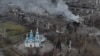
According to Ushakov, in his "90-minute" call, Putin offered Trump his version of the dynamics on the battlefield, with the Russian president informing his US counterpart about Russia's ground offensive in Ukraine's eastern Donetsk region.
On the eve of the calls with Trump, Russia and Ukraine made conflicting battlefield claims with Moscow insisting it had captured the region's key city of Kostyantynivka and Kyiv rejecting the assertion -- the stance reiterated by Zelenskyy on July 5.
Zelenskyy also warned that intelligence suggests Russia is preparing yet another massive air campaign against Ukraine, following the deadly barrage on the night of on the night of July 1–2.
"This is in the spirit of Putin - right after America's Independence Day and before the NATO summit in Ankara. Russia wants to add to the evil and kill people," Zelenskyy said in his video statement on July 5. In it he called on allies to provide Ukraine with air defense capacities, saying there is a sufficient amount of them globally and that they are needed on the ground, not in warehouses.

Trump "once again confirmed his readiness to work toward a rapid end to the fighting and finding solutions to overcome the crisis," Ushakov said following Putin's talks with the US president.
However, he added that Putin told Trump that Moscow continued to seek "a political-diplomatic resolution of the conflict, with due account of Russia's fundamental approach."
Despite diplomatic efforts led by the United States since Trump took over the White House in January 2025, Kyiv and Moscow have remained far apart on negotiating terms.
In 2026, as Washington has focused on the war with Iran, there has also been little momentum toward easing the fighting, with the Kremlin sticking to its hard-line stance and offering no compromise on its demand for full control of the Donbas, which comprises the Donetsk and Luhansk regions in eastern Ukraine.

