


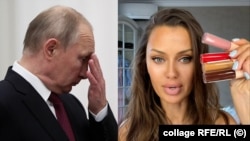
What’s your favorite shade of lip oil?
Russian influencer Victoria Bonya asked her 13 million Instagram followers that question this week, in content that was typical of her feed.
The lip oil video gained 45,000 likes. But she made far more of a splash with a very unusual item on April 14, in which she made a personal address to Russian President Vladimir Putin.
“Vladimir Vladimirovich, they’re afraid of you. The people are afraid of you; bloggers, artists are afraid; governors are afraid of you. But you are the president of our country. I don’t think we should be afraid of you,” said Bonya in the video that quickly gained 20 million views and more than a million likes.

In a country where political debate and criticism of the authorities is tightly controlled, the nearly 20-minute video generated excited debate online -- and quickly spawned another.
'Jokes Are Harshly Punished In Our Country'
Aiza, another influencer, told her 4 million followers that Russia suffered from “dead journalism, dead jurisprudence, [and] dead humor -- because jokes are harshly punished in our country.”
By comparison, Bonya’s video was milder, focusing on issues such as floods in Daghestan, pollution on the Black Sea coast, livestock culls, and blocked or slow Internet connections. Both videos avoided direct criticism of Putin, instead insisting that officials were not informing him of real problems. Neither did they mention the war in Ukraine.
The videos come at a time when Putin’s popularity ratings, as measured by Russian surveys of public opinion, are falling. Last week, the state-run Russian Public Opinion Research Center reported that Putin's approval rating had fallen to 67.8 percent -- its lowest level since Russia launched its full-scale invasion of Ukraine in 2022.
This was the latest in a series of polls showing a decline in his support that may be due to the ongoing war, with its steady stream of casualties and economic hardships.
But exiled Russian sociologist Igor Eidman told RFE/RL’s Russian Service that the survey results were probably also connected to a series of restrictions to the Internet, as Russian authorities seek to further stifle dissent.
“There’s been a political decision to isolate Russia and Russian Internet users from the global Internet, to follow the course taken by China or even Iran,” he said.

On April 14, Kremlin spokesman Dmitry Peskov announced that the mobile Internet shutdowns that had affected millions of people were temporary.
"It is clear that restrictions on Internet access cause inconvenience for many citizens, but...once the need for these measures has passed, Internet access will, of course, be fully restored and returned to normal," said Peskov.
Eidman said any “rollbacks” would probably be temporary “PR moves.”
Crackdown On War Bloggers
Meanwhile, a crackdown on pro-war bloggers who voice criticism of how Russia’s military campaign is being managed has continued unabated.
The latest instance came on April 13, when Aleksandr Vaskovsky’s Telegram channel announced that he’d been detained for “discrediting the army” after posting about corruption within Russia’s occupation authorities in Ukraine's Donetsk region.
He wrote the next day that he’d been released but would face charges in court.

Last month, Ilya Remeslo, a bombastic Kremlin booster, touched a public nerve when he penned a scathing broadside about the war and the overall state of the country. He also went after Putin himself, calling him a war criminal and complaining he was destroying Russia.
Less than two days after publishing the article, Remeslo was admitted to a psychiatric hospital.
Bonya, who lives in Monaco, or Aiza, who is based in Bali, may feel safe from arrest or other repressive measures.
But perhaps just to make sure, Bonya issued a follow-up video on April 15 saying she was refusing all interview requests and adding: “I have nothing more to say. I’m not some kind of opposition figure. I never was and I don’t plan to be.”
On April 16, she was back again, this time fighting back tears, to tell her followers that Peskov had said her address to Putin had been seen in the Kremlin and that “work was under way” on the problems she had raised.
Now, perhaps, she can focus on lip oil again.



