





In April 2024, Roman Michurin was found guilty of arson for setting fire to his girlfriend's apartment. It was at least his third criminal conviction, including one in a murder case in 2009.
He was handed a suspended sentence of 18 months. But, like tens of thousands of Russians convicted of crimes, he wiped the slate clean by volunteering for the war in Ukraine, where Moscow's forces are advancing slowly and at a massive cost in terms of casualties. Well over 1 million Russian soldiers have been killed or wounded since President Vladimir Putin launched the full-scale invasion four years ago this month.
Michurin eventually returned to the Irkutsk region and married about a year ago.
But in late January -- after stalking his wife and her son, who had sought refuge at a shelter -- he allegedly took a woman hostage at a bus stop outside the facility and strangled her to death in a rented apartment while dozens of police sought to negotiate her release, multiple people with knowledge of the situation told RFE/RL.
Violent crimes by Russian men who have returned from the front, many of them convicts who were freed to fight in Ukraine, have been a problem that is as persistent as it is gruesome.
In the summer of 2022, a year before he led an abortive mutiny and was then killed in a suspicious plane crash, Wagner mercenary group head Yevgeny Prigozhin began recruiting prison inmates to fight in Ukraine, where many were sent into some of the bloodiest battles in the Donbas region.

The Defense Ministry soon took up the practice, eager to keep numbers of fighters at the front from dwindling as Russia suffered setbacks and it became clear that the invasion, which Putin had hoped would swiftly subjugate Ukraine, would not be achieving its goals anytime soon.
'Extremely Frightened'
Putin ordered what he called a "partial mobilization" in September 2022, but the call-up added to the throngs of young Russians leaving the country and the Kremlin, which wants to avoid a repeat, has sought other ways to maintain manpower levels. In 2023, prominent prisoner rights activist Olga Romanova called Russia's penitentiaries a "bottomless reservoir of mercenaries."
In 2024, Putin signed a bill broadening the prison recruitment initiative to include not only convicts but defendants at virtually any stage in criminal proceedings.
Days before the killing in Irkutsk, the exiled newspaper Novaya Gazeta Europe reported that court verdicts had been imposed on about 8,000 people charged with crimes after returning from the war, including about 1,000 whose cases were handled in military courts, meaning they were still serving.
Another Russian media outlet, 7x7, reported last February that it had identified 271 instances in which veterans of the war were found guilty in cases involving killings.
Returnees who commit violent crimes often target people close to them, such as wives or girlfriends, children, parents, siblings.
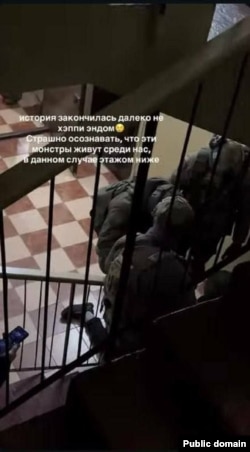
The killing in Irkutsk played out a little differently: The victim was living at the same shelter where Michurin's wife and 7-year-old son were staying and was seized at a bus stop on the street outside.
Michurin's "extremely frightened" wife had fled with their son to the shelter, Obereg, twice last year, in August and September, Irina, an employee, told RFE/RL. Irina's real name and some others in this report have been changed for safety reasons.
"And in January, she decided to break off relations with him completely and didn't contact him," Irina said. "So he started stalking [her]. He threatened her, us, and the child. Before that, he'd done terrible things to her -- literally cutting her skin, slashing her with a knife, burning her: a natural sadist."
Shelter staff and relatives of Michurin's wife, Yulia, had filed complaints against him and sought to alert the authorities that he was dangerous.
Yulia "was afraid to write, she was so intimidated and devastated by the police's attitude: They didn't respond to complaints or calls, and he threatened to harm her son if she filed a complaint," Irina said, adding: "Now she, poor thing, blames herself for the [victim's] death."
'He'd Strangled Her'
The victim, Alina, who grew up in an orphanage and was raising two daughters, had been living at the shelter while waiting for the state to provide her with an apartment.
"She was hardworking, bright, very kind," and "a perfectly capable, virtuous, responsible mother," Irina said. "And then she fell into the hands of this crazy man, who, for reasons incomprehensible to normal people, was walking free. We filed complaints against him dozens of times, but the police did nothing."
Alina's attacker took her to a nearby apartment he had rented, shelter employees said. When shelter staff showed up and asked him to open the door, he demanded they bring his wife and her son and also told them to get him alcohol and food.
"We called the police," Irina said. "They negotiated with him until 2 in the morning. They passed him vodka, food -- everything he asked for. For the first few hours, Alina kept answering from behind the door, 'Yes, yes, I'm alive, everything's fine.' Hours passed. Dozens of police officers and emergency services were all around.
"We watched, perplexed: When were they going to storm the place? He was getting drunker and more and more irrational. Finally, at 2:30 a.m., he opened the door himself, came out, and surrendered," she said. "We rushed inside, but Alina was no longer breathing. He'd strangled her."
In a statement on January 28, the regional branch of Russia's Investigative Committee said Michurin was being investigated on suspicion of murder and that it had asked a court to order him jailed pending further investigation and trial. It said the case was being handled by military prosecutors and a military court, indicating that Michurin was still serving.
A neighbor said Michurin had been "acting up" since he moved in, drunkenly picking fights with other residents and boasting that he could do as he pleases with impunity.
"'You can't do anything to me. I just came from the SVO. I could kill you and nothing would happen to me. If you lay a finger on me, you'll be charged with defamation,'" the neighbor quoted him as saying, using the SVO acronym for the "special military operation," which is what the Kremlin calls its war against Ukraine.
'A Serious Problem'
Shortly after he launched the full-scale invasion of Ukraine in February 2022, Putin signed legislation under which Russians can be imprisoned for "discrediting" the military, and his government state has used it widely as part of its effort to silence criticism of the war and quash dissent.

Observers say the legislation and the state's glorification -- at least on a formal level -- of those who fight in the war on Ukraine contributes to a sense among some veterans that they are above the law.
"I respect and honor the defenders of our homeland. But…a serious problem is brewing in our society," Aleksandr Sobolev, head of the Obereg shelter and the charitable fund that runs it, wrote in a post on the Russian social network VK on January 28.
"Psychopaths, rapists, and murderers, hiding behind their participation in the SVO, now regularly do terrible things, sensing their impunity," wrote Sobolev. He said that before Alina took refuge at the shelter, her husband had "beaten [her] every day and was certain that nothing would happen to him other than being sent back" to his unit.
"This is a shockingly wrong trend," he wrote. "Society should thank heroes, but it should not give impunity to criminals."
Sobolev wrote that Alina's husband had fled his unit in Rostov-on-Don, a city near the Ukrainian border and a major staging point for the invasion, but the Investigative Committee gave no details about Michurin, referring to him only as a "resident of the Irkutsk region."

