





Russia is making swift progress on a space-based Internet network that could end the battlefield advantage Ukraine enjoys through its use of Starlink. But the Russian satellite Internet is likely to have one key wartime vulnerability, experts say.
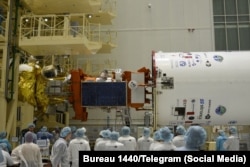
Rassvet (Dawn), a project of Russia's Bureau 1440 company, launched its first batch of 16 operational satellites into orbit in March. A second package was released in July and the company reportedly plans to have hundreds of satellites in orbit by next year.

Bureau 1440 has marketed its Starlink-type Internet system for civilian use, but Russian President Vladimir Putin explicitly discussed the project in the context of the war in Ukraine. During a June 12 meeting in the Kremlin, Putin told a group of soldiers that work is "proceeding at a good pace" on a Starlink equivalent that he hopes troops will “feel on the ground soon.”
China, the EU, and several other powers are also developing their own versions of Starlink.
Ian Muirhead, a space systems engineer and former British serviceman, told RFE/RL that the current rush to develop low Earth orbit satellite Internet is largely due to the fact that “a modern military cannot operate without relatively high data-capacity communications."
He says the Ukraine conflict has demonstrated that "the only real way you can assure [data-heavy communication] in conflict zones is with satellite constellations.”
Older space-based Internet systems used lone satellites tens of thousands of kilometers from earth, resulting in choppy, unreliable connections. In contrast, Starlink satellites orbit in "shells" at an altitude of 550 and 350 kilometers, allowing for vastly quicker data transfers but requiring whole constellations in orbit to ensure a user can access at least one satellite at any time from any location.
Muirhead says Russia’s low Earth orbit Internet will not be comparable to Starlink, which currently has more than 10,000 satellites swirling Earth and millions of paying customers. But he says, “the deployment of any standard of low Earth orbit network will be a huge increase in the communications available to [Russian] troops and will make a real difference to their command and control ability.”
But Muirhead points to one key security advantage Ukraine's Starlink access has over Russia's analogous system due to a component called ground stations.

Ground stations are generally an array of dishes connected physically to terrestrial Internet. The stations are the source of the Internet data which is sent up through passing satellites and back down to individual users.
Ground stations are large, immovable, and buzz with electromagnetic signals, making them difficult to conceal.
Starlink users in Ukraine are currently served by ground stations in Poland, Lithuania, and Turkey. All three are NATO countries, meaning Russia would risk triggering a US-backed military response if it were to destroy the stations used by Ukraine.

Kyiv has demonstrated its ability to strike targets throughout Russia in recent months using long-range drones. If Rassvet begins full operation, any ground stations on Russian territory are likely to become key targets for Kyiv.
"I'm sure Russia's priority targets are Starlink, but they can't destroy the Starlink ground stations, whereas Ukraine can attack. Even if [a Rassvet ground station] was in Siberia, there's nothing to stop Ukraine attacking that," Muirhead says.
Vadym Skibitskiy, the Deputy Chief of Ukraine's Defense Intelligence said in an interview published on August 10 that the dozens of satellites Rassvet currently has in orbit means Russian troops are already able to use the network "briefly when a satellite passes over our territory," adding that, "there is already a discussion about how to deal with this."

Victoria Samson, the director of Space Security and Stability at the Secure World Foundation told RFE/RL that Russia's limited launch capacity will be one of the chief obstacles to Rassvet achieving more extensive coverage.
The Russians "simply don't have the launch capacity," she said. "This does not mean that they can't get a satellite Internet constellation going but it probably won't be as fast or effective as Starlink (or the two versions that China is working on, known as Guowang and Qianfan)."

