




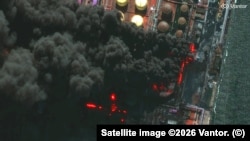
A major Russian oil export terminal was hit by Ukrainian drones for a third time in a week, officials said, the latest in a series of Ukrainian attacks that have severely restricted Russia's ability to take advantage of soaring global energy prices.
The Ust-Luga facility, on the southern shores of the Gulf of Finland near St. Petersburg, was damaged and set ablaze in the overnight attack on March 29, regional Governor Aleksandr Drozdenko said.
He did not identify the source of the drone; Russia's Defense Ministry said Ukraine had launched more than 345 drones overnight at Russian targets nationwide. Drozdenko said 31 drones were downed over the Leningrad region.
Ukraine's main security service, the SBU, claimed responsibility for the hit.
"All oil facilities are actually part of the Russian military-industrial complex and ensure the receipt of funds to the Russian budget that go to the war against Ukraine," Major General Yevhen Khmara, the head of the service, said in a statement. "Russia will pay a high price for its aggression."
It’s at least the third time that Ust-Luga has been hit in the past week; satellite imagery taken March 27 showed large plumes of smoke and flames billowing from the facility, which also handles coal, fertilizer, and iron ore exports.
Primorsk, another major export terminal on the northern shores of the gulf, was also hit a week ago.
It was not immediately clear where Ukraine was launching its drones from, though most analysts suspect the long-range drones were being fired from Ukrainian territory, which is approximately 935 kilometers from the Baltic Sea.
Estonia and Latvia last week reported that Ukrainian drones had crashed on their territory. And early on March 29, Finland's air force said its fighter jets had tracked what appeared to be a group of drones. One of them, which was identified as a Ukrainian AN196 drone, crashed near the southeastern Finnish town of Kouvola. No injuries or damage were reported.
Ukrainian President Volodymyr Zelenskyy, who is on a trip to the Middle East as part of an effort to market Kyiv's capabilities in anti-drone warfare, said on March 28 that about 60 percent of Ust-Luga's export capacity had been knocked out.
He also said unnamed "partners" had questioned Ukraine about the strikes, which have added to the squeeze of global oil supplies. He said Ukraine would stop targeting Russian facilities if Moscow stops targeting Ukraine's energy infrastructure, which it has been doing throughout the winter.
With access to the Baltic Sea, Primorsk and Ust-Luga are two of the largest terminals for the export of Russian oil to Western markets. Last week, Reuters reported the Ukrainian campaign may have taken more than 40 percent of Russia's overall export capacity off-line.
A major oil export pipeline, Druzhba, that crosses through Ukrainian territory, has also been offline for months now, after an unexplained explosion.
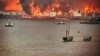
"This is the most serious threat to exports of Russian oil and oil products since the war began," energy analyst Boris Aronshtein said.
"The thoughtfulness, the scale and direction of the attacks, as well as the timing of their execution -- all of this together produced an effect that I personally cannot recall in the four-plus years of the war," he told Current Time on March 26.
Russia, meanwhile, kept its near nightly barrage of Ukrainian targets, firing more than 400 drones and missiles at sites across the country, Ukrainian officials said.
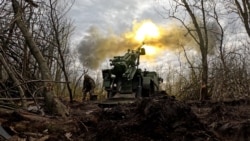

At least several people were wounded in the Kharkiv region as a result of the attack, local police officials, including three people whose car was hit by a drone.
In the Black Sea region of Odesa, drones struck an energy facility, causing power outages in several towns, according to emergency officials.