



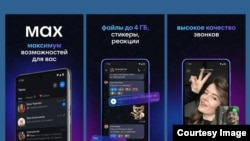
One St. Petersburg woman quit her job at a municipal agency to avoid installing the app. Siberian university students were told they couldn’t take final exams, or even threatened with expulsion, if they didn’t start using it. A man lied to his bosses about it and said he might have to resort to buying a second device -- a burner phone.
Six months ago, to great fanfare, Russian authorities began rolling out something they hoped would transform the digital lives of citizens: a national, state-backed messaging app that would help people do everything from complaining about trash pickup to registering for school classes and making dentist appointments.
Called Messenger Max, it’s a linchpin in a wider effort to build a “super-app” -- a one-stop-shopping tool, installed on every mobile phone, that ultimately will allow Russians to do myriad things under the watchful eye of state regulators and the Federal Security Service, known as the FSB.

Ads for Max are everywhere in Russia: billboards, pop-up windows on websites, TV commercials, shout-outs by government officials. Regulators have throttled more popular apps that are not under state control -– WhatsApp, Telegram -- to frustrate people and persuade them to switch.
So is it working? Are Russians switching?
In many cases, yes. But many are grumbling, and some are resisting.
“Max was the last straw,” said Oksana Petrova, a woman who quit her job in St. Petersburg after she was ordered to download Max.
When she asked why she had to, and voiced doubts about its security, she was lectured about how “all social media is under surveillance,” she said.
The Americans monitor WhatsApp, the French monitor Telegram, “but only the FSB monitors Max,” she quoted her boss as saying. If she didn’t install it, her boss told her, the FSB would take notice.
Petrova, like the other people RFE/RL’s North.Realities spoke to for this story, asked to use a pseudonym, to avoid arrest or prosecution.
One woman named Anastasia complained that her son was recently barred by his teacher from joining a school field trip to see a movie, because Anastasia did not confirm her permission -- using Max. The boy came home in tears.
The teacher “said ‘if you don’t like it, transfer to another school. I don’t use other messengers to communicate with parents; school order,’” Anastasia wrote in a comment to the social media app Threads -- a platform owned by Meta, the parent company of WhatsApp and Instagram.
Enter The Super-App
For years, authorities have struggled to find ways to control or monitor WhatsApp and Telegram, which was built by the Russian technology developer Pavel Durov.
Those efforts dovetailed with wider campaigns -- going back decades now -- to control how Russians use the Internet.
In addition to targeting Western Internet giants such as Facebook, Google, Apple, and Amazon, authorities have cultivated homegrown alternatives such as Yandex, VK, and Mail.ru and moved to control them outright.
Last year, VK, whose CEO is the son of the influential Kremlin adviser Sergei Kiriyenko, emerged as a leader in developing not only Messenger Max, but also an alternative to YouTube, the Google-owned video platform that is also hugely popular among Russians.

More than 15 years ago, the Digital Development Ministry rolled out an e-government service portal called Gosuslugi. It has simplified the lives of millions of Russians, streamlining many of the mundane tasks that Russian bureaucracies often made intolerable.
Since 2022, Gosuslugi has been moving to integrate more of its services into VK. National tech and media regulator Roskomnadzor used Gosuslugi to warn Russians about platforms like Instagram being blocked -- and encourage Russians to switch over to VK.
In June, the State Duma passed legislation authorizing the creation of Max. That same month, President Vladimir Putin publicly endorsed the app, announcing that all government services should be transferred to it.
Since then, there’s been a huge marketing campaign to get Russians to switch, a mix of threats or coercion.
“You have to acknowledge the resources being used to push this Max thing, by hook or by crook, including by Putin himself; that is, Putin himself has never promoted any other commercial organization -- except for Max,” Mikhail Klimarev, an activist and director of the Internet Protection Society, told Current Time. “I think that's reason enough to simply stay away from it, stay away from everything.”
In a public opinion poll conducted last month by the survey group Russian Field, 68 percent of Russians reported not using Max at all, while another 1 percent of respondents said they downloaded the app but did not use it. Those who do use it said it was mainly for chatting and messaging with friends and family, followed by official communications, including for schools.
School Daze
Last month, the Science and Higher Education Ministry sent a letter to all post-secondary institutions setting a series of deadlines for schools to register Max for official communication and to report how the app was being used.
At Kuban State University, students posted online photographs of a dean’s order mandating students download Max -- and the requirement that they write “explanatory statements” if they refuse.
Similar orders were reported at other universities. In Voronezh, students were ordered to install the app or they would not be allowed to take final exams. In Yekaterinburg, students were threatened with expulsion.
At Kazan State University, the chemistry department told students that they would be physically blocked from even entering the building unless they obtained an electronic entrance pass using Max.
OVD-Info, an independent watchdog group that monitors police repression, said it had received more than two dozen complaints as of the end of November from students and teachers complaining about being forced to use the app.
But some students said they were indifferent.
"I don’t have strong feelings about it. I have it installed. I've registered with it, but I don't use it," said Aleksei, a student at Pskov State University. "Other people are the same.”
He said Max was more reliable, compared with other messaging apps too.
Viktoria Romanova, an activist with OVD-Info, said university administrators have skirted existing laws by using vague language to push students to use Max.
"Direct and overt threats like expulsion or firing, or not allowing students to take exams, are less common," she told RFE/RL. "Typically, they use vague statements about potential problems, threats of disciplinary action, and the creation of situations in which it's simply impossible not to install Max.”
This past week, regulators floated the idea of requiring banks and their clients to use only Max -- rather than SMS messages -- for personal banking operations such as dual-factor authentication and transaction notifications.
Also this week, a number of Russians have complained about problems with Gosuslugi, the e-government portal. The news site Vyorstka reported that an electronic signature, known as GosKlyuch, which is used to sign and exchange legal documents within Gosuslugi, would now require using Max.
Aleksei, a shift supervisor at a municipal heating plant in St. Petersburg, said he lied to his boss that he had downloaded the app. Most of his colleagues did the same.
"People who are afraid of having their personal data being disclosed, I think, will buy devices and use them for accessing WhatsApp, to create new e-mail accounts, so they won't have to use Gosuslugi, Sberbank, or anything," he said. "That’s how it is. It’s disgusting."

