


Accessibility links

Breaking News

How Russia Targets Trains In Effort ‘To Paralyze’ Ukraine’s Logistics

A firefighter by a passenger train hit by a Russian drone strike in Shostka, October 4, 2025, in a photo provided by Ukrainian police

Summary

  • Russia has intensified attacks on Ukraine's rail infrastructure, targeting trains, stations, and substations.
  • Ukraine's railways remain critical for military logistics, economic exports, and humanitarian aid despite disruptions.
  • Over 220 strikes on railway infrastructure have been recorded in the past two months, causing delays and rerouting efforts.

Glass crunched underfoot as the RFE/RL camera operator passed through the charred carriage. At the end of the corridor, twisted wreckage smoldered.

The Russian attack on a passenger train at Shostka, in northeastern Ukraine, on October 4, was the latest in a series of strikes at trains and rail infrastructure which have caused deaths, damage, and disruption.

"Russia's desire is obvious: to paralyze Ukrainian logistics, because a significant portion of cargo, including military cargo, uses rail transport," former Ukrainian Infrastructure Minister Volodymyr Omelyan said in an interview with RFE/RL’s Ukrainian Service.

“We have seen strikes on railway depots, and rolling stock has also been damaged. Railway substations are the target of constant attacks,” he added.

Russia’s New Target: Ukrainian Trains
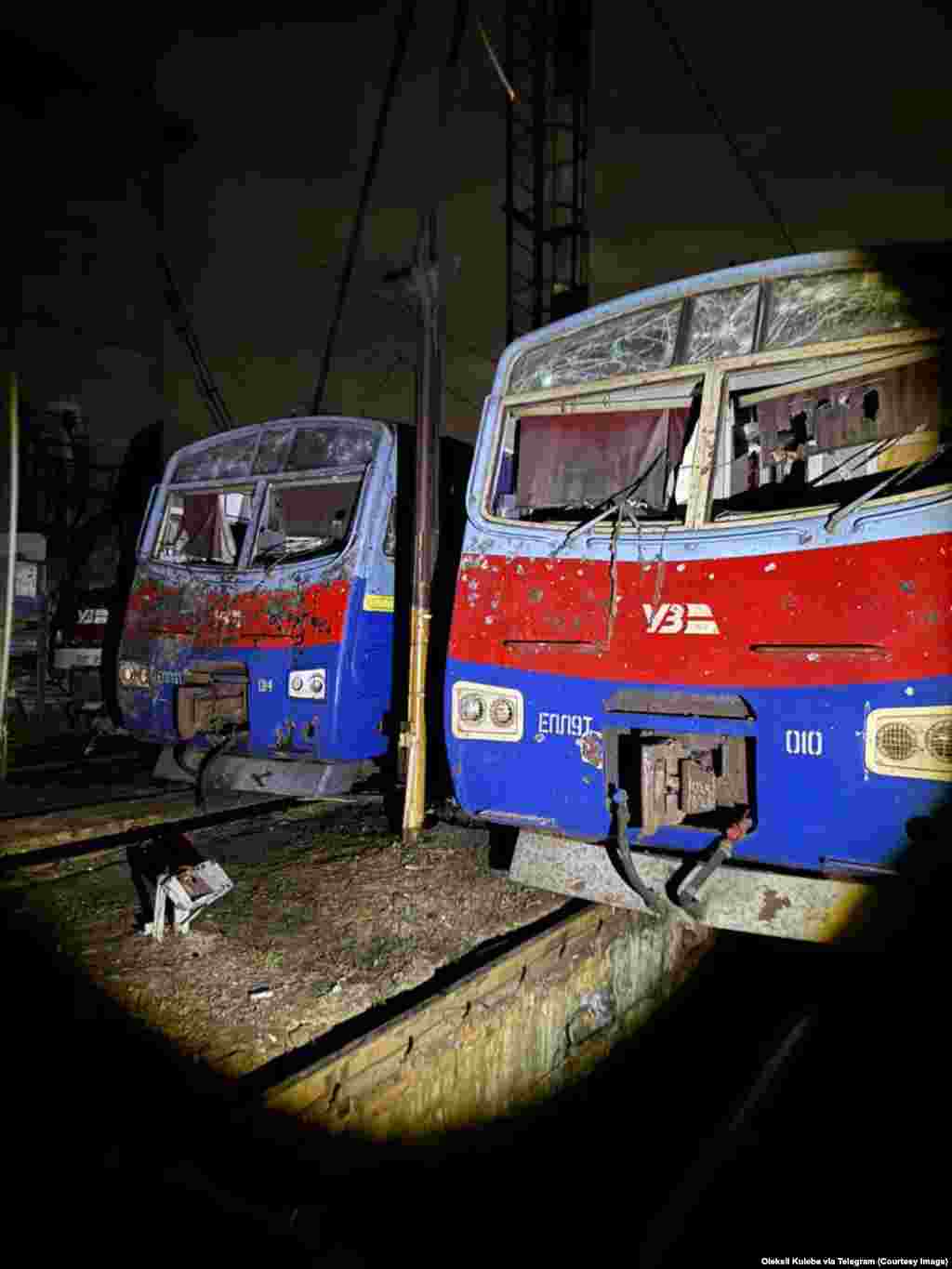
Locomotives in Poltava, central Ukraine, pictured on October 7 after an overnight Russian strike on a railway depot.<br><br>The Russian attack is the latest in a series targeting Ukraine’s railway infrastructure.
1/7 Locomotives in Poltava, central Ukraine, pictured on October 7 after an overnight Russian strike on a railway depot.

The Russian attack is the latest in a series targeting Ukraine’s railway infrastructure.
A series of Russian strikes targeting trains and railway infrastructure have raised fears the Kremlin is probing Ukraine's response to supply disruptions amid Russia's ongoing war on Ukraine.
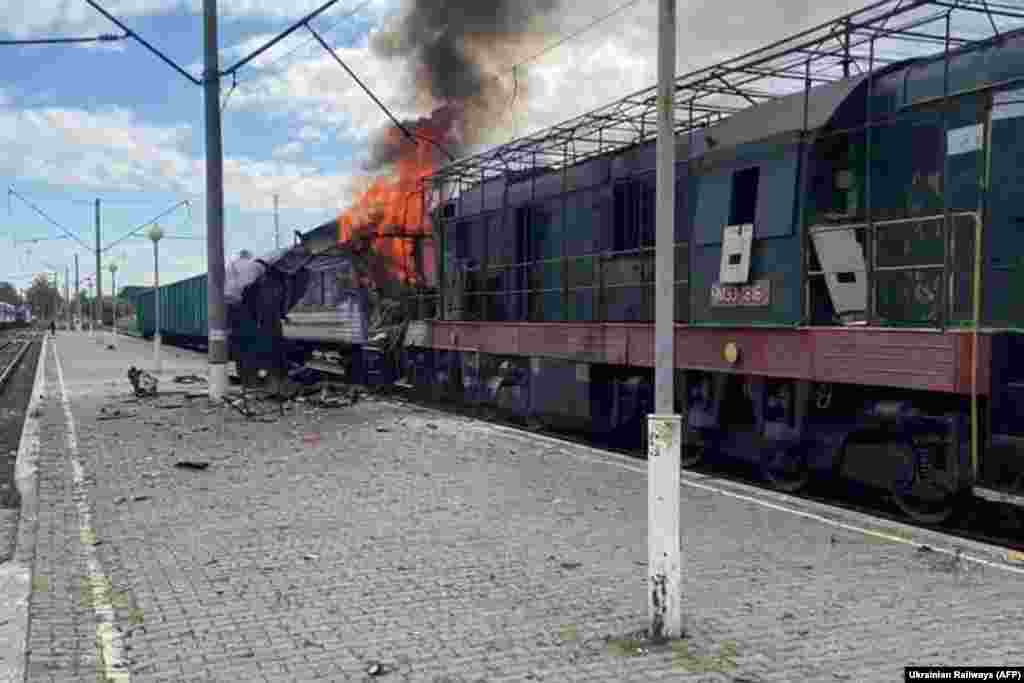
A train fitted with anti-drone netting burns after being struck by drones at the station in Shostka, northeastern Ukraine, on October 4.<br><br>Several people including children were reported injured in the strikes and one person was killed. The second of two drones reportedly struck while rescuers were responding to the first attack.
2/7 A train fitted with anti-drone netting burns after being struck by drones at the station in Shostka, northeastern Ukraine, on October 4.

Several people including children were reported injured in the strikes and one person was killed. The second of two drones reportedly struck while rescuers were responding to the first attack.
A series of Russian strikes targeting trains and railway infrastructure have raised fears the Kremlin is probing Ukraine's response to supply disruptions amid Russia's ongoing war on Ukraine.
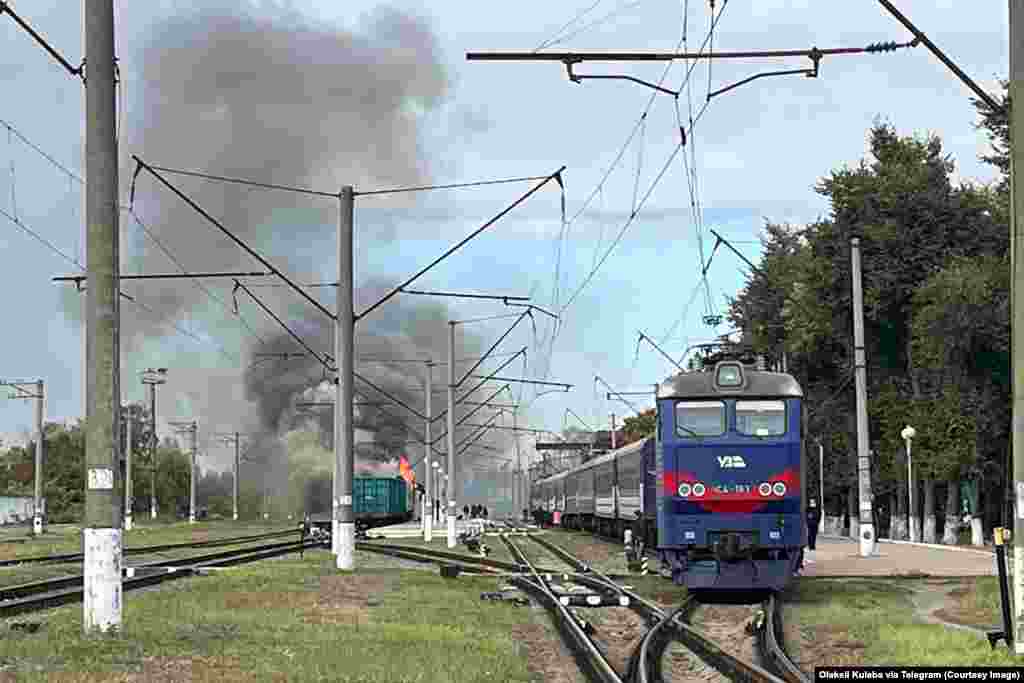
The scene at Shostka on October 4.<br><br>Ukraine’s Deputy Prime Minister Oleksiy Kuleba <a href="https://www.radiosvoboda.org/a/news-kuleba-rosiiski-udary-zaliznytsia/33552183.html" class="wsw__a" dir="ltr">said on October 7</a> that the Kremlin is seeking to “paralyze the work of Ukrainian Railways, which remains a critical artery of the country.”<br>
3/7 The scene at Shostka on October 4.

Ukraine’s Deputy Prime Minister Oleksiy Kuleba said on October 7 that the Kremlin is seeking to “paralyze the work of Ukrainian Railways, which remains a critical artery of the country.”
A series of Russian strikes targeting trains and railway infrastructure have raised fears the Kremlin is probing Ukraine's response to supply disruptions amid Russia's ongoing war on Ukraine.
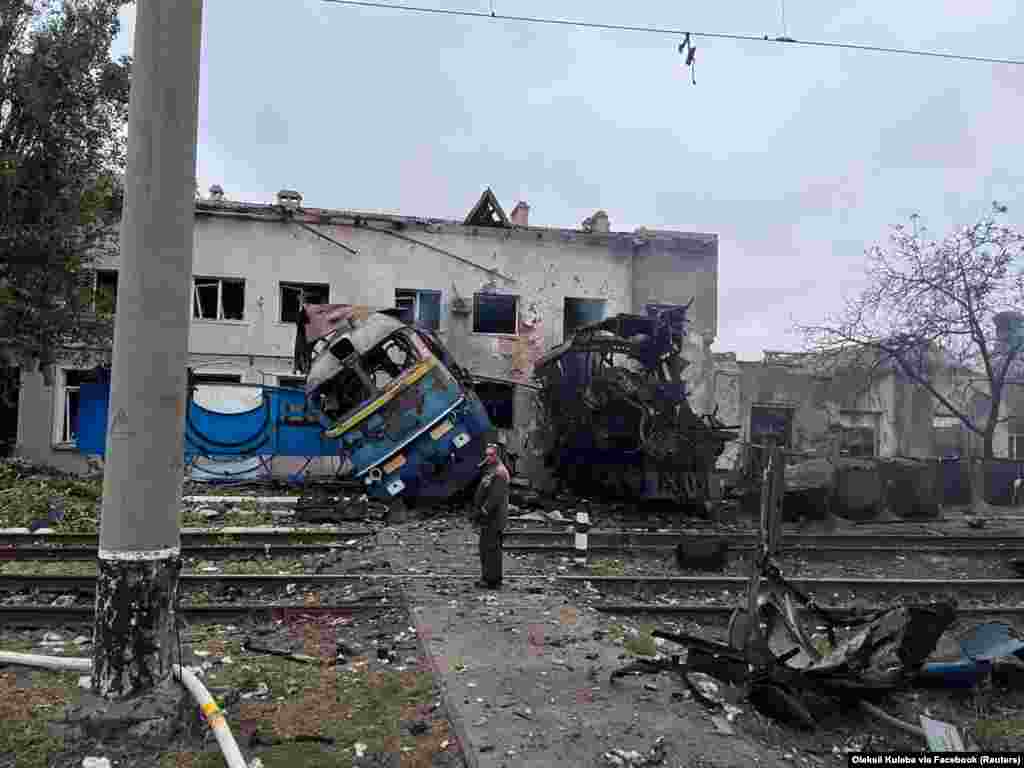
A railway worker next to a destroyed train at a depot in Odesa, southern Ukraine, on October 2 after it was hit by an overnight strike.<br><br>Attacks on Ukraine’s rail infrastructure come amid a massive Ukrainian drone campaign <a href="https://www.rferl.org/a/ukraine-russia-war-drone-strikes-oil-refinery/33539528.html" class="wsw__a" dir="ltr">targeting Russia’s fuel production</a> facilities.
4/7 A railway worker next to a destroyed train at a depot in Odesa, southern Ukraine, on October 2 after it was hit by an overnight strike.

Attacks on Ukraine’s rail infrastructure come amid a massive Ukrainian drone campaign targeting Russia’s fuel production facilities.
A series of Russian strikes targeting trains and railway infrastructure have raised fears the Kremlin is probing Ukraine's response to supply disruptions amid Russia's ongoing war on Ukraine.
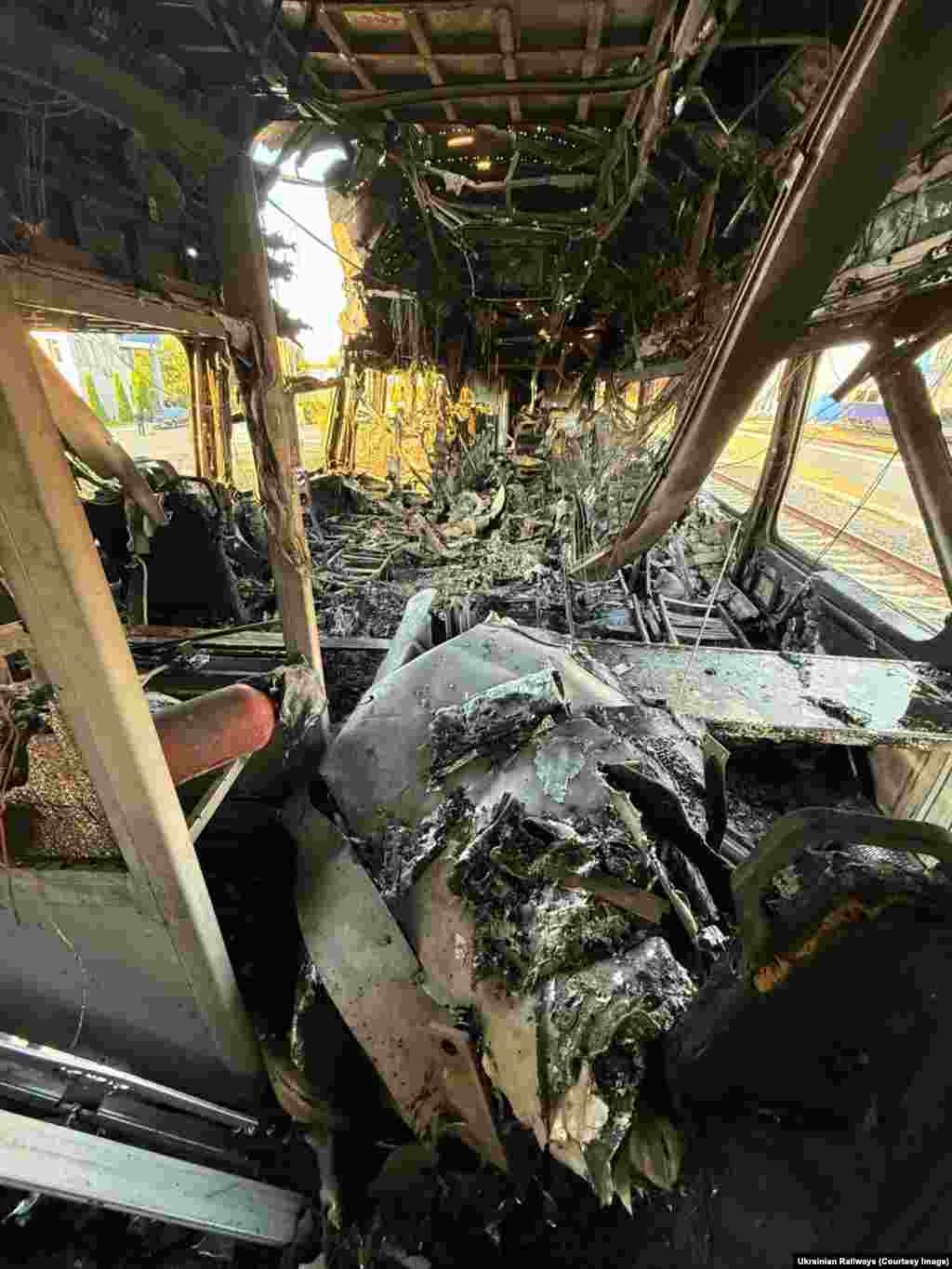
The interior of a high speed passenger train in Kyiv after it was hit with a Shahed drone overnight on August 27-28.<br><br>With Ukraine’s airspace closed to passenger flights and many roads in eastern Ukraine in poor condition, trains are in some cases the only feasible way for locals, and military equipment, to be transported over long distances.
5/7 The interior of a high speed passenger train in Kyiv after it was hit with a Shahed drone overnight on August 27-28.

With Ukraine’s airspace closed to passenger flights and many roads in eastern Ukraine in poor condition, trains are in some cases the only feasible way for locals, and military equipment, to be transported over long distances.
A series of Russian strikes targeting trains and railway infrastructure have raised fears the Kremlin is probing Ukraine's response to supply disruptions amid Russia's ongoing war on Ukraine.
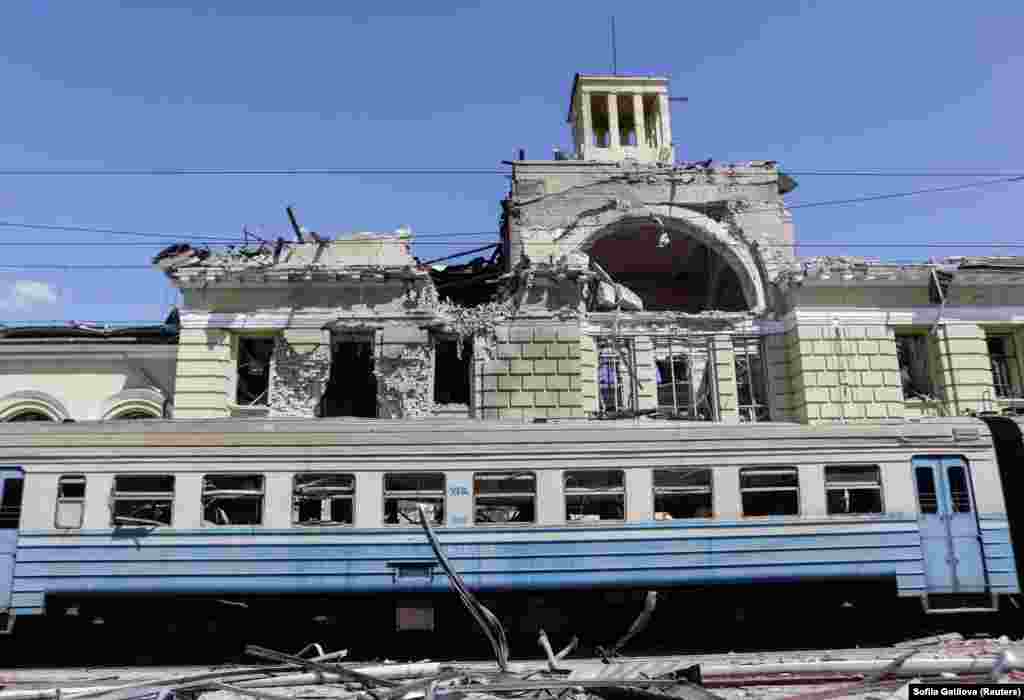
A carriage on the damaged train station of Lozova, eastern Ukraine, photographed on August 5 after a massive Russian attack on the railway hub.<br><br>Analysts <a href="https://www.dw.com/ru/ataki-rf-na-zeleznuu-dorogu-otvet-na-udary-ukrainy-po-npz/a-74066456" target="_self" class="wsw__a" dir="ltr">have speculated</a> the recent targeting of Ukraine’s rail infrastructure in eastern Ukraine may be a way to probe the railways’ responsiveness to disruption to see how long supply lines could be tied up in the event of a major Russian ground assault.
6/7 A carriage on the damaged train station of Lozova, eastern Ukraine, photographed on August 5 after a massive Russian attack on the railway hub.

Analysts have speculated the recent targeting of Ukraine’s rail infrastructure in eastern Ukraine may be a way to probe the railways’ responsiveness to disruption to see how long supply lines could be tied up in the event of a major Russian ground assault.
A series of Russian strikes targeting trains and railway infrastructure have raised fears the Kremlin is probing Ukraine's response to supply disruptions amid Russia's ongoing war on Ukraine.
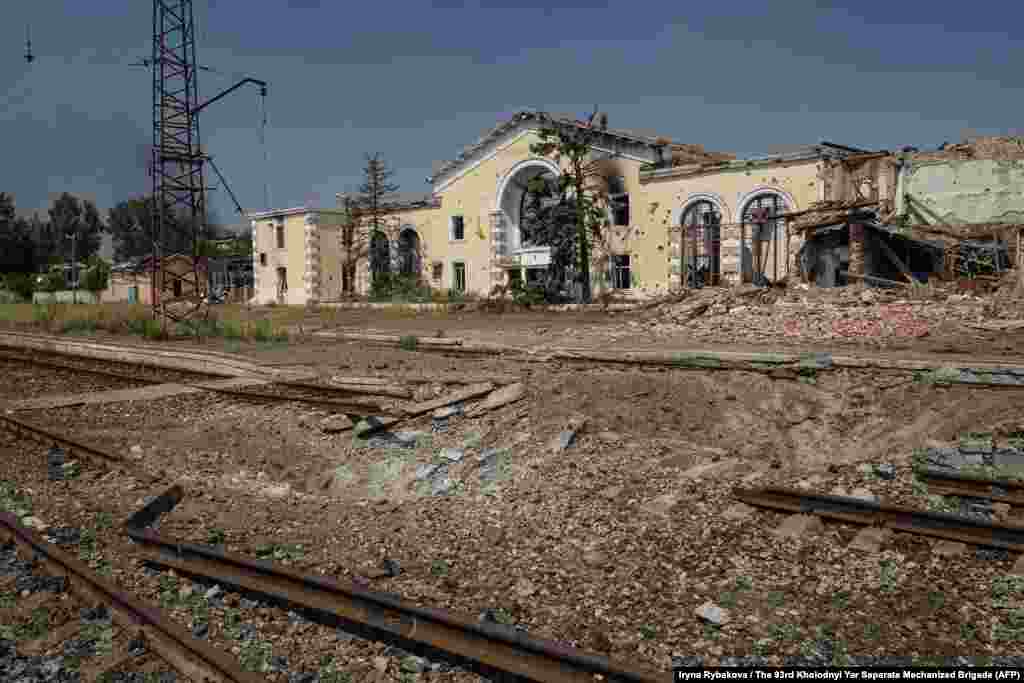
A destroyed railway station in the frontline town of Kostyantynivka in eastern Ukraine, photographed on July 30.<br><br>On October 5, Ukraine's Prime Minister Yulia Svyrydenko called for increased air defences to be provided to Ukraine in response to the attacks on its railways, a tactic <a href="https://x.com/Svyrydenko_Y/status/1974543956189831309" target="_self" class="wsw__a" dir="ltr">she called</a> a "doctrine of cruelty."<br>
7/7 A destroyed railway station in the frontline town of Kostyantynivka in eastern Ukraine, photographed on July 30.

On October 5, Ukraine's Prime Minister Yulia Svyrydenko called for increased air defences to be provided to Ukraine in response to the attacks on its railways, a tactic she called a "doctrine of cruelty."
A series of Russian strikes targeting trains and railway infrastructure have raised fears the Kremlin is probing Ukraine's response to supply disruptions amid Russia's ongoing war on Ukraine.
Previous slide
Next slide

Ukraine’s rail network, and keeping it running, have been a major source of national pride, economic necessity, humanitarian transport, and a critical lifeline in a war effort that has lasted almost four years.

Despite daily air attacks around the country by Russian drones and missiles, trains ferrying military equipment and troops, humanitarian missions to get food to war-torn regions, and cargo cars filled with grain and other exports to keep money flowing into Kyiv’s coffers have managed to run continuously.

An estimated 60-65 percent of the country’s economic output still moves via rail despite the perils brought about by the war. Even world leaders have taken to Ukrainian trains to meet officials in an area where air travel is impossible.

The strategic importance hasn’t been lost on Moscow’s military leadership.

A Systematic Campaign

Early on in the war, Ukraine’s railways were largely left alone. Analysts say Russia likely thought the war would be quick so there was no need to unnecessarily damage key infrastructure.

Russia did target Ukrainian railways at times, as witnessed by a deadly strike at Kramatorsk station in April 2022 that sparked global condemnation.

But this year, Ukrainian officials say it has become a systematic campaign.

Hours after the Shostka attack, Ukrainian Prime Minister Yulia Svyrydenko wrote on social media that “Russians have entered a new stage of barbarism” with repeated attacks since the summer.

“Over the past two months alone, 220 Russian strikes on railway infrastructure — including trains, stations, and electricity substations — have been recorded,” she wrote.

Railway hubs have become a particular target.

"There is a greater concentration of rolling stock at hub stations, and logistics are more complicated there - so hitting hub stations looks more attractive to the Russians,” said Omelyan.

The exact extent of the disruption is unclear. Svyrydenko said Ukraine’s state-owned rail company was adjusting routes in frontline regions and using replacement buses on others.

In fact, it has been doing so for some time.

'A Typical Night'

On September 17, for example, the Visit Ukraine tourism website noted “night shelling caused damage to the railway” causing changes on six major routes serving regional centers including Dnipro and Kherson.

That day, Ukrainian railways chief Oleksandr Pertsovsky noted on Facebook “a typical day – or rather night – for Ukrainian railways. The Dnipro line of the railway is hit and de-energized by a Russian drone attack.”

"Reserve locomotives are on standby, locomotive crews are leaving, they will help minimize delays and traditionally – get everyone to their destination!" Pertsovskyi added.

Nearly half of Ukraine’s network is electrified. But power outages make it impossible for electric locomotives to operate, and Ukraine has a limited and ageing stock of diesel-powered train engines.

Recognizing the importance to act quickly, Ukraine’s Budget Committee in August approved an expansion of a reserve fund that Pertsovskyi said allows the government to “swiftly fund critical repairs and make quick allocations to support Railways' operational needs.”

Russia’s attacks strike military and economic blows.

Military equipment is imported into Ukraine and transported within it by rail. This also applies to military vehicles. In parts of eastern Ukraine, where fighting is most intense, the roads are in such poor condition that rail connections are even more important to keep things moving.

The railways are used to transport metals and iron ore to the western border and to ports in the south. Freight trains also transport grain. All of these are strategic products, the export of which helps to sustain Ukraine’s war effort.

The campaign of strikes also make rail travel a risky undertaking for both ordinary Ukrainians and visiting Western politicians.

"This is terrorizing people. It causes constant disruptions to passenger traffic. And in addition to the attacks on cities, all this adds even more instability,” said Serhiy Vovk, head of the Center for Transport Strategies, a Kyiv-based consultancy.

“When a train is knocked off its schedule due to damage, it has a domino effect on other train routes, because the schedule is designed in such a way that trains do not stand idle for long,” he told RFE/RL.

On October 8, the impact of the relentless campaign continued.

Ukrainian railways reported “enemy attacks” had led to delays, cancellations, and route changes of numerous trains. The previous day, the regional military administration in Poltava said direct hits and falling debris had caused damage and fires on buildings and rolling stock.

  • 16x9 Image

    Rostyslav Khotin

    Rostyslav Khotin is a senior editor with RFE/RL's Ukrainian Service. He has previously worked as a correspondent for Reuters in Kyiv, at the BBC World Service in London, and as a correspondent for the "1+1" TV channel and the UNIAN agency in Brussels.

  • 16x9 Image

    RFE/RL's Ukrainian Service

    RFE/RL's Ukrainian Service has seen its audience grow significantly since Russia's full-scale invasion in February 2022 and is among the most cited media outlets in the country. Its bold, in-depth reporting from the front lines has won many accolades and awards. Its comprehensive coverage also includes award-winning reporting by the Donbas.Realities and Crimea.Realities projects and the Schemes investigative unit.

  • 16x9 Image

    Ray Furlong

    Ray Furlong is a Senior International Correspondent for RFE/RL. He has reported for RFE/RL from the Balkans, Kazakhstan, Georgia, and elsewhere since joining the company in 2014. He previously worked for 17 years for the BBC as a foreign correspondent in Prague and Berlin, and as a roving international reporter across Europe and the former Soviet Union.

This item is part of
XS
SM
MD
LG