

Accessibility links

Breaking News

Russia Slams EU Resolution Stating Nazi-Soviet Pact 'Paved Way' For WWII

German Foreign Minister Joachim Von Ribbentrop (left), Soviet leader Josef Stalin, and Soviet Foreign Minister Vyacheslav Molotov (right) meet at the Kremlin on August 23, 1939, to sign the nonaggression pact.
1/16 German Foreign Minister Joachim Von Ribbentrop (left), Soviet leader Josef Stalin, and Soviet Foreign Minister Vyacheslav Molotov (right) meet at the Kremlin on August 23, 1939, to sign the nonaggression pact.
On August 23, 1939, the Soviet Union and Nazi Germany signed a nonaggression treaty in Moscow, paving the way for the Nazi and Soviet invasions of Poland the following month and the beginning of World War II. Known colloquially as the Molotov-Ribbentrop Pact, after Soviet Foreign Minister Vyacheslav Molotov and German Foreign Minister Joachim von Ribbentrop, the agreement gave Adolf Hitler a free hand to attack Poland without fear of Soviet intervention. At the same time, Hitler and Josef Stalin established a secret protocol dividing Central and Eastern Europe into "spheres of influence."
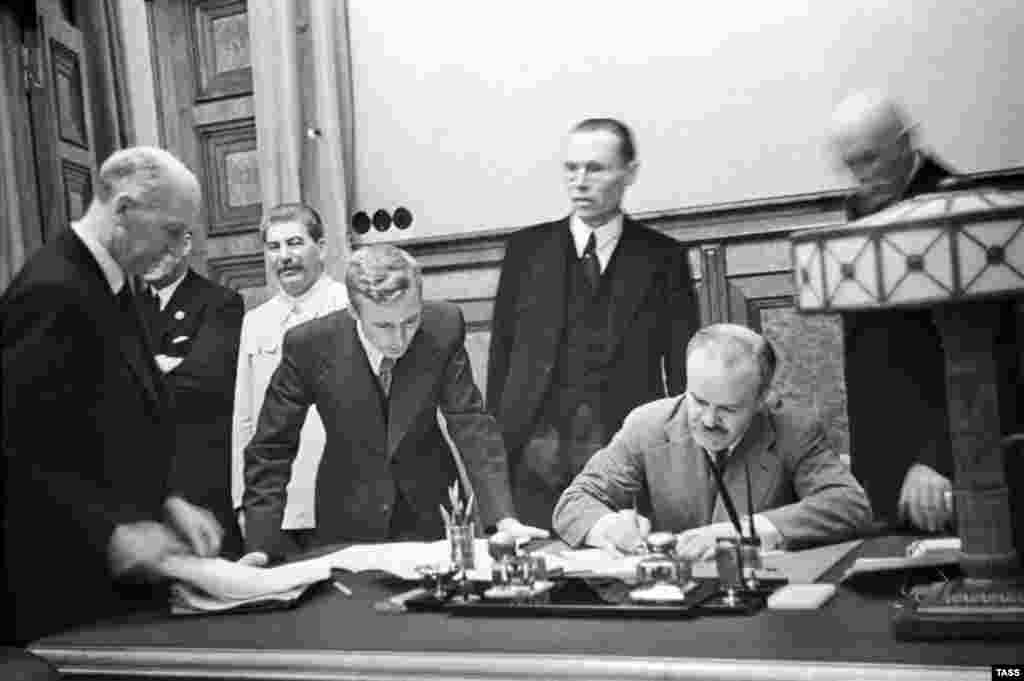
Molotov signs the treaty. For the Soviet Union, the pact bought time to rebuild its military before what appeared to be an inevitable conflict.
2/16 Molotov signs the treaty. For the Soviet Union, the pact bought time to rebuild its military before what appeared to be an inevitable conflict.
On August 23, 1939, the Soviet Union and Nazi Germany signed a nonaggression treaty in Moscow, paving the way for the Nazi and Soviet invasions of Poland the following month and the beginning of World War II. Known colloquially as the Molotov-Ribbentrop Pact, after Soviet Foreign Minister Vyacheslav Molotov and German Foreign Minister Joachim von Ribbentrop, the agreement gave Adolf Hitler a free hand to attack Poland without fear of Soviet intervention. At the same time, Hitler and Josef Stalin established a secret protocol dividing Central and Eastern Europe into "spheres of influence."
Von Ribbentrop shakes hands with Stalin after signing the Treaty of Friendship, Cooperation, and Demarcation, the continuation of the nonaggression pact.
3/16 Von Ribbentrop shakes hands with Stalin after signing the Treaty of Friendship, Cooperation, and Demarcation, the continuation of the nonaggression pact.
On August 23, 1939, the Soviet Union and Nazi Germany signed a nonaggression treaty in Moscow, paving the way for the Nazi and Soviet invasions of Poland the following month and the beginning of World War II. Known colloquially as the Molotov-Ribbentrop Pact, after Soviet Foreign Minister Vyacheslav Molotov and German Foreign Minister Joachim von Ribbentrop, the agreement gave Adolf Hitler a free hand to attack Poland without fear of Soviet intervention. At the same time, Hitler and Josef Stalin established a secret protocol dividing Central and Eastern Europe into "spheres of influence."
The final page, in German, of the Additional Secret Protocol, which divided Central and Eastern Europe into "spheres of influence."
4/16 The final page, in German, of the Additional Secret Protocol, which divided Central and Eastern Europe into "spheres of influence."
On August 23, 1939, the Soviet Union and Nazi Germany signed a nonaggression treaty in Moscow, paving the way for the Nazi and Soviet invasions of Poland the following month and the beginning of World War II. Known colloquially as the Molotov-Ribbentrop Pact, after Soviet Foreign Minister Vyacheslav Molotov and German Foreign Minister Joachim von Ribbentrop, the agreement gave Adolf Hitler a free hand to attack Poland without fear of Soviet intervention. At the same time, Hitler and Josef Stalin established a secret protocol dividing Central and Eastern Europe into "spheres of influence."
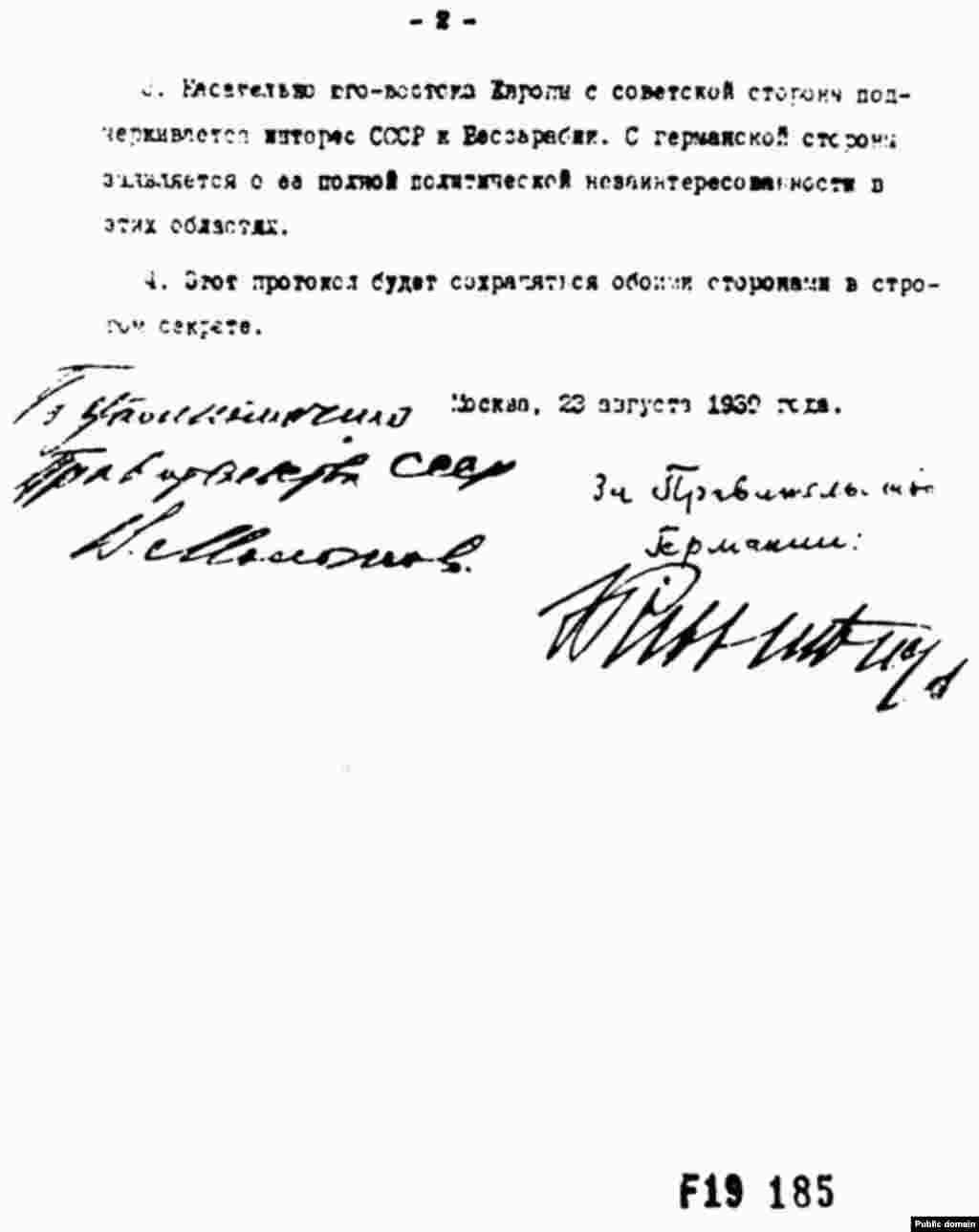
The same document in Russian
5/16 The same document in Russian
On August 23, 1939, the Soviet Union and Nazi Germany signed a nonaggression treaty in Moscow, paving the way for the Nazi and Soviet invasions of Poland the following month and the beginning of World War II. Known colloquially as the Molotov-Ribbentrop Pact, after Soviet Foreign Minister Vyacheslav Molotov and German Foreign Minister Joachim von Ribbentrop, the agreement gave Adolf Hitler a free hand to attack Poland without fear of Soviet intervention. At the same time, Hitler and Josef Stalin established a secret protocol dividing Central and Eastern Europe into "spheres of influence."
A map published by "Izvestiya" on September 18, 1939, one day after the Soviet invasion of Poland, shows the demarcation line determined by the Molotov-Ribbentrop Pact.
6/16 A map published by "Izvestiya" on September 18, 1939, one day after the Soviet invasion of Poland, shows the demarcation line determined by the Molotov-Ribbentrop Pact.
On August 23, 1939, the Soviet Union and Nazi Germany signed a nonaggression treaty in Moscow, paving the way for the Nazi and Soviet invasions of Poland the following month and the beginning of World War II. Known colloquially as the Molotov-Ribbentrop Pact, after Soviet Foreign Minister Vyacheslav Molotov and German Foreign Minister Joachim von Ribbentrop, the agreement gave Adolf Hitler a free hand to attack Poland without fear of Soviet intervention. At the same time, Hitler and Josef Stalin established a secret protocol dividing Central and Eastern Europe into "spheres of influence."
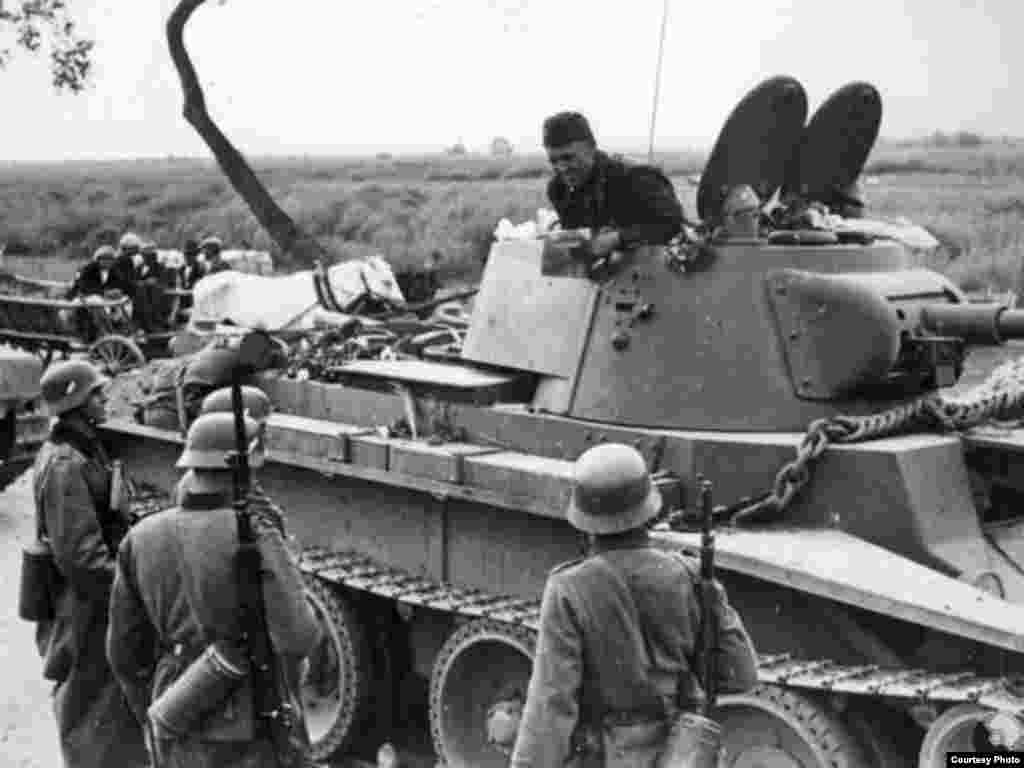
German and Soviet troops meet at the demarcation line, or the so-called "Border of Peace," in September 1939.
7/16 German and Soviet troops meet at the demarcation line, or the so-called "Border of Peace," in September 1939.
On August 23, 1939, the Soviet Union and Nazi Germany signed a nonaggression treaty in Moscow, paving the way for the Nazi and Soviet invasions of Poland the following month and the beginning of World War II. Known colloquially as the Molotov-Ribbentrop Pact, after Soviet Foreign Minister Vyacheslav Molotov and German Foreign Minister Joachim von Ribbentrop, the agreement gave Adolf Hitler a free hand to attack Poland without fear of Soviet intervention. At the same time, Hitler and Josef Stalin established a secret protocol dividing Central and Eastern Europe into "spheres of influence."
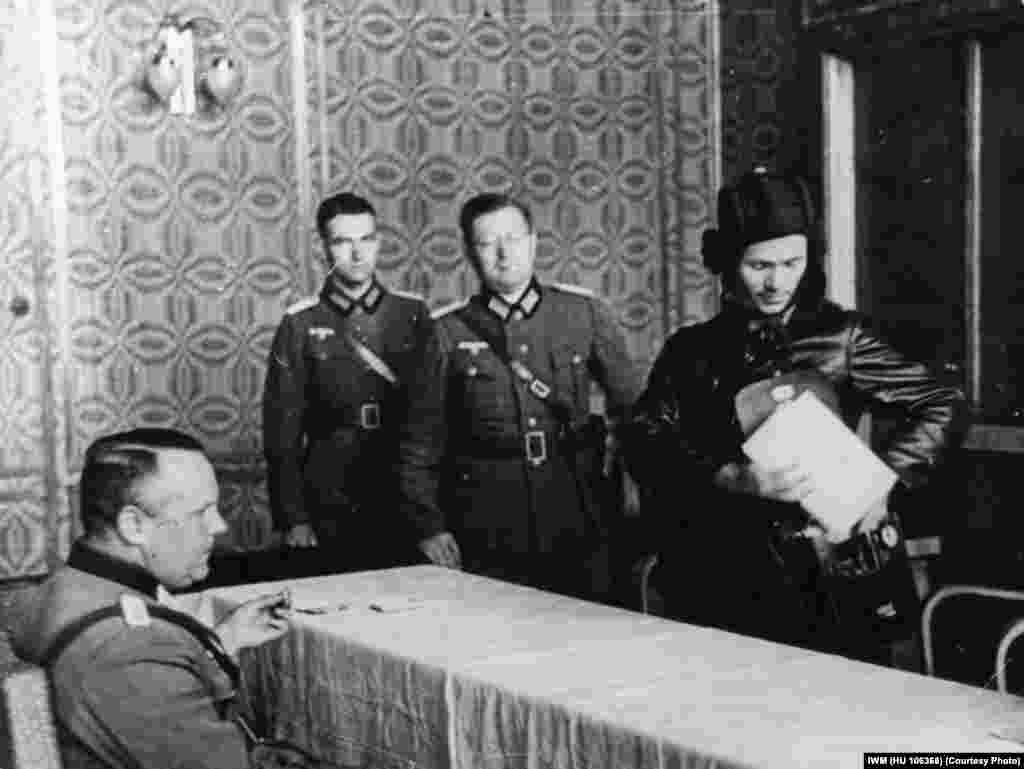
Soviet Commissar Vladimir Borovitsky meets with German officers to discuss the partition of Poland between the two armies at the captured town of Brest-Litovsk (present-day Brest, Belarus).
8/16 Soviet Commissar Vladimir Borovitsky meets with German officers to discuss the partition of Poland between the two armies at the captured town of Brest-Litovsk (present-day Brest, Belarus).
On August 23, 1939, the Soviet Union and Nazi Germany signed a nonaggression treaty in Moscow, paving the way for the Nazi and Soviet invasions of Poland the following month and the beginning of World War II. Known colloquially as the Molotov-Ribbentrop Pact, after Soviet Foreign Minister Vyacheslav Molotov and German Foreign Minister Joachim von Ribbentrop, the agreement gave Adolf Hitler a free hand to attack Poland without fear of Soviet intervention. At the same time, Hitler and Josef Stalin established a secret protocol dividing Central and Eastern Europe into "spheres of influence."
German and Soviet soldiers meet in Brest on September 22, 1939.
9/16 German and Soviet soldiers meet in Brest on September 22, 1939.
On August 23, 1939, the Soviet Union and Nazi Germany signed a nonaggression treaty in Moscow, paving the way for the Nazi and Soviet invasions of Poland the following month and the beginning of World War II. Known colloquially as the Molotov-Ribbentrop Pact, after Soviet Foreign Minister Vyacheslav Molotov and German Foreign Minister Joachim von Ribbentrop, the agreement gave Adolf Hitler a free hand to attack Poland without fear of Soviet intervention. At the same time, Hitler and Josef Stalin established a secret protocol dividing Central and Eastern Europe into "spheres of influence."
Soviet and German troops in the captured town of Brest, where they staged a joint victory parade on September 22, 1939
10/16 Soviet and German troops in the captured town of Brest, where they staged a joint victory parade on September 22, 1939
On August 23, 1939, the Soviet Union and Nazi Germany signed a nonaggression treaty in Moscow, paving the way for the Nazi and Soviet invasions of Poland the following month and the beginning of World War II. Known colloquially as the Molotov-Ribbentrop Pact, after Soviet Foreign Minister Vyacheslav Molotov and German Foreign Minister Joachim von Ribbentrop, the agreement gave Adolf Hitler a free hand to attack Poland without fear of Soviet intervention. At the same time, Hitler and Josef Stalin established a secret protocol dividing Central and Eastern Europe into "spheres of influence."
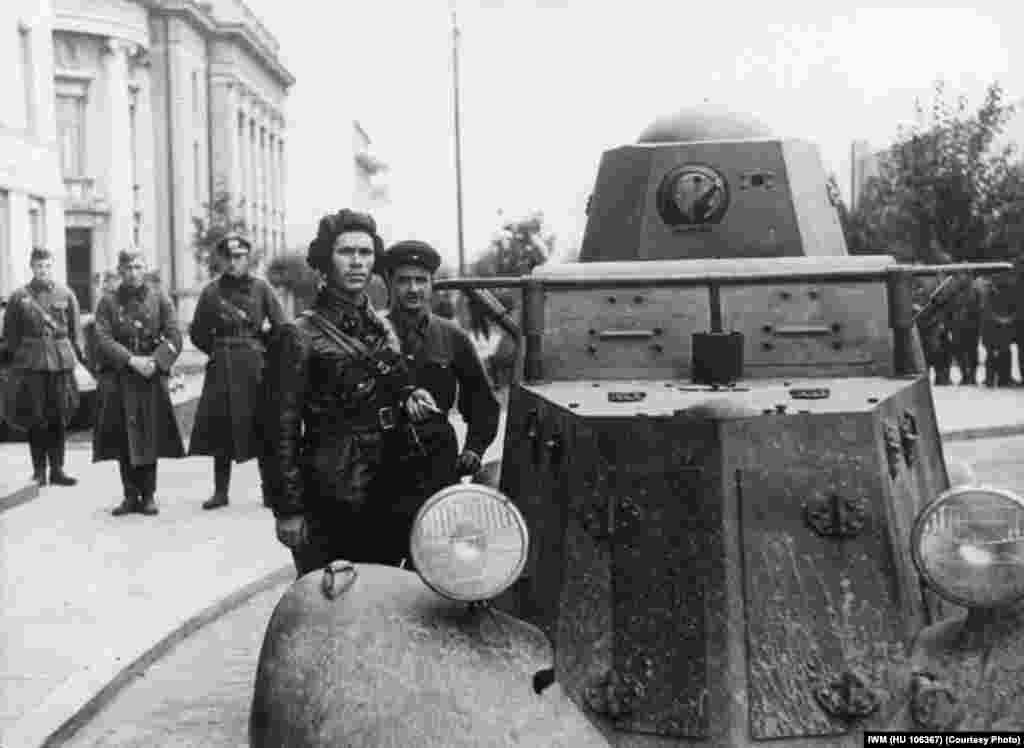
Soviet Commissar Borovitsky and one of his soldiers stand beside an armored car in Brest.
11/16 Soviet Commissar Borovitsky and one of his soldiers stand beside an armored car in Brest.
On August 23, 1939, the Soviet Union and Nazi Germany signed a nonaggression treaty in Moscow, paving the way for the Nazi and Soviet invasions of Poland the following month and the beginning of World War II. Known colloquially as the Molotov-Ribbentrop Pact, after Soviet Foreign Minister Vyacheslav Molotov and German Foreign Minister Joachim von Ribbentrop, the agreement gave Adolf Hitler a free hand to attack Poland without fear of Soviet intervention. At the same time, Hitler and Josef Stalin established a secret protocol dividing Central and Eastern Europe into "spheres of influence."
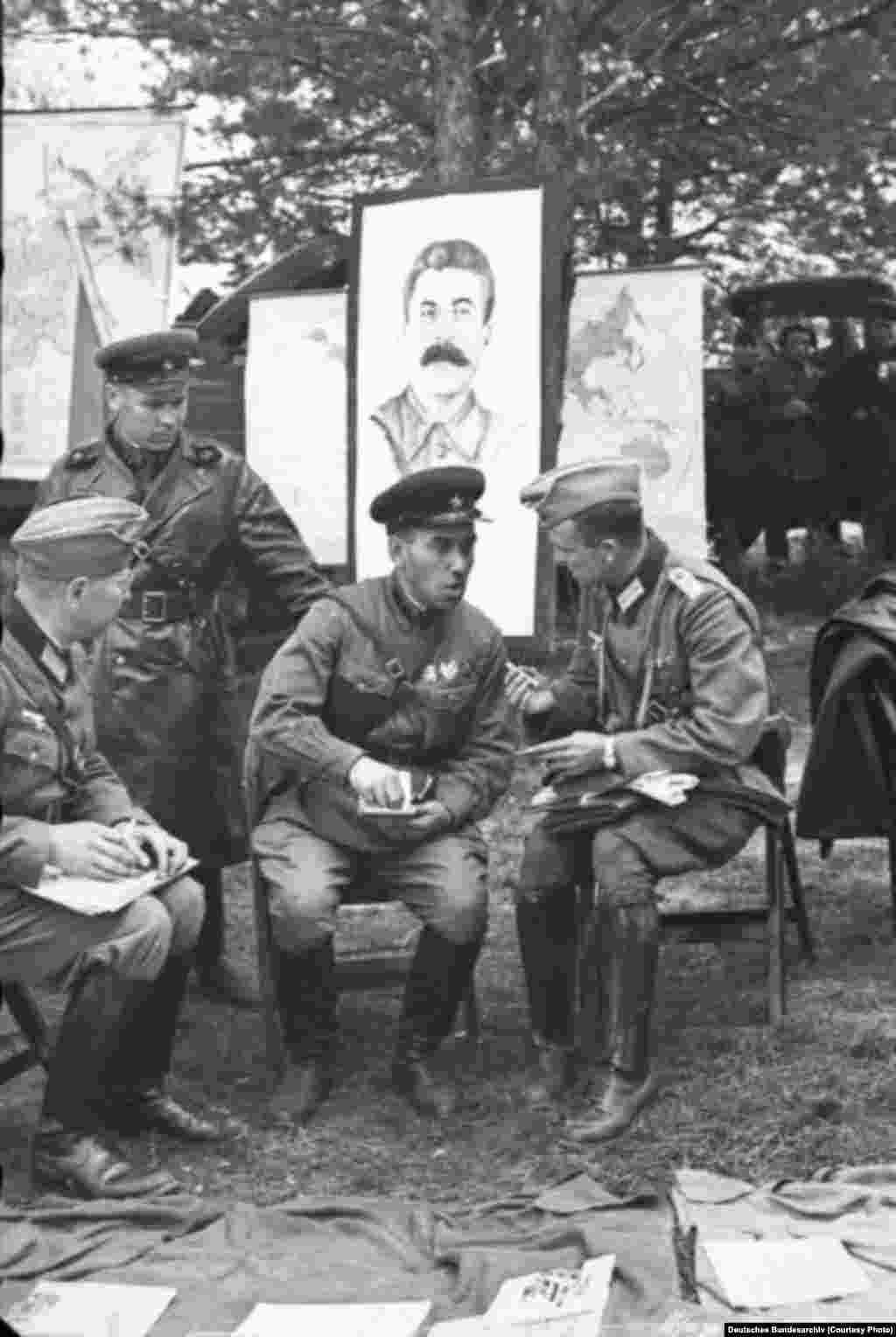
German Lieutenant Colonel Gustav-Adolf Riebel shakes hands with Brigadier Semyon Krivoshein during the joint Nazi-Soviet victory parade in Brest.
12/16 German Lieutenant Colonel Gustav-Adolf Riebel shakes hands with Brigadier Semyon Krivoshein during the joint Nazi-Soviet victory parade in Brest.
On August 23, 1939, the Soviet Union and Nazi Germany signed a nonaggression treaty in Moscow, paving the way for the Nazi and Soviet invasions of Poland the following month and the beginning of World War II. Known colloquially as the Molotov-Ribbentrop Pact, after Soviet Foreign Minister Vyacheslav Molotov and German Foreign Minister Joachim von Ribbentrop, the agreement gave Adolf Hitler a free hand to attack Poland without fear of Soviet intervention. At the same time, Hitler and Josef Stalin established a secret protocol dividing Central and Eastern Europe into "spheres of influence."
A British perspective on the nonaggression pact in a cartoon by David Low, published in the "Evening Standard" on September 20, 1939
13/16 A British perspective on the nonaggression pact in a cartoon by David Low, published in the "Evening Standard" on September 20, 1939
On August 23, 1939, the Soviet Union and Nazi Germany signed a nonaggression treaty in Moscow, paving the way for the Nazi and Soviet invasions of Poland the following month and the beginning of World War II. Known colloquially as the Molotov-Ribbentrop Pact, after Soviet Foreign Minister Vyacheslav Molotov and German Foreign Minister Joachim von Ribbentrop, the agreement gave Adolf Hitler a free hand to attack Poland without fear of Soviet intervention. At the same time, Hitler and Josef Stalin established a secret protocol dividing Central and Eastern Europe into "spheres of influence."
Part of the Molotov-Ribbentrop Pact published in the Soviet newspaper "Pravda" on September 28, 1939
14/16 Part of the Molotov-Ribbentrop Pact published in the Soviet newspaper "Pravda" on September 28, 1939
On August 23, 1939, the Soviet Union and Nazi Germany signed a nonaggression treaty in Moscow, paving the way for the Nazi and Soviet invasions of Poland the following month and the beginning of World War II. Known colloquially as the Molotov-Ribbentrop Pact, after Soviet Foreign Minister Vyacheslav Molotov and German Foreign Minister Joachim von Ribbentrop, the agreement gave Adolf Hitler a free hand to attack Poland without fear of Soviet intervention. At the same time, Hitler and Josef Stalin established a secret protocol dividing Central and Eastern Europe into "spheres of influence."
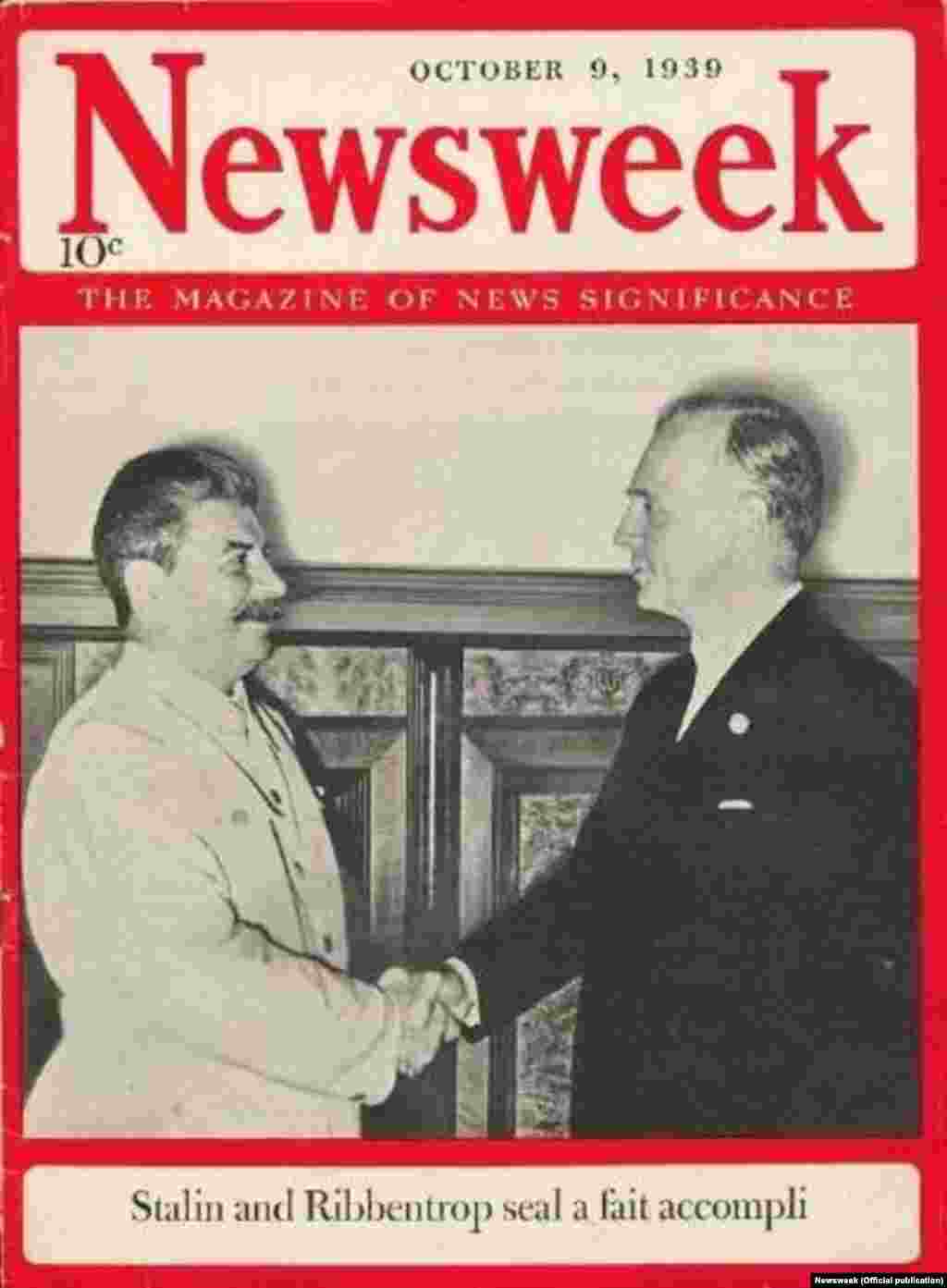
Stalin and von Ribbentrop on the cover of "Newsweek" on October 9, 1939
15/16 Stalin and von Ribbentrop on the cover of "Newsweek" on October 9, 1939
On August 23, 1939, the Soviet Union and Nazi Germany signed a nonaggression treaty in Moscow, paving the way for the Nazi and Soviet invasions of Poland the following month and the beginning of World War II. Known colloquially as the Molotov-Ribbentrop Pact, after Soviet Foreign Minister Vyacheslav Molotov and German Foreign Minister Joachim von Ribbentrop, the agreement gave Adolf Hitler a free hand to attack Poland without fear of Soviet intervention. At the same time, Hitler and Josef Stalin established a secret protocol dividing Central and Eastern Europe into "spheres of influence."
Molotov (left) in Berlin on November 14, 1940. The nonaggression pact remained in effect until Germany's invasion of the Soviet Union on June 22, 1941.
16/16 Molotov (left) in Berlin on November 14, 1940. The nonaggression pact remained in effect until Germany's invasion of the Soviet Union on June 22, 1941.
On August 23, 1939, the Soviet Union and Nazi Germany signed a nonaggression treaty in Moscow, paving the way for the Nazi and Soviet invasions of Poland the following month and the beginning of World War II. Known colloquially as the Molotov-Ribbentrop Pact, after Soviet Foreign Minister Vyacheslav Molotov and German Foreign Minister Joachim von Ribbentrop, the agreement gave Adolf Hitler a free hand to attack Poland without fear of Soviet intervention. At the same time, Hitler and Josef Stalin established a secret protocol dividing Central and Eastern Europe into "spheres of influence."
Previous slide
Next slide

Russia has slammed a resolution adopted by the European Union that states the 1939 nonaggression pact between the Soviet Union and Nazi Germany "paved the way for the outbreak of World War II."

On September 20, Russia's Foreign Ministry labeled the European Parliament resolution as politicized revisionism.

The ministry complained that the text did not mention Western powers' 1938 Munich Agreement that led to Nazi Germany's invasion of Czechoslovakia.

"The European Parliament marked yet another outrageous attempt to equate Nazi Germany -- the aggressor country -- and the Soviet Union, whose peoples, at the cost of huge sacrifices, liberated Europe from fascism," the Foreign Ministry said in a statement.

The world this year marked the 80th anniversary of the accord – known as the Molotov-Ribbentrop Pact -- in which Nazi Germany and the Soviet Union agreed to divide up Central and Eastern Europe.

The EU resolution said the pact set out to divide Europe "between the two totalitarian regimes" of Nazi Germany and the Soviet Union.

The Nazis eventually betrayed the pact with their surprise invasion of the Soviet Union in June 1941.

Based on reporting by dpa and Interfax
This item is part of
XS
SM
MD
LG