


Accessibility links

Breaking News

A Chinese School In Occupied Ukraine? Analysts See Kremlin Propaganda At Work

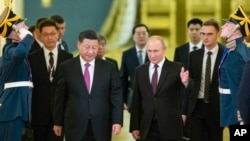
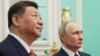
Russian President Vladimir Putin (center right) welcomes his Chinese counterpart, Xi Jinping (center left), for talks at the Kremlin in June.

In Ukraine's Russian-occupied Luhansk, where shelling still echoes across devastated streets and reconstruction promises remain largely unmet, a new headline is making waves: Chinese activists reportedly plan to open a private school for Chinese citizens.

The story, first published by Russian state outlets and quickly picked up by pro-Kremlin Telegram channels, claims the school will serve 300 Chinese students, teaching them Russian and preparing them for eventual enrollment in Russian universities.

It's presented as a showcase of international cooperation and a step toward "economic normalization" in Ukraine's war-torn eastern regions that Russia has claimed.

However, Ukrainian experts and regional analysts see a very different picture.

From September 1, Russia is effectively banning Ukrainian-language education in the occupied regions, a move that the Kremlin can use to claim the territories are part of Russia on a linguistic basis.

Moscow has officially justified its moves on language education as reflecting “changes in the geopolitical situation in the world.”

Many dismiss the narrative as a Kremlin propaganda ploy designed to project legitimacy over occupied territories.

Others warn of potentially deeper motives, including quiet Chinese economic activity, covert intelligence operations, and attempts by Moscow to weave Beijing into its occupation strategy.

"Consider this: Would Chinese families really risk sending their teenage children into an active war zone for education?" says Kostyantyn Batozskiy, a Ukrainian political analyst and director of the Azov Development Agency.

"This is not about education. It's about optics, influence, and control," he says, adding that it was a "classic" Kremlin news story on the occupied region's supposedly bright future.

"Like their endless talk of rebuilding the ruined Donetsk airport or restoring the town of Shyrokyne -- none of it materializes. It's about keeping occupied populations distracted with grandiose promises."

Terminal Conflict: Donetsk Airport's 10 Years On The Front Lines

This June 2012 photo shows the terminal building of the Donetsk Sergei Prokofiev International Airport soon after its opening in May that year.
1/12 This June 2012 photo shows the terminal building of the Donetsk Sergei Prokofiev International Airport soon after its opening in May that year.
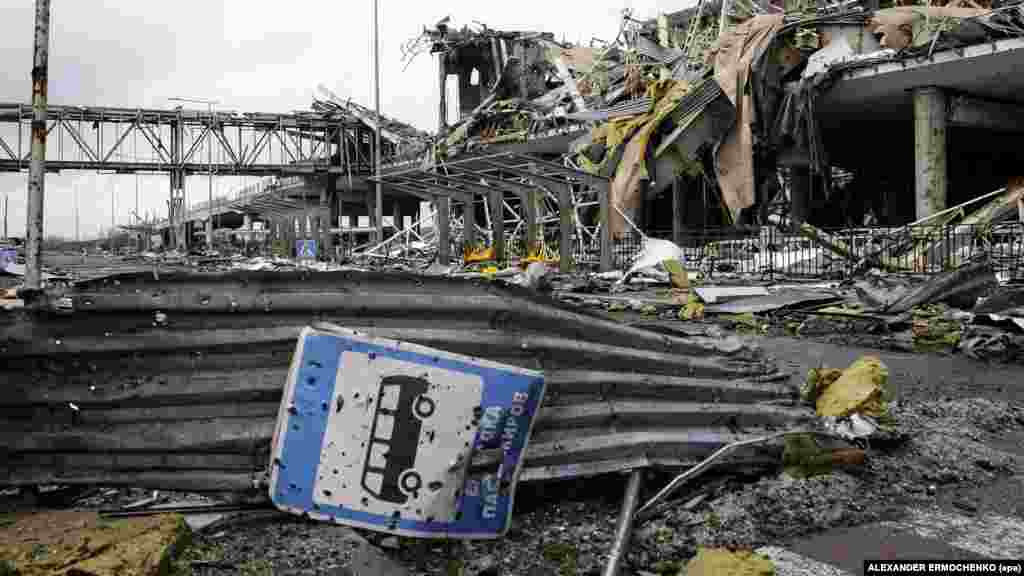
Up until May 2014, Donetsk had one of the finest airports in Ukraine. But when fighting broke out there a decade ago, the site was reduced to rubble that remains a no-man's land to this day.
Today, this is all that remains of the airport. Over the past 10 years, the facility been reduced to rubble as it sat on, or alongside, the front line in Ukraine.<br />
&nbsp;
2/12 Today, this is all that remains of the airport. Over the past 10 years, the facility been reduced to rubble as it sat on, or alongside, the front line in Ukraine.
 
Up until May 2014, Donetsk had one of the finest airports in Ukraine. But when fighting broke out there a decade ago, the site was reduced to rubble that remains a no-man's land to this day.
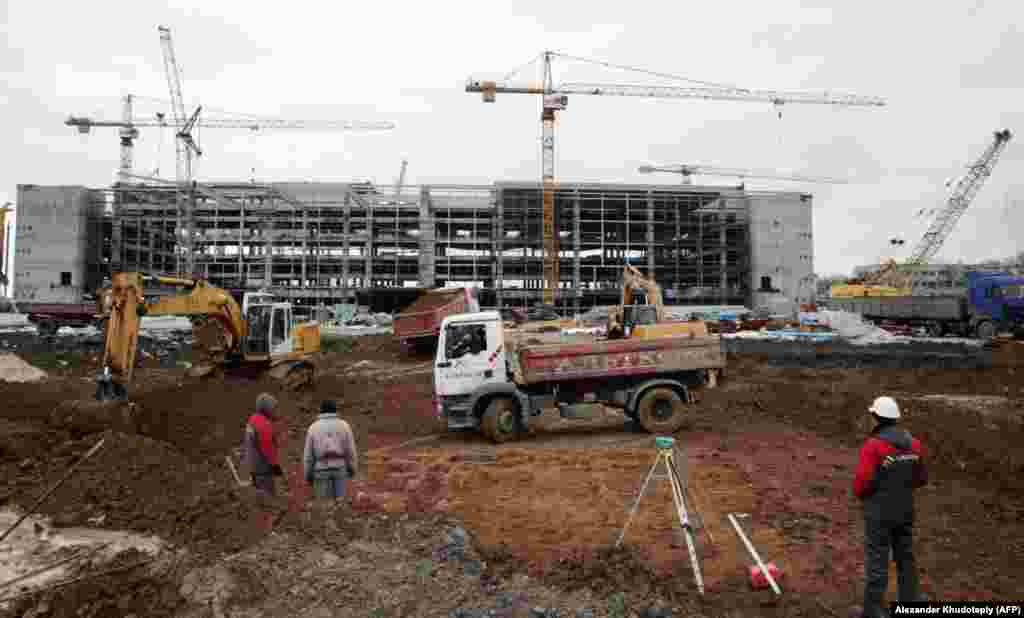
The airport is shown under construction in February 2011.<br />
<br />
The refurbished Donetsk airport was built in time to host teams and fans for the 2012 UEFA European Football Championship, which Ukraine hosted jointly with Poland.
3/12 The airport is shown under construction in February 2011.

The refurbished Donetsk airport was built in time to host teams and fans for the 2012 UEFA European Football Championship, which Ukraine hosted jointly with Poland.
Up until May 2014, Donetsk had one of the finest airports in Ukraine. But when fighting broke out there a decade ago, the site was reduced to rubble that remains a no-man's land to this day.
Bus stops and taxi stands on the grounds of the new airport in June 2012<br />
<br />
The facility was named after Russian composer <strong><a href="https://en.wikipedia.org/wiki/Sergei_Prokofiev">Sergei Prokofiev</a></strong>, who was born in what is now the Ukrainian region of Donetsk in 1891.&nbsp;<br />
&nbsp;
4/12 Bus stops and taxi stands on the grounds of the new airport in June 2012

The facility was named after Russian composer Sergei Prokofiev, who was born in what is now the Ukrainian region of Donetsk in 1891. 
 
Up until May 2014, Donetsk had one of the finest airports in Ukraine. But when fighting broke out there a decade ago, the site was reduced to rubble that remains a no-man's land to this day.
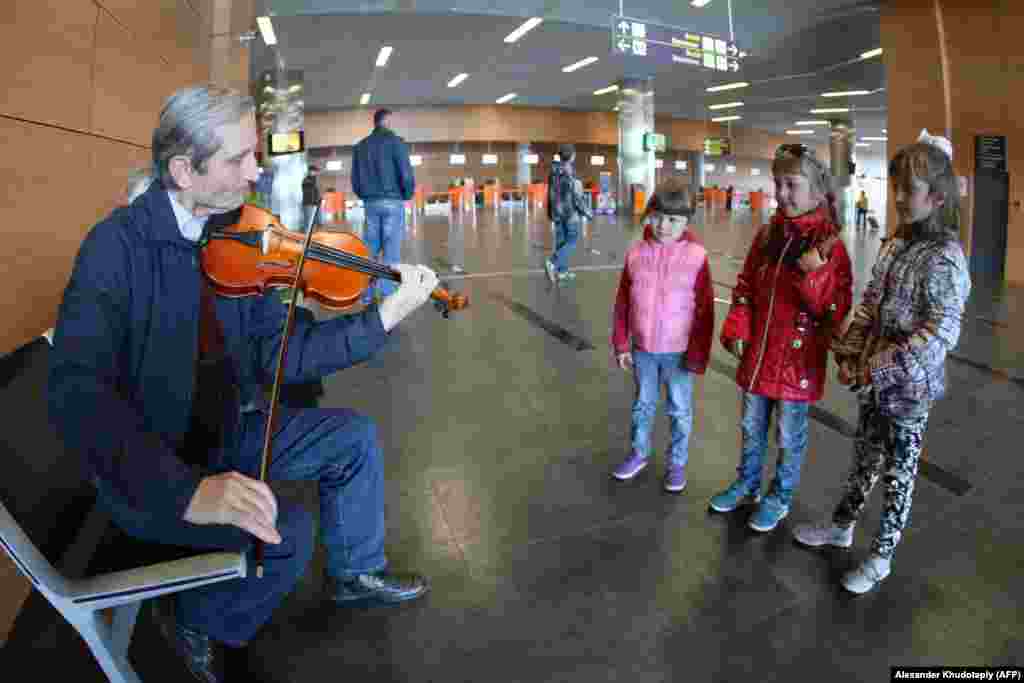
Children listen to a musician warming up before he performs inside the airport in March 2014.<br />
<br />
At the airport&rsquo;s opening in May 2012, Ukraine&rsquo;s deputy prime minister <strong><a href="https://rsport.ria.ru/20120514/596995591.html">predicted</a></strong> that the sleek new facility&#39;s opening would &quot;serve around 4 million passengers a year&quot; by 2015.
5/12 Children listen to a musician warming up before he performs inside the airport in March 2014.

At the airport’s opening in May 2012, Ukraine’s deputy prime minister predicted that the sleek new facility's opening would "serve around 4 million passengers a year" by 2015.
Up until May 2014, Donetsk had one of the finest airports in Ukraine. But when fighting broke out there a decade ago, the site was reduced to rubble that remains a no-man's land to this day.
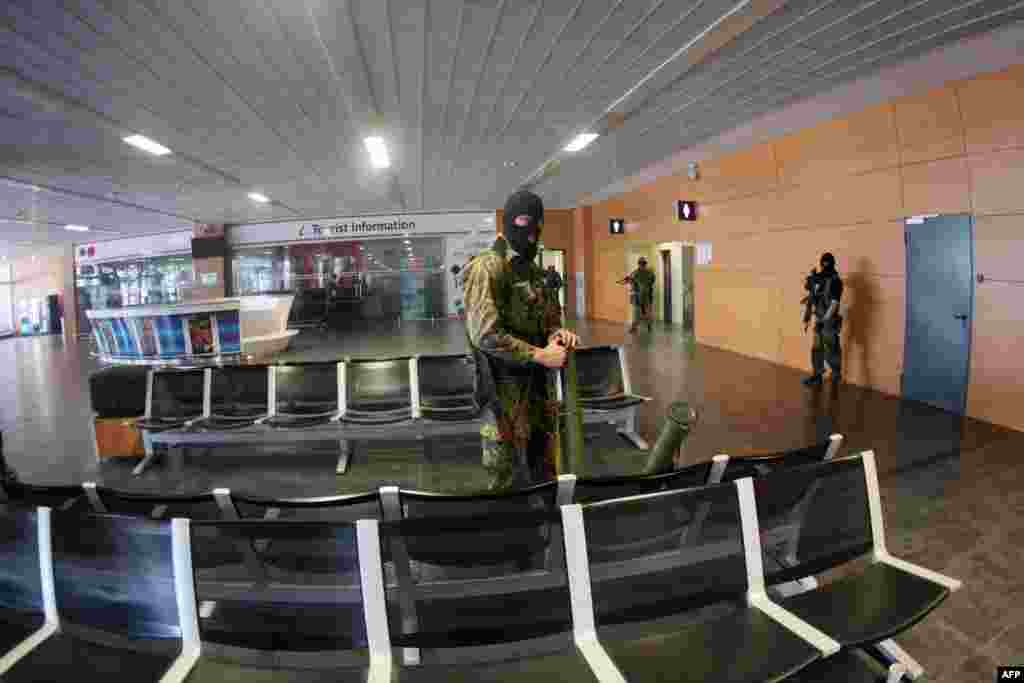
Russian-backed militants patrol inside the airport on May 26, 2014.<br />
<br />
Separatists seized the Donetsk facility immediately after a presidential election saw Petro Poroshenko voted into power on May 25, following the ousting of pro-Russian President Viktor Yanukovych.&nbsp;<br />
<br />
&nbsp;
6/12 Russian-backed militants patrol inside the airport on May 26, 2014.

Separatists seized the Donetsk facility immediately after a presidential election saw Petro Poroshenko voted into power on May 25, following the ousting of pro-Russian President Viktor Yanukovych. 

 
Up until May 2014, Donetsk had one of the finest airports in Ukraine. But when fighting broke out there a decade ago, the site was reduced to rubble that remains a no-man's land to this day.
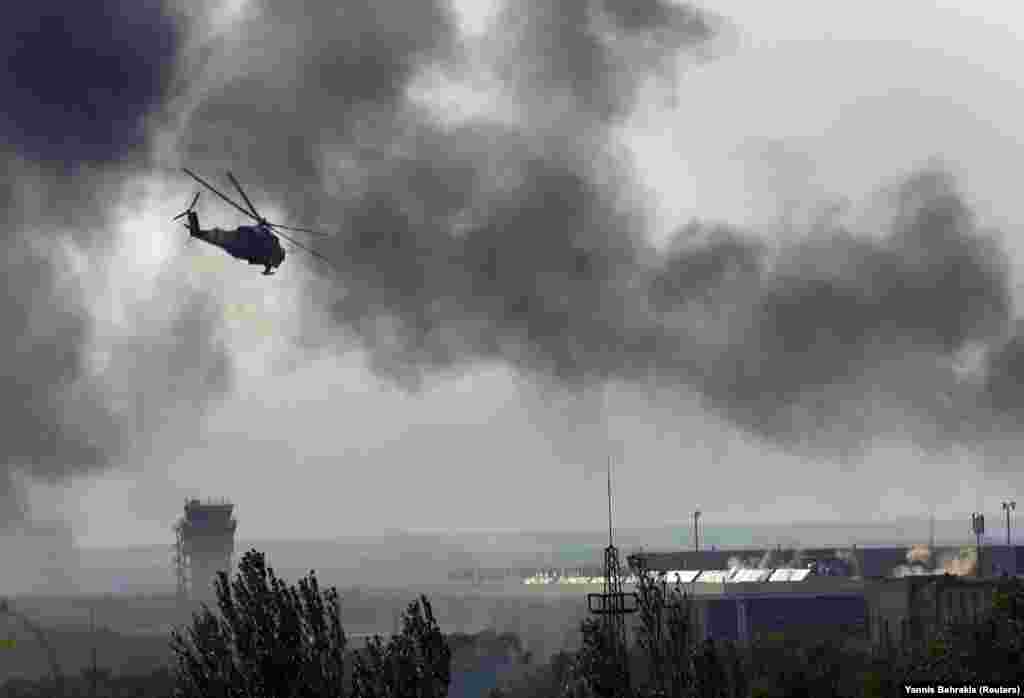
A Ukrainian helicopter gunship fires its autocannon at the separatist-held airport on May 26.<br />
<br />
By May 27, 2014, the airport had been recaptured by Ukrainian forces, who would hold it for several months as war with Russian-backed separatists spread across the eastern Donbas region.
7/12 A Ukrainian helicopter gunship fires its autocannon at the separatist-held airport on May 26.

By May 27, 2014, the airport had been recaptured by Ukrainian forces, who would hold it for several months as war with Russian-backed separatists spread across the eastern Donbas region.
Up until May 2014, Donetsk had one of the finest airports in Ukraine. But when fighting broke out there a decade ago, the site was reduced to rubble that remains a no-man's land to this day.
Russian-backed separatists are seen inside the remains of the Donetsk airport amid the second battle for the airport in October 2014.<br />
<br />
In September 2014, separatist forces launched an attack on Ukrainian troops holed up inside the facility. The airport was the only remaining foothold Kyiv had in Donetsk after the eastern city had been taken over by pro-Kremlin forces.<br />
&nbsp;
8/12 Russian-backed separatists are seen inside the remains of the Donetsk airport amid the second battle for the airport in October 2014.

In September 2014, separatist forces launched an attack on Ukrainian troops holed up inside the facility. The airport was the only remaining foothold Kyiv had in Donetsk after the eastern city had been taken over by pro-Kremlin forces.
 
Up until May 2014, Donetsk had one of the finest airports in Ukraine. But when fighting broke out there a decade ago, the site was reduced to rubble that remains a no-man's land to this day.
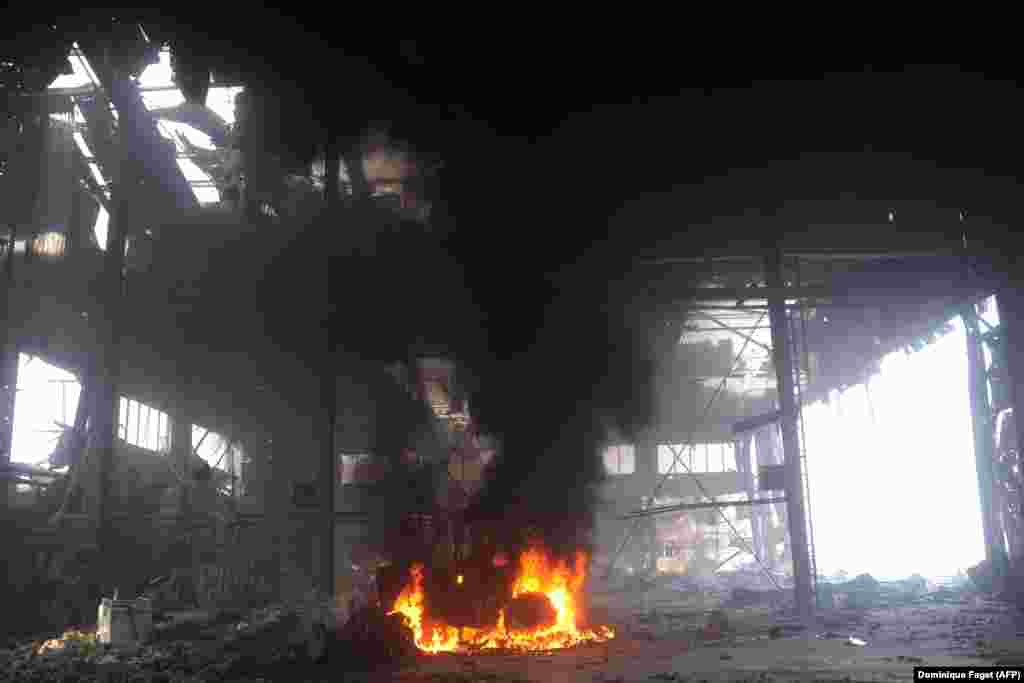
A vehicle burns inside the airport in October 16.<br />
<br />
Amid close-quarter fighting for control of the facility throughout late 2014 until early 2015, the airport was reduced to rubble as Russian-backed forces eventually regained control.&nbsp;
9/12 A vehicle burns inside the airport in October 16.

Amid close-quarter fighting for control of the facility throughout late 2014 until early 2015, the airport was reduced to rubble as Russian-backed forces eventually regained control. 
Up until May 2014, Donetsk had one of the finest airports in Ukraine. But when fighting broke out there a decade ago, the site was reduced to rubble that remains a no-man's land to this day.
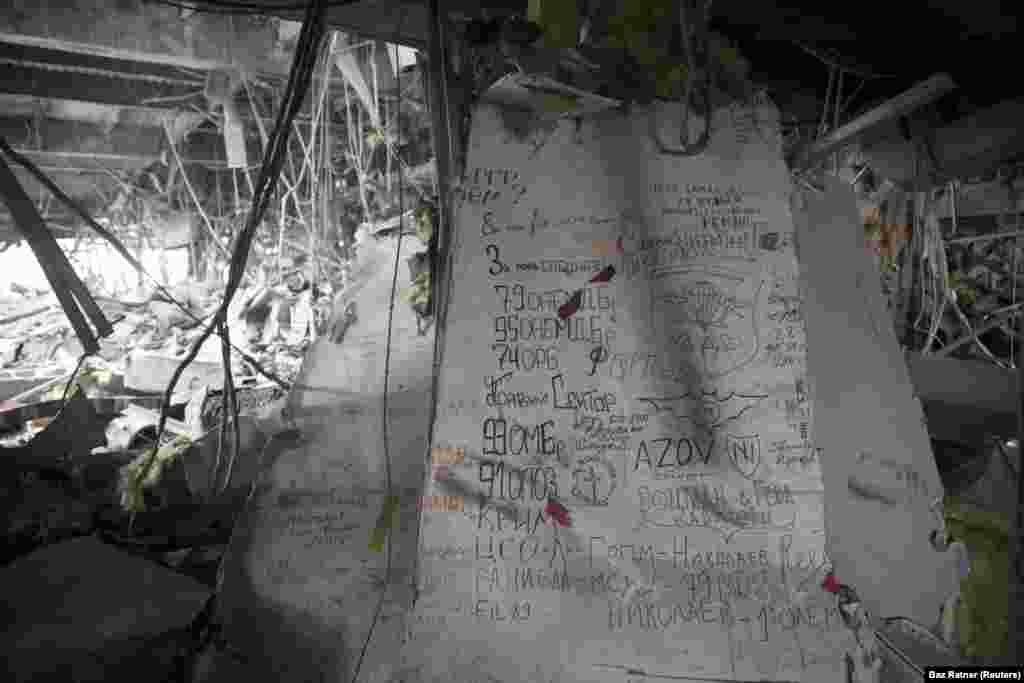
Graffiti left by Ukrainian fighters is seen inside the airport in March 2015.<br />
<br />
From 2015 the airport became a frontline site between Ukrainian and Russian-backed forces and a symbol of the ruination of the largely static trench conflict.
10/12 Graffiti left by Ukrainian fighters is seen inside the airport in March 2015.

From 2015 the airport became a frontline site between Ukrainian and Russian-backed forces and a symbol of the ruination of the largely static trench conflict.
Up until May 2014, Donetsk had one of the finest airports in Ukraine. But when fighting broke out there a decade ago, the site was reduced to rubble that remains a no-man's land to this day.
A couple looks at the ruins of the airport in April 2017.<br />
<br />
After the Kremlin launched its all-out invasion of Ukraine in February 2022, the entire territory of the ruined airport was taken over by Russian forces by November that year.&nbsp;
11/12 A couple looks at the ruins of the airport in April 2017.

After the Kremlin launched its all-out invasion of Ukraine in February 2022, the entire territory of the ruined airport was taken over by Russian forces by November that year. 
Up until May 2014, Donetsk had one of the finest airports in Ukraine. But when fighting broke out there a decade ago, the site was reduced to rubble that remains a no-man's land to this day.
The latest available image of the airport ruins, taken on May 26, 2024<br />
<br />
Today, the destroyed airport is firmly under Russian control. But with the front line roughly 20 kilometers away, the site remains within reach of Ukrainian artillery, meaning it is likely to remain a wasteland for the foreseeable future.
12/12 The latest available image of the airport ruins, taken on May 26, 2024

Today, the destroyed airport is firmly under Russian control. But with the front line roughly 20 kilometers away, the site remains within reach of Ukrainian artillery, meaning it is likely to remain a wasteland for the foreseeable future.
Up until May 2014, Donetsk had one of the finest airports in Ukraine. But when fighting broke out there a decade ago, the site was reduced to rubble that remains a no-man's land to this day.
Previous slide
Next slide

Such a strategy isn't new.

Russian occupation authorities in Luhansk and Donetsk, known commonly as the Donbas, have repeatedly presented projects considered by many as improbable -- including multistory hospitals, sprawling industrial parks, and even luxury resorts -- as evidence of "normalization." Few have ever progressed beyond press releases.

But there's another layer to the Chinese school story that experts say is more alarming: Even if the school itself never opens, the fact that such claims are being promoted reflects Moscow's growing effort to draw China closer into its occupation enterprise.

'Tacit Approval Of The Occupation'

Artur Kharytonov, president of the Liberal Democratic League of Ukraine and an expert on East and Southeast Asia, calls the announcement "cheap propaganda."

But he cautions against dismissing it as entirely baseless.

"In China's totalitarian system, nothing of this scale happens without top-level approval," he says. He adds that commitments Chinese President Xi Jinping has made to his Russian counterpart, Vladimir Putin, -- such as recognizing Russian elections and expressing respect for Russia's constitution -- "all point to tacit approval of the occupation."

Kharytonov points to Crimea as a cautionary precedent.

Since Russia's illegal annexation of the peninsula in 2014, Ukrainian officials have repeatedly warned that Chinese companies have engaged in trade and investment activities there, despite Beijing's official recognition of Ukraine's territorial integrity.

"Crimean wine makes its debut at Chinese trade fairs. Stolen Ukrainian grain and metals from occupied Donetsk appear on Chinese platforms, such as AliExpress, China's online retailer," Kharytonov says. "This is reality, not speculation."
Yuriy Poita, head of the Asia-Pacific Section at the New Geopolitics Research Network, says he believes the putative school may not target teenagers at all.

"It's more plausible that this is a facility to train Chinese engineers, technicians, or workers involved in joint Russian-Chinese projects in occupied territories," he says.

As Russian-controlled infrastructure in Ukraine's Donbas crumbles under years of neglect and war, Chinese firms have reportedly supplied construction materials and machinery for rebuilding efforts.

"Complex equipment requires skilled personnel" Poita says. "You can't deploy these systems without on-site Chinese experts. Language training for local workers -- and vice versa -- could easily be packaged as 'education.'"

Political Purpose

For Russia, having Chinese citizens visibly active in Luhansk serves a political purpose.

"They desperately want to show the world that Ukraine's occupied region is a de facto part of Russia, attracting foreign citizens for work and study," Batozskiy says.

But on the ground, there's little evidence of a significant Chinese presence.

Instead, most foreign laborers are Central Asian migrants, hired for construction projects in the region. This has sparked resentment among locals, who see jobs slipping away as Russian authorities favor imported workers over them.

"Russia doesn't trust the local population," Batozskiy explains. "They prefer outsiders to rebuild and secure these regions. But Central Asian migrants don't legitimize annexation internationally. Chinese nationals might -- at least symbolically."

Kharytonov raises a more concerning possibility: that Chinese involvement in occupied territories could extend to covert military or intelligence activities.

"Chinese specialists brought into Luhansk might be linked to the People's Liberation Army or Chinese intelligence services," he warns. "Proximity to the frontlines gives them unparalleled access to battlefield data and Ukrainian infrastructure."
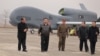
He draws parallels with earlier reports of North Korean officers entering Ukraine's Russian-occupied Donetsk region disguised as students -- a ruse uncovered when Ukrainian forces killed several of them and captured some of them in combat.

And recent Ukrainian counterintelligence operations have heightened concerns.

In June, Ukraine's Security Service (SBU) detained two Chinese nationals for allegedly attempting to steal blueprints for the Neptune missile system. This Ukrainian design has proven effective in the Black Sea.

"China doesn't necessarily want the missile itself," Kharytonov says. "It wants the blueprints of a battle-tested system to enhance its own capabilities."
Russia's pursuit of deeper ties with Beijing goes beyond practical cooperation -- it also reflects an ideological alignment.

"Moscow now refers to itself as a 'civilization-state,' echoing Chinese political rhetoric," Batozskiy notes. "They've borrowed Chinese surveillance methods, censorship tools, and propaganda models. Promoting a Chinese school in Luhansk reinforces this narrative of shared destiny."

Illusion Of Economic Revival

Such moves also help Moscow sell the illusion of economic revival in occupied territories.

Repeated rumors of Chinese investment in Soviet-era industrial giants, such as the Azovstal steel works, have circulated in Kremlin-friendly media.

"No sane investor would rebuild those behemoths," Batozskiy says. "But these myths serve to pacify locals and present a veneer of international legitimacy."

Even if Beijing denies official involvement, Chinese companies have reportedly helped establish new plants in occupied Donetsk, supplying critical equipment and technical expertise.

"It's a gray-zone operation," Poita says. "China avoids open political alignment but allows its firms to profit from Russia's land grabs."

Kharytonov sees a clear pattern.

"China ideologically supports Russia's war," he says. "It will buy anything from these territories -- grain, metals, whatever -- because it's cheap and politically useful."

The proposed Chinese school in Luhansk may never open its doors, but the narrative around it offers a revealing glimpse into Moscow's hybrid strategy -- using international partners, real or imagined, to solidify its grip on occupied Ukraine.

"Nothing in China happens by accident," Kharytonov says. "Even a modest presence-- engineers, trainers, or 'students'-- could serve multiple purposes: economic, political, and military."

As Russia and China deepen their "friendship without limits," even a simple school becomes a potential front in their shared authoritarian project, he adds.

  • 16x9 Image

    Olha Katsan

    Olha Katsan is a multimedia producer with RFE/RL's Ukrainian Service. 

  • 16x9 Image

    Donbas.Realities

    Donbas.Realities is a regional news outlet of RFE/RL's Ukrainian Service.

This item is part of
XS
SM
MD
LG