




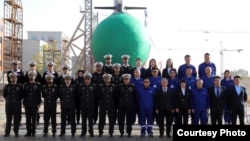
Pakistan's navy on December 17 launched its fourth Hangor-class submarine, the PNS Ghazi, at the Wuchang Shipbuilding Industry Group’s Shuangliu Base in Wuhan, marking the completion of construction for all four China-built boats in a landmark eight-submarine program.
Under a 2015 defense contract valued at roughly $5 billion with China Shipbuilding & Offshore International Company, Pakistan is acquiring eight advanced Hangor-class diesel-electric attack submarines to modernize its undersea warfare capabilities and replace its aging Agosta 90B fleet.
The Hangor program represents one of the largest and most sophisticated foreign military procurements in Pakistan’s history, reflecting deepening China–Pakistan defense cooperation that spans fighter jets, missile systems, and nuclear energy projects.
Four vessels, including the PNS Ghazi, were constructed at Wuchang; the remaining four are being built domestically at Karachi Shipyard & Engineering Works under a comprehensive technology transfer arrangement, with deliveries planned through 2028 despite earlier delays related to foreign engine supply issues.

The 2,800-ton submarines -- export derivatives of China’s Type 039A (Yuan) class -- are equipped with air-independent propulsion (AIP) systems that enable prolonged submerged operations, six 533 mm torpedo tubes for heavyweight torpedoes and missiles, and compatibility with Pakistan’s nuclear-capable Babur-3 submarine-launched cruise missile.
Pakistan’s military has hailed the program as a major boost to its undersea deterrent, enhancing operational flexibility and its ability to maintain a credible presence in the Arabian Sea and wider Indian Ocean region.
Analysts say these submarines are intended to strengthen Pakistan’s anti-access/area-denial posture by complicating adversary surface operations and undersea tracking in contested waters, particularly as India expands its own submarine and anti-submarine warfare capabilities.
Media from rival India frame the Hangor deployment as part of an intensifying regional naval competition, with Islamabad’s acquisitions viewed in the context of broader Indo-Pacific security dynamics and the US-led Quadrilateral Security Dialogue (QUAD) involving Australia, India, Japan, and the United States.
Islamabad-based political economist Shakil Ahmad Ramay told RFE/RL’s Radio Mashaal that QUAD’s evolving role has “impacted the balance of power” in the regional, accelerating Chinese-Pakistani naval ties like the Ghazi rollout. He emphasized mutual security pacts: China supports Pakistan against territorial threats, while Pakistan backs Beijing’s One-China policy, with Chinese built reactors now generating around 4,500 megawatts of electricity in Pakistan.
Beyond strategic signaling, the technology transfer to Islamabad is seen as a potential catalyst for Pakistan’s domestic shipbuilding capacity, providing technical expertise, workforce development, and future sustainment capabilities.
With the launch of Ghazi, all four China-built submarines are now undergoing rigorous sea trials, and are expected to begin entering service as early as 2026, according to Pakistani and Chinese defense officials.

