


Russian health officials have finally granted permission for opposition leader Aleksei Navalny, who is in a coma in a Siberian hospital with suspected poisoning, to be evacuated to Germany for treatment.
Navalny's family and allies have been fighting to transfer him to Germany for urgent treatment, but Russian doctors treating him had refused for hours to allow him to leave the hospital in the Siberian city of Omsk, arguing that he was not fit to travel.
But later on August 21, a senior official at the Omsk hospital, Anatoly Kalinichenko, told the media that Navalny could now be transported, as his condition has stabilized.
The transport from the Russian hospital is planned to be conducted within the day, Kalinichenko was quoted as saying.
According to Russia's RIA Novosti news agency, the flight to Berlin is scheduled for the morning of August 22.
German doctors who arrived with an ambulance plane that is waiting to transport him to Berlin's Charite hospital, were earlier in the day allowed to examine Navalny in Omsk after being refused access to him because of what they said was his grave condition.
"We...made the decision that we do not oppose his transfer to another hospital, the one that his relatives indicate to us," Kalinichenko told journalists.
Navalny's wife had earlier appealed to President Vladimir Putin to allow her husband’s evacuation to Germany for urgent medical care.
"I officially appeal to you [Putin] to demand you allow the transportation of...Navalny to...Germany," Yulia Navalnaya said in a letter published on social media on August 21.
The Kremlin earlier said that the decision to refuse the transfer to Germany of Navalny was based only on medical grounds.
"This is a question of a purely medical decision," President Vladimir Putin's spokesman, Dmitry Peskov, told journalists on August 21 after Russian doctors said Navalny was not well enough to be moved from the Omsk hospital where he is being treated.
But Navalny's supporters denounced the medical verdict as a ploy to stall until any poison would no longer be found in his body.
Navalny's spokeswoman, Kira Yarmysh, had called the hospital's decision "an attempt on his life being carried out right now by doctors and the deceitful authorities that have authorized it."
"It is deadly to remain in the Omsk hospital without equipment or a diagnosis," she tweeted.
The 44-year-old anti-corruption campaigner became ill on August 20 while on a flight to Moscow from the Siberian city of Tomsk, forcing the aircraft to make an unscheduled landing in Omsk, where he was transported by ambulance to the hospital.
After offering to have him flown to Germany for treatment, the German government said on August 21 that Navalny's life must be saved.
"The most important priority is of course that Mr. Navalny's life can be saved and that he can recover," government spokesman Steffen Seibert told reporters in Berlin.
There has been no official diagnosis of Navalny's condition, but his team believes he was poisoned because of his activities.
Yarmysh said she believed the politician was poisoned when he drank tea he had bought at the Tomsk airport.
But Aleksandr Murakhovsky, the head doctor at Omsk Emergency Hospital No. 1, told journalists the most likely cause of Navalny's condition was a disorder pertaining to his metabolism of carbohydrates, according to comments carried by state news agency TASS.
"Today we have some working diagnoses. The main one is...a metabolic disorder," Murakhovsky said, adding that Navalny's condition "may be caused by a sudden drop of blood sugar levels."
Murakhovsky's comments came after Yarmysh quoted Navalny’s associate, Ivan Zhdanov, as saying that "a police officer at the hospital had just said that a poison was found in Aleksei's body, which was dangerous not only for him, but also for those around him."
The European Union has asked for a swift investigation into what caused Navalny to fall into a coma.
"We are very worried about Aleksei Navalny's health following his suspected poisoning yesterday," EU spokeswoman for foreign affairs and security policy Nabila Massrali said on August 21.
"We expect a swift, independent, and transparent investigation. If confirmed, those responsible must be held to account," Massrali added, urging Russia to permit Navalny to be transferred abroad for treatment.
Peskov told reporters that Russian law enforcement would launch an investigation if poisoning was confirmed, but TASS quoted an unidentified law enforcement source as saying that there were "no grounds for opening a criminal case, no crime elements have been identified."
'Very Courageous Man'
White House national-security adviser Robert O'Brien said on August 20 that the suspected poisoning was "extraordinarily concerning" and could have an impact on U.S.-Russia relations.
"He's a very courageous man. He is a very courageous politician to have stood up to [Russian President] Putin inside Russia, and our thoughts and our prayers are with him and his family," O'Brien said in an interview on Fox News.
"It's extraordinarily concerning and if the Russians were behind this...it's something that we're going to factor into how we deal with the Russians going forward," he said.
Navalny, who has exposed rampant corruption in Russia, has suffered physical attacks in the past.
Run-Ins Endured By Aleksei Navalny, Russia's Leading Opposition Figure
1/15Aleksei Navalny in court in December 2011 after his arrest during an unauthorized anti-government march in Moscow. Navalny was sentenced to 15 days detention for “resisting law enforcement officers.” It was the first of what would later become a regular occurrence for the opposition figure.
Pictures from some of the dozens of encounters Russia’s leading opposition figure has had with police, the courts, and unknown assailants through his years of public activism. Navalny has been jailed more than 10 times and has spent hundreds of days in custody since 2011.
2/15A sign expressing support for Navalny scrawled on the back of a truck outside the detention center where Navalny was being held after his December 2011 arrest. In February 2011, Navalny described President Vladimir Putin’s political party, United Russia, as “the party of crooks and thieves” in a radio interview. The phrase was widely picked up by opposition groups.
Pictures from some of the dozens of encounters Russia’s leading opposition figure has had with police, the courts, and unknown assailants through his years of public activism. Navalny has been jailed more than 10 times and has spent hundreds of days in custody since 2011.
3/15Navalny is escorted to a court session in Moscow in May 2012. He was detained during an opposition rally a day after the May 7 inauguration of Putin. Navalny was sentenced to another 15 days of jail for "participating in an illegal public event."
Pictures from some of the dozens of encounters Russia’s leading opposition figure has had with police, the courts, and unknown assailants through his years of public activism. Navalny has been jailed more than 10 times and has spent hundreds of days in custody since 2011.
4/15A journalist films Navalny’s Moscow apartment after it was ransacked by police on June 11, 2012. Russian police raided several opposition leaders' homes amid widespread anti-government protests in the spring and summer of 2012.
Pictures from some of the dozens of encounters Russia’s leading opposition figure has had with police, the courts, and unknown assailants through his years of public activism. Navalny has been jailed more than 10 times and has spent hundreds of days in custody since 2011.
5/15Masked men drive away after searching Navalny’s Moscow office on June 12, 2012. Navalny was later summoned for questioning by police, which prevented his participation in a planned protest.
Pictures from some of the dozens of encounters Russia’s leading opposition figure has had with police, the courts, and unknown assailants through his years of public activism. Navalny has been jailed more than 10 times and has spent hundreds of days in custody since 2011.
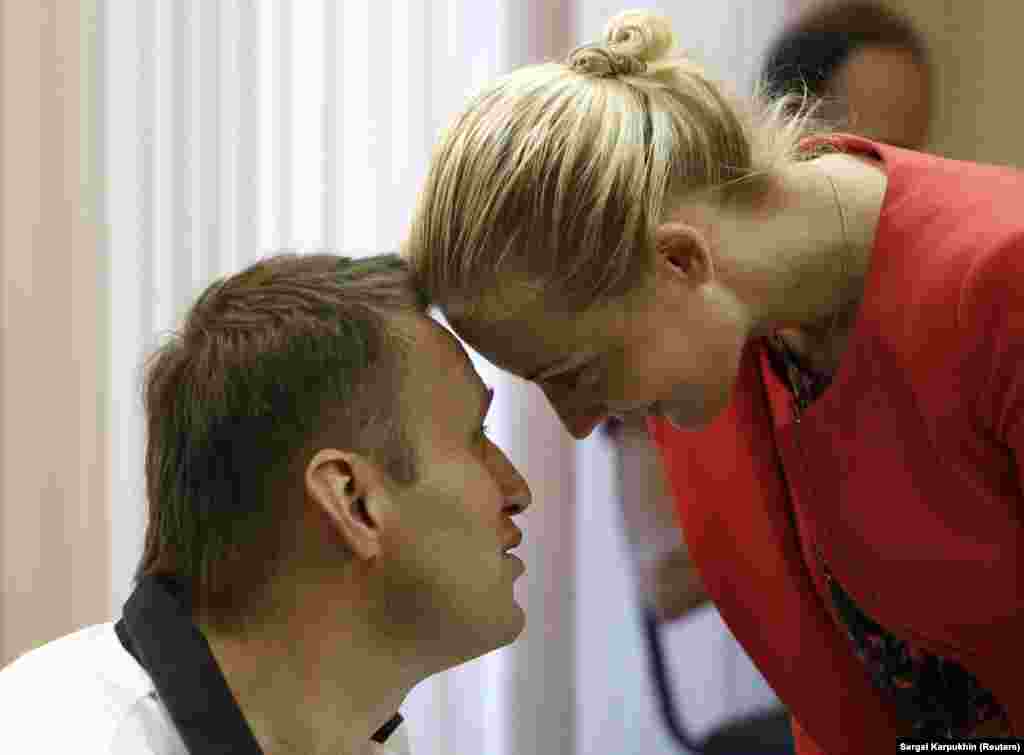
6/15Navalny and his wife, Yulia, during a break in court proceedings in Kirov in July 2013. Navalny was charged with stealing 16 million rubles ($500,000) from a state timber firm. He rejected the charges as trumped up. The court handed down a five-year prison term that was later reduced to a suspended sentence after widespread public protests.
Pictures from some of the dozens of encounters Russia’s leading opposition figure has had with police, the courts, and unknown assailants through his years of public activism. Navalny has been jailed more than 10 times and has spent hundreds of days in custody since 2011.
7/15Navalny and his brother Oleg (inside cage) during a court hearing in Moscow in December 2014. The pair were convicted of stealing around $500,000 from Russian firms during business dealings dating back several years. They rejected the charges. Aleksei Navalny’s sentence was suspended, but his brother served a full prison term of 3 1/2 years, being released in June 2018.
Pictures from some of the dozens of encounters Russia’s leading opposition figure has had with police, the courts, and unknown assailants through his years of public activism. Navalny has been jailed more than 10 times and has spent hundreds of days in custody since 2011.
8/15Navalny being detained after leaving a radio station in Moscow in January 2015. Shortly before, Navalny had snipped off an electronic bracelet he was required to wear while under house arrest for his 2014 suspended sentence.
Pictures from some of the dozens of encounters Russia’s leading opposition figure has had with police, the courts, and unknown assailants through his years of public activism. Navalny has been jailed more than 10 times and has spent hundreds of days in custody since 2011.
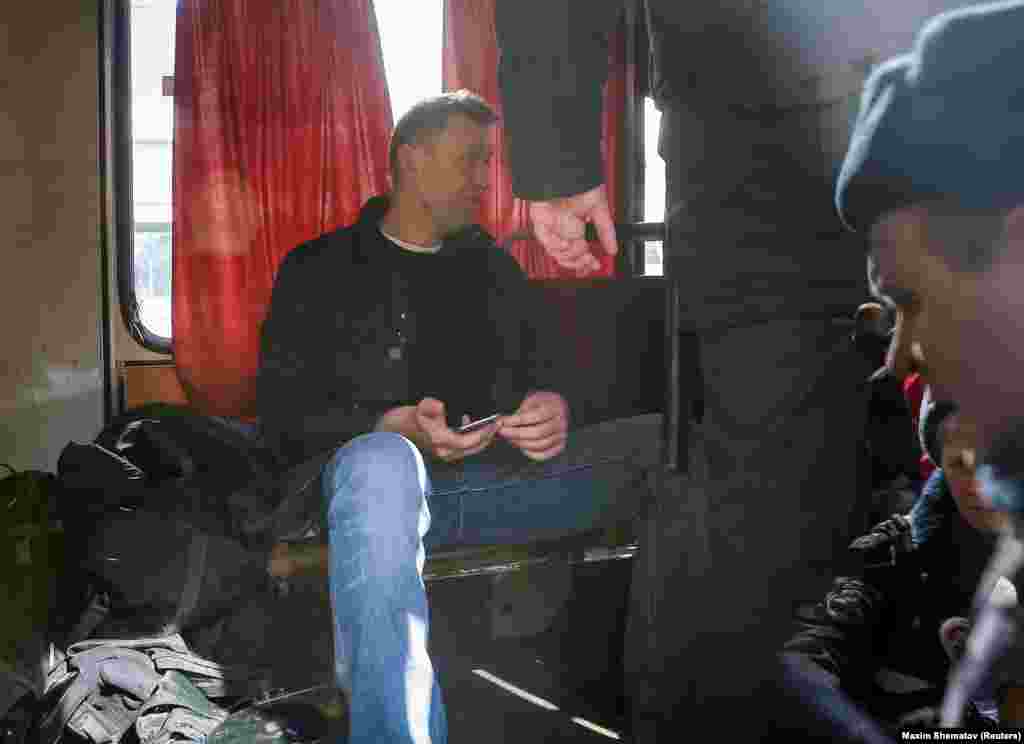
9/15Navalny sitting in a police van after being seized by police during a massive Moscow rally in March 2017. He was fined $350 for taking part in what the authorities called an illegal protest.
Pictures from some of the dozens of encounters Russia’s leading opposition figure has had with police, the courts, and unknown assailants through his years of public activism. Navalny has been jailed more than 10 times and has spent hundreds of days in custody since 2011.
10/15Navalny on his way to the hospital after being splashed with green dye by unknown assailants in Moscow in April 2017. He suffered burns to his eye in the attack.
Pictures from some of the dozens of encounters Russia’s leading opposition figure has had with police, the courts, and unknown assailants through his years of public activism. Navalny has been jailed more than 10 times and has spent hundreds of days in custody since 2011.
11/15Navalny leaves a Moscow jail in October 2018 after serving 20 days on charges of staging illegal protests.
Pictures from some of the dozens of encounters Russia’s leading opposition figure has had with police, the courts, and unknown assailants through his years of public activism. Navalny has been jailed more than 10 times and has spent hundreds of days in custody since 2011.
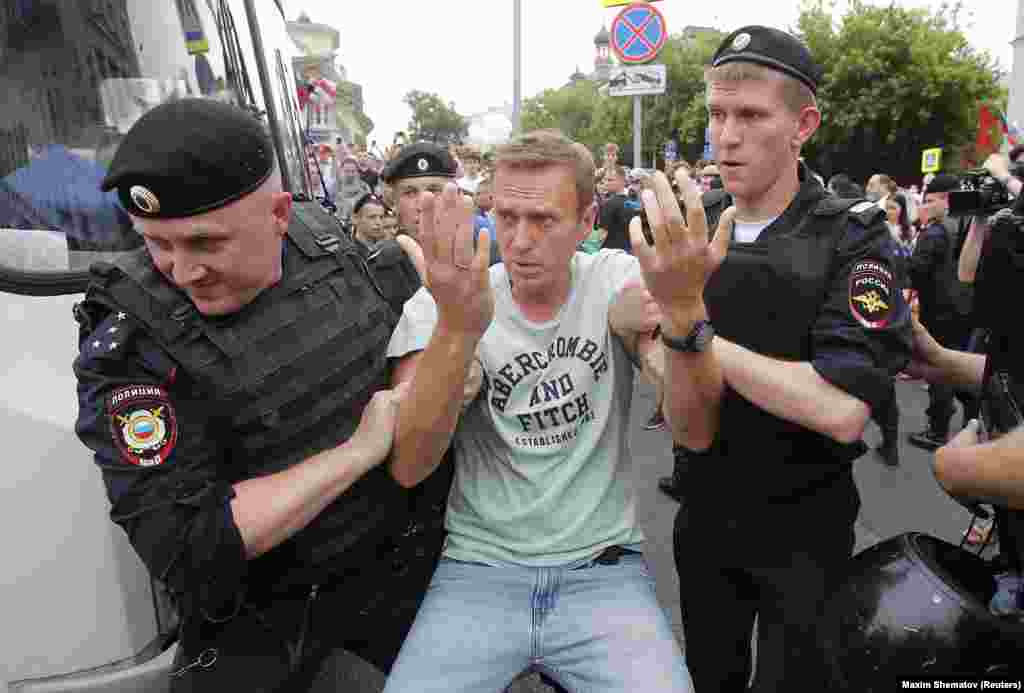
12/15Police detain Navalny during a rally in support of investigative journalist Ivan Golunov, who was detained by police and accused of drug possession on June 12, 2019.
Pictures from some of the dozens of encounters Russia’s leading opposition figure has had with police, the courts, and unknown assailants through his years of public activism. Navalny has been jailed more than 10 times and has spent hundreds of days in custody since 2011.
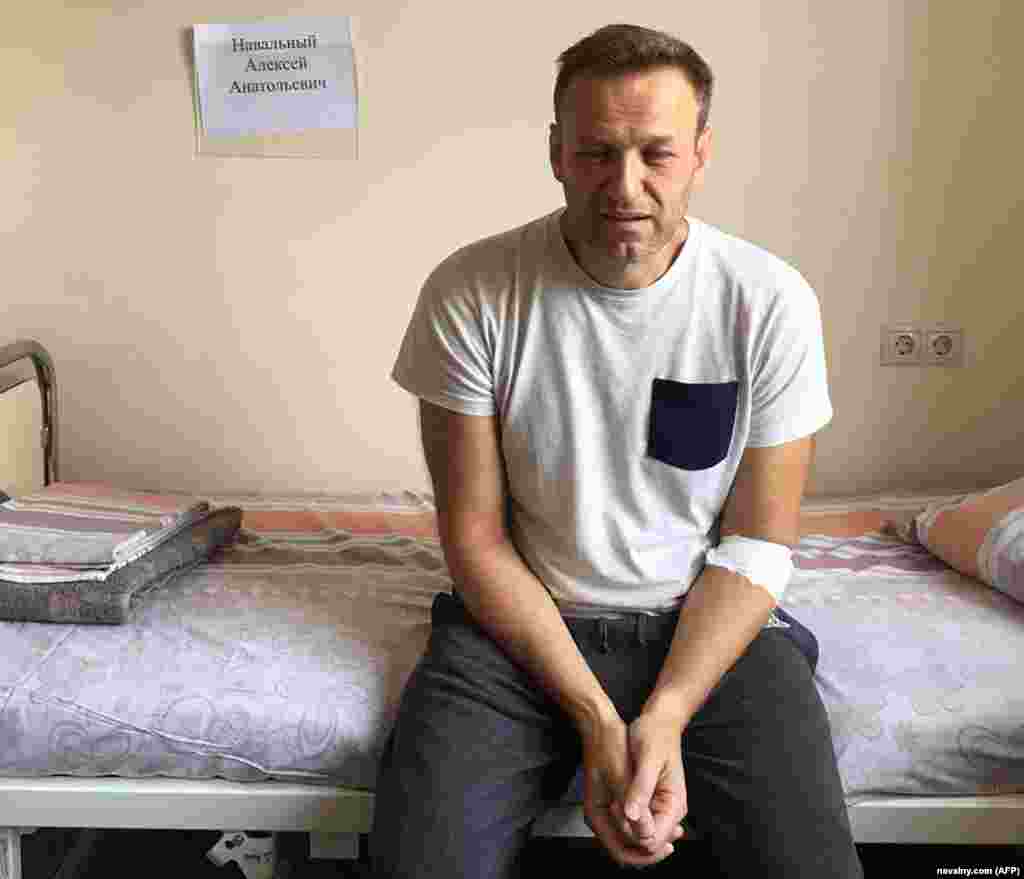
13/15Navalny, his eyes red and puffy, sits on a hospital bed in Moscow on July 29, 2019, after feeling unwell in his Moscow cell while serving a prison term on charges of calling an unauthorized rally. He said he believed he'd been poisoned. Doctors attributed it to an "acute allergic reaction."
Pictures from some of the dozens of encounters Russia’s leading opposition figure has had with police, the courts, and unknown assailants through his years of public activism. Navalny has been jailed more than 10 times and has spent hundreds of days in custody since 2011.
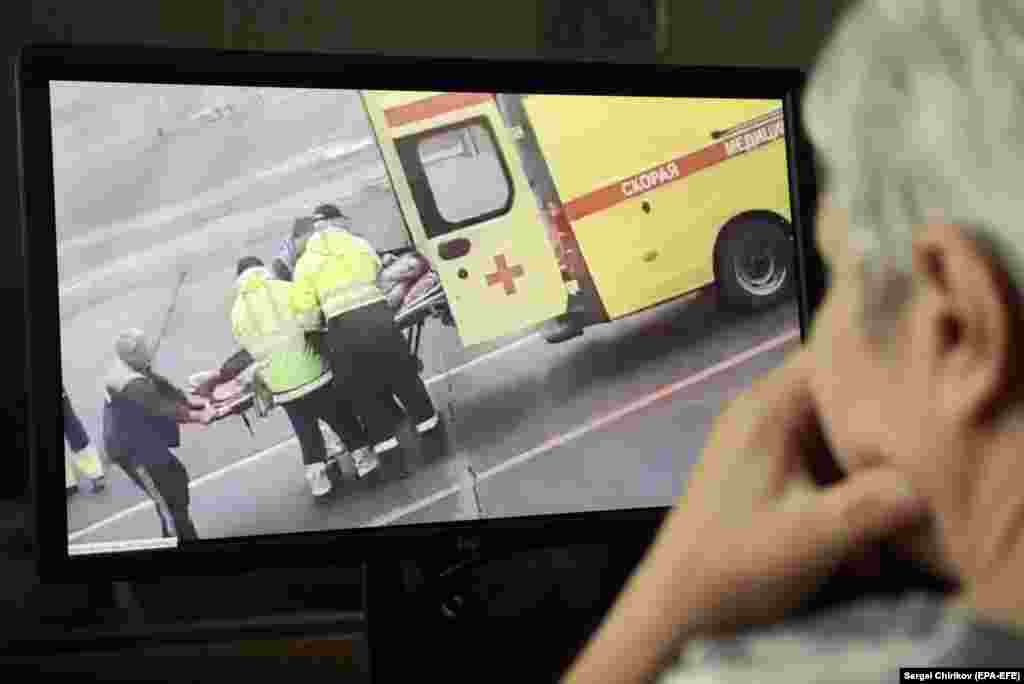
14/15A person watches a video on social media showing Navalny being carried on a stretcher by an ambulance team in Omsk after falling gravely ill from suspected poisoning while aboard a flight from Tomsk to Moscow on August 20.
Pictures from some of the dozens of encounters Russia’s leading opposition figure has had with police, the courts, and unknown assailants through his years of public activism. Navalny has been jailed more than 10 times and has spent hundreds of days in custody since 2011.
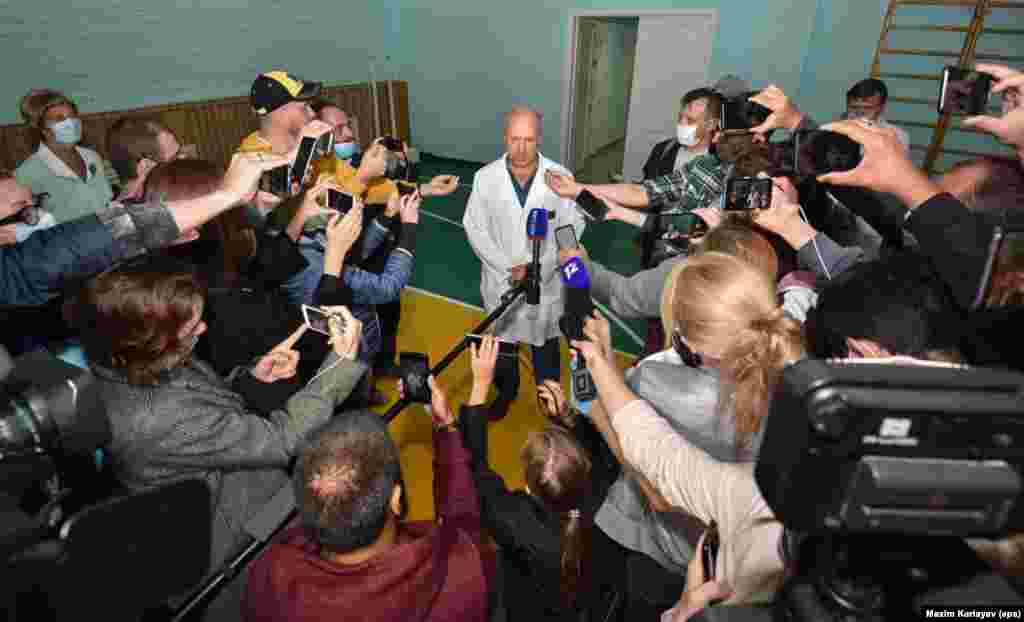
15/15A doctor at an Omsk hospital tells journalists that Navalny had been placed in an induced coma.
Pictures from some of the dozens of encounters Russia’s leading opposition figure has had with police, the courts, and unknown assailants through his years of public activism. Navalny has been jailed more than 10 times and has spent hundreds of days in custody since 2011.
In July 2019, Navalny was given a 30-day jail term after calling for unauthorized protests. During that jail sentence, he was taken to a hospital with severe swelling of the face and a rash, and later alleged he was poisoned.
He has been jailed several times in recent years, barred from running for president, and had a bid to run for Moscow mayor blocked.
The head of the legal department of the Anti-Corruption Foundation Navalny founded, Vyacheslav Gimadi, wrote on Twitter, "There is no doubt that Navalny was poisoned for his political position and activity."

With reporting by TASS, ngs55.ru , AP, dpa, Reuters, Fox News, and AFP