




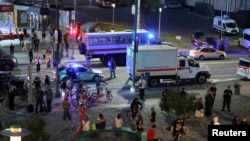
Russian authorities said on August 2 that an improvised explosive device was detonated at a restaurant in central Moscow, killing at least three people and wounding 21 others, as investigators worked to determine who was behind the bombing.
The National Anti-Terrorism Committee said the device exploded at a restaurant on Kudrinskaya Square, near the center of the Russian capital, around 8 p.m. local time on August 1.
It said those killed included a woman suspected of bringing the explosive device to the restaurant, a security guard who stopped her from entering, and one of the restaurant's guests.
Some sources have reported five deaths in the incident, but Russian authorities have yet to confirm.
"An improvised explosive device was detonated in a restaurant," the committee said in a statement carried by Russian state news agencies.
The 21 wounded suffered injuries of varying degrees of severity, according to the committee. It said operational and investigative measures were under way to establish the circumstances of the blast.
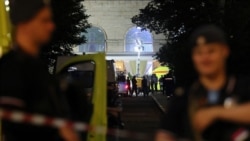

The explosion occurred at Balzi Rossi Italian restaurant, which is located in one of Moscow's Stalin-era skyscrapers.
The restaurant had been closed for a private function, according to its website.
The Telegram channel for Astra, an independent Russian-language news outlet, reported that the venue was hosting a Russian general's party, citing military vehicles outside.
Journalist Oleg Kashin suggested the celebration may have been for Colonel-General Aleksandr Chaiko, head of Russia's Aerospace Forces.
However, Russian authorities have not commented yet on who the intended target was.
Russian state media reported that the explosive went off after the unidentified woman was stopped from entering the restaurant.
Images released by Russian media showed heavily armed law-enforcement officers, ambulances, and emergency vehicles at the scene. Roads around Kudrinskaya Square were temporarily closed, while the area was cordoned off.
Russian authorities have not identified the woman or the other victims. They have also not said who may have been responsible for the bombing or identified a possible motive.
The circumstances surrounding the detonation remained unclear. Reuters, citing the newspaper Kommersant, reported that the bomb may have been intended to kill or injure people on the restaurant's summer terrace and may have been detonated remotely.
The report said the woman carrying the device may not have known that it was an explosive.
Previous Attacks
The possibility of a link to Russia's war against Ukraine is likely to come under scrutiny, given a series of attacks and attempted assassinations in Russia targeting senior military figures and prominent supporters of the Kremlin's war effort.
Russian authorities have repeatedly blamed Ukraine for such attacks, although Kyiv has not publicly claimed responsibility for the August 1 bombing.
In April 2025, Russia blamed Ukraine for the killing of Lieutenant General Yaroslav Moskalik, a senior Russian military officer, in a car bombing near Moscow. Ukraine did not publicly acknowledge responsibility.
In December 2024, Lieutenant General Igor Kirillov, head of Russia's nuclear, biological, and chemical protection troops, was killed along with his assistant when a bomb attached to a scooter exploded outside an apartment building in Moscow. Ukraine's SBU security service later said it was behind the operation.
Other prominent Russian figures have also been targeted since Moscow launched its full-scale invasion of Ukraine in February 2022.
Darya Dugina, the daughter of nationalist ideologue Aleksandr Dugin, was killed in a car bombing outside Moscow in August 2022. Russian authorities accused Ukraine, which denied involvement.
In April 2023, Vladlen Tatarsky, a prominent pro-Kremlin military blogger, was killed when a statuette handed to him exploded at a cafe in St. Petersburg. Russia said the killing was a terrorist attack and accused Ukraine of involvement, but provided no evidence.
And in May 2023, pro-Kremlin writer and nationalist figure Zakhar Prilepin was seriously wounded in a car bombing that killed another person in the Nizhny Novgorod region.
So far, Russian authorities have not drawn any connection between those attacks and the August 1 bombing.
The latest blast came as Moscow has sought to tighten security around senior military and government officials.
Russia's Federal Security Service said earlier this year that authorities would step up protection around high-ranking military officials following a series of assassinations and attempted killings that Moscow has blamed on Kyiv.
The bombing also occurred as Russia continues its war in Ukraine, with Moscow and Kyiv carrying out regular drone and missile attacks against targets on each other's territory.
There was no immediate indication that the Moscow blast was connected to the fighting in Ukraine.
Investigators and forensic specialists from the Moscow branch of Russia's Investigative Committee were working at the scene, according to Russian authorities.