




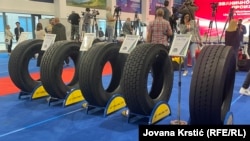
The United States has banned imports of car tires from the Chinese-owned Linglong factory in northern Serbia following years of allegations that workers there were subjected to forced labor and abusive conditions.
For Rafik Buks, an Indian construction worker who helped build the plant in Zrenjanin in 2024, the move comes as no surprise.
“What we experienced in Serbia was forced labor,” he says. “We were controlled, exploited, and treated without dignity.”
Buks recalls being promised legal work, decent pay, and humane accommodation before leaving India. “None of it was true,” he says.
US customs officials announced on December 18 that they were blocking imports from the Zrenjanin facility, citing evidence that workers’ passports had been confiscated, wages withheld, and staff exposed to abusive living and working conditions.
Washington’s decision follows years of warnings from local and international NGOs about the treatment of Linglong’s largely Asian workforce and raises uncomfortable questions for Serbia’s government, which has courted Chinese investment and hailed the $940 million project as one of "national importance."
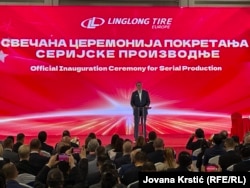
Serbian authorities, however, have remained conspicuously silent. Neither Linglong nor any Serbian institution has publicly addressed the US allegations.
That contrast alarms Mirjana Mitic of Astra, a Serbian anti-trafficking NGO.
“What is most worrying is the gap between the reaction of international institutions and that of institutions in Serbia,” she says.
While foreign governments and rights groups have responded forcefully, complaints filed at home have languished without resolution.
Concerns about forced labor at Linglong first surfaced several years ago when the facility was being built, and NGOs and media reported on the plight of hundreds of Vietnamese workers housed in squalid barracks near the construction site.

In 2021 and 2022, RFE/RL's Balkan Service documented overcrowded dormitories, food served on the floor, and claims that wages were months in arrears and passports had been seized. Linglong denied responsibility, insisting that the workers were employed by subcontractors, and Serbian authorities effectively shut reporters out of the camp.
The case was later verbally declared closed by the government’s anti-trafficking center, which said it had been unable to communicate with the workers before they left the country.
This pattern repeated itself with a subsequent complaint on behalf of Buks and 10 other Indian men, alleging human trafficking and labor exploitation.
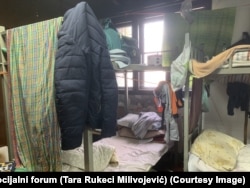
The men said their passports had been taken and their pay withheld. They also said that they were not only sent to the tire plant construction site but also to other building projects around Serbia, even as Linglong claimed they had never worked for the company.
Prosecutors in Zrenjanin said they had asked police to gather information; the Serbian Interior Ministry has yet to say what, if anything, that investigation found.
Linglong again rejected the accusations, asserting that the Indians had not worked on its factory. According to Mitic, the men eventually received back pay and compensation, plus travel tickets home, but no official findings have ever been published.
'I Will Not Chase Away Investors'
European institutions have also raised the alarm.
In 2021 the European Parliament passed a resolution urging Serbia to investigate allegations that roughly 400 Vietnamese workers at Linglong had been subjected to forced labor. Belgrade has never provided a public answer.
Serbian President Aleksandar Vucic has repeatedly defended the project, dismissing criticism as a “media-political campaign” against a prized Chinese investor. “We will try to help the Vietnamese workers, but I will not chase away investors,” he said at the time.
The factory itself finally began production in September 2024, five years after building started.
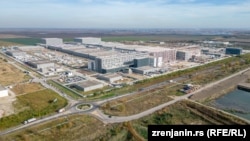
It sits on 100 hectares of state land granted free of charge and has received at least $89 million in direct subsidies.
An account in the company's financial report related to “capital subsidies and other state allocations for the construction and acquisition of fixed assets and intangible assets,” shows that from 2020 to 2024, Linglong was awarded just over $247 million.
What is clear is that the plant is overwhelmingly export-oriented.
In 2024, Linglong shipped tires worth $209 million abroad, while sales on the domestic Serbian market totaled $11.2 million. The firm does not disclose where its exports go, and it has not said how much was destined for the US market now closed off by Washington’s ban. Company filings show its workforce grew by 48 percent last year to almost 1,750 employees.
Local activists say the factory continues to rely heavily on foreign labor hired through a web of subcontractors.
“From the very beginning, during construction and now in production, Chinese workers have been employed in worse conditions than Serbian workers,” says Tara Rukeci of the Zrenjanin Social Forum, a local NGO which has supported migrant staff.
She says large agencies such as China Energy initially brought in hundreds of people, but that the field has since fragmented into many smaller intermediaries, making oversight even harder.
A Broader Pattern
The Linglong controversy is also part of a broader pattern.
Chinese investors have become central to Serbia’s infrastructure and industrial strategy under the Belt and Road Initiative, Beijing’s flagship plan to link Asia and Europe.
Alongside new roads, bridges, and factories, rights groups and EU officials have catalogued a trail of environmental damage, opaque contracts and reports of labor exploitation.
In 2021, RFE/RL reported that Chinese workers at a copper mine camp near Bor in eastern Serbia lived in poor conditions and were barred from leaving the site or interacting with locals.
Those concerns have repeatedly featured in European Commission reports on Serbia’s progress toward EU membership, which warn that Chinese-backed projects often bypass European standards on transparency, environmental protection and social rights.
For workers like Buks, the consequences are painfully personal. “What happened in Serbia changed me forever,” he says. “Now I check every foreign job offer very carefully.”

