


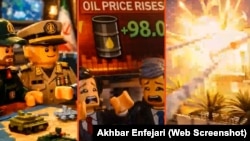
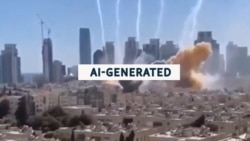
WASHINGTON -- From viral Lego-style videos and AI-generated hip-hop tracks to fabricated battlefield imagery, the war in Iran is revealing how artificial intelligence (AI) is being weaponized in modern warfare and statecraft.
To discuss this rapid shift, RFE/RL spoke with Max Lesser, senior analyst on emerging threats at the Foundation for Defense of Democracies (FDD) Center on Cyber and Technology Innovation.
RFE/RL: You have tracked Iranian influence operations closely. How sophisticated has Iran become online? Are we watching the world's first real AI war unfolding around Iran right now?
Max Lesser: Iran has become increasingly sophisticated in its online influence operations. There's definitely been a big shift. The AI Lego videos are probably one of the most successful propaganda efforts that I've ever seen come out of Iran targeting foreign audiences.
But that's just one type of Iranian influence operation. They've conducted successful hack-and-leak operations, for example against the [US President Donald] Trump campaign leading up to the 2024 elections, and they've had a long history of aggressive influence operations targeting foreign audiences.

Whether this is the first AI war, I wouldn't say that personally. In previous conflicts, for example during the 12-day war [in June 2025], Iran was creating deepfakes and spreading deepfakes on state media and things like that. But a lot of that was more focused on their domestic audience and trying to convince their own domestic audience that they were having military successes.
What distinguishes this moment is that there is a long history of Iran using AI in influence operations targeting foreign audiences, but I don't think they had done that particularly successfully until now. They're doing it more successfully now because they're figuring out how to use AI to communicate to Americans in ways that resonate with Americans -- using hip-hop music, using Lego videos. Apparently, sympathetic Americans are even telling them what they should put in their next video.
So it's not the first time that Iran has used AI in propaganda and influence operations. It's not the first time they've done it during wartime. But I think it's the first time where we've seen their use of AI in influence operations make such a splash.
'Psychological Warfare Is Crucial'
RFE/RL: To understand the scope of this, when people in the West scroll through social media during this conflict, how much of what they are seeing could actually be fake?
Lesser: It's hard to put a number on it because everybody's feed is different, based on preferences and algorithms. But in terms of fakes and deepfakes specifically, whenever people see videos claiming to show strikes or battlefield footage, they should verify them before believing them. Sometimes there is real footage of successful strikes, but there are also many techniques being used to fabricate or manipulate imagery.
It's not just Iran doing this. I actually started tracking this type of behavior years ago when the Houthis -- an Iranian proxy -- were using AI-generated imagery of ships going up in flames during attacks in the Red Sea.
There's definitely a precedent for this type of behavior. It's been happening for years. Whenever people encounter those sorts of images, they should exercise caution and look for verification outside social media.
RFE/RL: Is Iran using AI mainly to spread propaganda or to deliberately create confusion and panic inside the West? What exactly are they trying to communicate through these campaigns?
Lesser: A huge part of it is telling their story and spreading narratives like the US being imperialist and Iran portraying itself as resisting that oppression. A lot of the messaging tries to align the Iranian government and its struggle against America with progressive causes in the US.
In one of their recent Lego videos, they showed an Iranian man speaking with an anti-Trump liberal in Portland. They also referenced Black Lives Matter protests and anti-Trump demonstrations.
There's a lot of messaging designed to appeal to specific audiences in America: people who are anti-war, anti-Trump. Surprisingly, you even saw rainbow imagery, even though Iran is an extremely anti-gay country. They are strategically using imagery and narratives they believe will resonate with Western audiences.
Another major theme is [American financier and convicted child sex offender Jeffrey] Epstein. They frequently refer to American and Israeli elites as the "Epstein class" and try to portray themselves as part of a global resistance movement against corrupt elites. Again, the most powerful thing is storytelling. That's what gets clicks.
RFE/RL: Do we know who inside the Iranian system is running these campaigns? And how much of it is automated, involving bots, synthetic influencers, AI-generated accounts, etc.?
Lesser: One important actor is the Basij, Iran's voluntary paramilitary force. The Basij has units focused specifically on propaganda and psychological operations. A lot of that is domestic. The Basij uses influence operations as a tool of domestic control against the Iranian population.
They flood Iranian social media platforms and Western platforms like X with Persian-language propaganda targeting Iranians and the diaspora. We've documented hundreds of these accounts at FDD, though we believe there are probably thousands engaging in this activity.

Then there are different units inside the [Iranian Revolutionary Guards Corps], as well as Iran's Intelligence Ministry, known as MOIS. These groups have all been involved in influence operations, cyberattacks, and information warfare.
Iran's state broadcaster, IRIB, also plays a role by seeding propaganda domestically that later spreads abroad. But there's also a gray zone where pro-regime civilians participate independently or semi-independently.
For example, the creators of the Lego videos initially denied ties to the Iranian government but later admitted the Iranian government was one of their customers. What remains unclear is whether they are taking direct orders from Tehran or simply producing content the government later distributes.
RFE/RL: Beyond X and TikTok, are there particular platforms Iran is weaponizing against the West, such as Telegram, Instagram, or others?
Lesser: Definitely. Telegram is widely used for coordination because it's less popular among Americans and offers fewer restrictions. We've seen Iranian influence operations use Telegram to crowdsource and coordinate participants.
Meta also released a report earlier in the conflict explaining that Iranian operatives were posing as Americans on Facebook and Instagram to engage directly with American audiences.
They were also creating fake media outlets and fake news organizations. Platforms like Meta tend to enforce policies more aggressively, which is why Iran often uses more covert tactics there.
RFE/RL: You've warned about authoritarian influence ecosystems. How closely are Iran, Russia, and China now working together online?
Lesser: It's very difficult to prove direct operational coordination. Personally, I haven't seen concrete evidence of them messaging each other behind the scenes and coordinating propaganda campaigns directly. But they absolutely use each other's content, mirror each other's narratives, and copy each other's tactics.
Russia was really one of the pioneers in this space with fake accounts, hack-and-leak operations, and covert influence campaigns. Iran and China learned from those models and developed their own versions.
For example, Russia carried out the hack-and-leak [operation] against the [Hillary] Clinton [presidential] campaign in 2016, while Iran conducted a high-profile hack-and-leak operation targeting the Trump campaign in 2024.
While I can't say there's confirmed coordination, they are clearly learning from one another, echoing one another, and sometimes directly copying each other.

RFE/RL: Is the United States prepared for this kind of AI-powered psychological warfare?
Lesser: No, I don't think so. You can look at what happened with the Lego videos. There really wasn't a meaningful response from the United States. But it's also hard to know what the response should be. We can't simply take these videos down. We have a free and open Internet and protections for free speech.
Even if you remove them from one platform, they'll reappear elsewhere -- Telegram or other platforms with less moderation. So this isn't just about takedowns. America has to educate its own people about who the Iranian regime is, how it oppresses its population, and how it uses propaganda strategically. That's what will ultimately make people less susceptible to these campaigns.
RFE/RL: Are Iranian influence networks targeting American and European audiences differently in order to exploit political polarization inside Western democracies?
Lesser: They definitely tailor messaging. For example, they've promoted Scottish independence narratives through covert accounts targeting audiences in Scotland. They've also created fake French media outlets and localized campaigns in Europe.
But many of the narratives they use in America also resonate in Europe: anti-Trump messaging, anti-war messaging, anti-establishment narratives. Essentially, they're saying: “You're anti-Trump? We're anti-Trump too. You're against this war? We're against this war, too.” Then they package those narratives into emotionally engaging Lego videos with catchy music, and people begin feeling emotionally aligned with them.
The American government needs to do a better job informing the public about how brutal the Iranian regime actually is, how it treats its own people, and how long it has supported terrorism and repression.
Iran is telling a story. The United States needs to tell a stronger and more truthful story in response.