


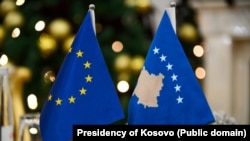
The European Union says it will start lifting sanctions this month first imposed on Kosovo in summer 2023, when Pristina implemented the results of controversial elections in the Serb-dominated north despite warnings from Brussels.
The move could potentially resuscitate the Balkan country's EU hopes, allowing this to be the year its EU membership application, submitted in late 2022, can finally be assessed by the European Commission. It may also allow for a restart of the Brussels-facilitated dialogue with Serbia after a two-year hiatus.
The sanctions raised eyebrows when first adopted as they lacked precedent when it came to the bloc's relationship with an EU hopeful. For starters, they were not sanctions in a strict political and procedural sense and have been referred to as "measures" in the "corridor lingo" of Brussels.
EU sanctions must be presented to the 27 EU member states in a formal legal act and then unanimously agreed. This was the case, for example, when Brussels imposed asset freezes and visa bans on individuals from EU candidate country Turkey in 2019 due to the unauthorized drilling for gas in the Eastern Mediterranean.
With Kosovo, nothing of the sort happened. Instead, the EU foreign policy chief at the time, Josep Borrell, wrote a letter to EU member states outlining the measures and recommending the capitals implement them even though there was no obligation. The directorate-general for enlargement, the EU's department dealing with countries wanting to join the bloc, then informed Kosovo of what would hit them.
These measures were mainly EU-related, meaning funding for Kosovo from the bloc's common budget would be frozen, high-level visits would be on hold, and the Stabilization and Association Council -- the main political conduit for Brussels-Pristina relations -- would not meet until further notice.
Intriguingly, while there was no formal EU unanimity to impose the sanctions, member states later stepped in to demand unanimity to lift them. In one of his last acts before leaving office in 2024, Borrell asked for the measures to be removed, but there was no consensus and the initial decision stood.
Some momentum in Kosovo's favor came with the new European Commission team starting at the tail-end of 2024 as diplomats noted that outgoing Hungarian Enlargement Commissioner Oliver Varhelyi had "a soft spot" for Serbia and prevented any real movement in favor of Pristina.
An approach of "gradual lifting" of the measures was announced, though what it entailed wasn't spelled out. Both European Commission President Ursula von der Leyen and new EU foreign policy chief Kaja Kallas visited the country in 2025, dismissing the notion of a ban on high-level visits even though no high-ranking Kosovar politician came to Brussels on a bilateral visit that year.
The political breakthrough came at an EU-Western Balkans summit in Brussels on December 17, when Von der Leyen announced that the measures would be lifted. This came after what Brussels called "smooth and peaceful" local elections in north Kosovo in October reversing the move from 2023.
But that wasn't the end of the story.
In the run-up to the summit France, Hungary, Italy, Slovakia, and Spain pushed for a two-step lifting in which roughly half the frozen money -- 216 million euros -- could be released for Pristina imminently. The remainder, some 205 million euros, would be distributed first after the national parliamentary elections on December 28; they argued that incumbent Prime Minister Albin Kurti could benefit too much electorally if all the cash was released immediately.
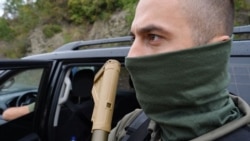

A new condition had been set by largely the same countries had been instrumental in Serbia avoiding similar EU measures later in 2023 after Serb militants with alleged Belgrade backing attacked Kosovar police in the northern village of Banjska, leaving one law enforcement officer dead.
While other EU member states grumbled that pro-Serbian member states yet again were causing anti-Kosovo moves, they eventually agreed as they wanted to avoid another political impasse.
In the end, Kurti increased his vote share and the EU promptly put out a statement saying the second part of the frozen funds would be released in early 2026.
The issue now is that while the political decisions have been taken to lift all the measures, the actual technical work hasn't yet kicked in. In fact, the first batch of money has been "programmed" -- meaning earmarked for various Kosovo recipients -- but has not yet been received. According to EU officials RFE/RL has spoken to, Brussels has not made the formal move to "program" the second batch even though it is expected to be a formality made later in January.
As these measures were imposed in an unprecedented way in 2023, there is discussion in Brussels about what is needed to technically lift them. For example, do EU member states need to be consulted again in writing or in some council working group or committee, or can the commission just go ahead regardless?
What is clear, however, is the European Commission wants to re-engage with Kosovo. Few in the building believe Serbia and Kosovo will be happy to take part in the dialogue to normalize relations anytime soon, but the Brussels envoy for the talks, Danish diplomat Peter Sorensen, recently had his mandate renewed for another two years.
It is believed that Kallas, who has yet to host a single dialogue at the highest political level, is keen to try to achieve something in the Western Balkans after a bruising start as the bloc's top diplomat.
With Brussels increasingly sidestepped on issues such as peace talks about Ukraine, the Gaza war, and the situation in Iran, EU officials half-jokingly note that getting Serbia and Kosovo to agree might be the "lowest-hanging fruit" available for the bloc at the moment.
There could also be a chance that EU member states finally agree to send over Kosovo's EU membership application to the European Commission for the EU executive to assess whether Pristina can join the club down the line.
The last country that truly tried to tackle the issue is the Czech Republic, which received the application during its six-month presidency of the council in the latter half of 2022. The five Kosovo nonrecognizers Cyprus, Greece, Romania, Slovakia, and Spain blocked any movement, however, and have made it clear to fellow EU member states holding the rotating council chair that they won't entertain the issue.
We can expect that nothing will happen in the first half of 2026 while Cyprus is at the helm, but there might be a change when Ireland takes over in July. Dublin has indicated it is pushing hard to conclude EU accession negotiations with Montenegro by the end of the year and hopes to push Albania, Moldova, and Ukraine closer to the club as well. With EU enlargement being one of Ireland's top priorities, it may even test the waters on Kosovo.
Rumors are swirling in Brussels corridors that Spain -- often the most hardened of the nonrecognizing quintet -- will finally allow the commission to give an assessment so long as the process doesn't force member states to immediately tackle the issue of Kosovar statehood.