


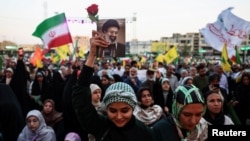
WASHINGTON -- As US President Donald Trump signals an agreement with Iran could be within reach, major questions remain over Tehran's nuclear ambitions, regional security, and the durability of any future deal.
Amid continuing tensions across the Middle East -- from southern Lebanon to the Strait of Hormuz -- RFE/RL spoke with Lisa Gable, a former US ambassador who served during the George W. Bush administration and is now the chairwoman of World In 2050, about the prospects for diplomacy, the challenges of verification, and the broader geopolitical stakes.
RFE/RL: One of the biggest questions is whether diplomacy can stay on track amid ongoing tensions and potential cease-fire violations. How vulnerable are the current talks to developments on the ground, particularly when a single military incident can quickly change the political environment?
Gable: It can, but we haven't seen it do so yet. One of the things you see in this particular situation that is very different from what we've had in the past when dealing with the Middle East and Iran is that, through the work of the first Trump administration and the Abraham Accords, you are seeing a much stronger form of communication, engagement, and conversation with allies in the region.
If we think through the history of that region, the United States has never had a stronger relationship with countries like Qatar, the UAE, Oman, and Saudi Arabia. Having those countries be part of the Abraham Accords and having those relationships develop has changed the dynamics of what we're seeing today.

RFE/RL: Iranian officials have publicly pointed to mixed signals from Washington. Can diplomacy succeed when both sides question each other's intentions?
Gable: More sophisticated players realize there are multiple levels of negotiation. You've got people talking at different levels in different governments and in different areas of the region.
We have military conversations going on. We have public conversations that guide public discourse, but they're not always fully representative of everything going on behind the scenes.
I would be reluctant to make any prediction right now and would actually question who could, given the different levels of conversation that are taking place.
RFE/RL: Secretary of State Marco Rubio recently suggested Iran is discussing issues it previously refused to negotiate. Do you see that as evidence of meaningful movement, or is it too early to interpret such signals as a breakthrough?
Gable: It's too early to predict. We've seen different points in the conversation, and we've seen reversals in the conversation. But I have great respect for Secretary Rubio. As I mentioned, there are different levels of conversation taking place.
What we also don't have a full grasp of is who's really in charge in Iran. We've had a lot of changes in the hierarchy, and it would not be surprising to discover that some players in the country might be having one set of conversations while others are having different conversations.
At this stage of the game, I would listen to what Rubio is saying and use that as guidance.
RFE/RL: If the United States continues to emphasize sanctions relief and access to international commerce, while Iran remains focused on economic recovery, which side currently holds the stronger negotiating position?
Gable: It comes down to the unity of allied nations involved in this conversation. The commercial aspects of this are affected by the Strait of Hormuz, but any disruption there affects many countries. It's not only affecting the United States; it's also affecting China and Russia. That works to our benefit, but at the same time, that level of basic commercial activity -- particularly the movement of ships -- is going to be the primary concern for everyone.
RFE/RL: How important is bipartisan support if any agreement is going to survive beyond the current political cycle?
Gable: We're entering a very highly contested election in November. To the degree that we can get some level of bipartisan support, we are always stronger. That vote [NOTE: The US House of Representatives approved a war powers resolution on June 3 aimed at curbing Trump's military campaign against Iran] didn't take place with a broad number of Republicans, but you did see some Republicans move over to the Democratic side. That is a signal.
The question is: What conversations are going on in the background as everyone seeks a resolution that brings peace, security, and safety, while also giving us the financial flexibility we need within the markets?

RFE/RL: Looking beyond Washington and Tehran, which external actors -- whether Gulf states, European allies, or regional mediators -- are most critical to turning a temporary arrangement into lasting peace?
Gable: The Gulf states. As I said earlier, the Trump administration deserves credit for building closer relationships within the Gulf during the first Trump administration. The European allies, to some degree -- except for countries in the Balkans, Poland, and some others -- have tried to maintain their distance, which is very unfortunate because we are essentially protecting their rights and access to energy, upon which they are very reliant.
I would hope our European allies would be more supportive of any American initiative, but they have not been to date.
RFE/RL: Should the ultimate goal be a narrow agreement focused solely on the nuclear issue, or a broader framework that also addresses regional security, proxy groups, and economic normalization? Which approach offers the best chance of lasting stability?
Gable: It's a multistep process, and again, it depends on veracity and the ability to trust. I go back to Ronald Reagan's phrase: "Trust, but verify." Can we verify what's happening on the nuclear front? At the same time, can we monitor the actions of the Iranians as they relate to the United States and allied countries like Israel?
Israel has faced some of the greatest challenges over the last several years from Iran-backed proxies, and so we'll be watching that very closely.

