




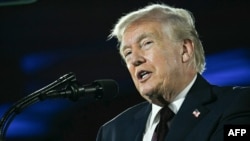
US President Donald Trump postponed threatened attacks on Iranian power plants for a second time, apparently giving Tehran 10 more days to open the Strait of Hormuz to shipping, and said talks on ending the war were going "very well."
Trump announced the postponement in a March 26 social media post that followed a series of public warnings that Iran had better free up the crucial waterway and comply with US conditions "before it is too late."
“As per Iranian Government request…I am pausing the period of Energy Plant destruction by 10 Days to Monday, April 6, 2026, at 8 P.M., Eastern Time,” (2 a.m. CET on April 7) he wrote on his platform, Truth Social.
On March 21, Trump said the United States would "obliterate" Iran's power plants if Tehran did not open the Strait of Hormuz, a crucial oil and gas transport channel that Iran has effectively blocked to most traffic amid the war with the United States and Israel, within 48 hours. He later extended the deadline to March 27.
Senior Iranian officials have denied Tehran is in negotiations with Washington, but Iran said on March 25 that it was reviewing a 15-point US proposal and put forward what it said were five conditions that needed to be met in order for the conflict to end.
"Talks are ongoing and, despite erroneous statements to the contrary by the Fake News Media, and others, they are going very well," Trump said in the Truth Social post on March 26.
In a post earlier in the day, Trump said Iranian negotiators "better get serious soon, before it is too late, because once that happens, there is NO TURNING BACK, and it won't be pretty!"
"They are 'begging' us to make a deal, which they should be doing since they have been militarily obliterated, with zero chance of a comeback, and yet they publicly state that they are only 'looking at our proposal,'" he wrote.
During a cabinet meeting at the White House, he said Iran has a chance "to permanently abandon their nuclear ambitions and to join a new path forward. We'll see if they want to do it. If they don't, we're their worst nightmare. In the meantime, we'll just keep blowing them away."

The details of the US plan have not been disclosed, but Western media have widely reported the proposal included some of the key demands Washington has been pushing for since before the current conflict began with US-Israeli air strikes against Iran on February 28.
Trump's special envoy Steve Witkoff confirmed that the United States had sent Iran a "15-point action list."
Speaking to reporters during the cabinet meeting, he suggested the diplomacy could be successful "if we can convince Iran that this is the inflection point with no good alternatives for them other than more death and destruction."
"We have strong signs that this is a possibility," Witkoff said. He said Pakistan had acted as a mediator, confirming statements by Pakistani officials.
While the US plan reportedly suggested dismantling Iran's nuclear facilities, limiting its missile capabilities, and ending its support for regional proxy forces, it was also thought to include some new elements, such as ones concerning the Strait of Hormuz, which has all but shut after several vessels were struck by Iran.
Iran has responded sharply, saying the US conditions were excessive and that it will end the war when it chooses and if its conditions are met. Tehran insisted on its right to freely develop its ballistic missile program and sovereignty over the Strait of Hormuz.
On March 26, a senior Iranian official reportedly told Reuters that Tehran sees the 15-point plan as only serving the interests of the United States and Israel, calling it "one-sided and unfair."
A day earlier, White House Press Secretary Karoline Leavitt told reporters there were "elements of truth" in the media reports but did not confirm any details.
She also suggested Trump will consider wider strikes on Iran if Tehran fails to "understand that they have been defeated militarily."
On March 26, US-based news outlet Axios cited two US officials and additional sources who said the US military is preparing a range of options for a potential "final blow" against Iran.
According to the report, possible scenarios included a US invasion or blockade of Kharg Island, Iran's primary oil export hub, as well as an invasion of Larak Island, which plays a key role in Tehran's control over the Strait of Hormuz.
A key oil and gas transit route, the Strait of Hormuz has became a central issue of the US-Israeli war with Iran. Shipping in the waterway -- a major artery for global oil and gas supplies -- has ground to a virtual halt due to Iranian strikes on some vessels and threats of more from Tehran.
During a press conference at the White House on March 26, Trump said he believed Tehran was seeking negotiations because of its "present" to the United States, which he said allowed 10 oil tankers to pass through the Strait of Hormuz.
Tehran has said ships from "non-hostile" nations would have clear passage through the Strait of Hormuz. Officials have not specified which countries that includes, though vessels from Malaysia and Pakistan have reportedly been allowed passage.
Even if some ships are allowed through, the overall uncertainty, however, for shipping traffic has made it impossible to secure insurance, effectively blocking them using the
Separately, Trump has been pushing US allies to help the United States open the vital waterway. Several European countries said they were willing to consider helping once the conflict had ended, while others outright rejected the request, which came with no specifics.
On March 26, Trump criticized his NATO allies for not helping the United States in the campaign, adding that "the USA needs nothing from NATO."
"NATO nations have done absolutely nothing to help with the lunatic nation, now militarily decimated, of Iran," he wrote using all capital letters.
Speaking to Fox News last weekend, NATO Secretary-General Mark Rutte said he understood Trump's frustration, adding the alliance was looking to work on the issue together with Japan, South Korea, Australia, New Zealand, the United Arab Emirates, and Bahrain.
At his annual remarks on March 26, Rutte did not mention the Strait of Hormuz but warned of Iran's ties with Russia.
He also reiterated that US weapon deliveries to Ukraine paid by Kyiv's European allies were "critical" as global attention has vastly shifted from Moscow's invasion to the conflict in the Middle East.

