



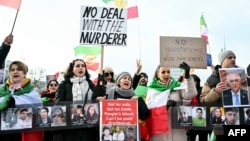
A second round of indirect talks between Iran and the United States over Tehran's nuclear program concluded in Geneva, Switzerland, on February 17 without an agreement.
"Progress was made, but there are still a lot of details to discuss," a US official told RFE/RL. "The Iranians said they would come back in the next two weeks with detailed proposals to address some of the open gaps in our positions.'
Iran's Foreign Minister Abbas Araqchi told his country's state media that the two sides had "reached an understanding" on key issues, but cautioned that it "does not mean that we will reach an agreement soon."
He added that Tehran and Washington will begin work on potential agreement documents but said no date had been set for the next round of talks.
In an interview to Fox News after the end of the February 17 talks, US Vice President JD Vance said that Iran "is not ready yet to recognize [US President Donald] Trump's red lines."
"Iran says it is not seeking nuclear weapons, but we know it is not true," Vance said. "We would very much like to resolve all the issues through a conversation." The vice president added that Trump has "many tools" to prevent the world's most unpredictable regime from acquiring the "world's most dangerous weapon."
Addressing a special session of the Conference on Disarmament at the United Nations after the talks with the United States, Araqchi said Tehran was "hopeful that negotiation will lead to a sustainable and negotiated solution which can serve the interest" of all parties involved.
He added, however, that Iran is "fully prepared to defend itself" against US strikes.
Mediated by Oman, the negotiations aim to resolve the years-long dispute over Iran's nuclear program as the United States continues to amass forces in the Arabian Sea.
President Donald Trump has warned that failure to reach a deal could lead to military strikes.
Iran's Supreme Leader Ayatollah Ali Khamenei shrugged off US threats of military action as Iranian and US negotiators began the talks.
Addressing a crowd of supporters in Tehran, Khamenei suggested that Iran has the capability to sink US warships amassing on its doorstep.
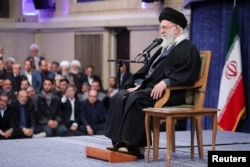
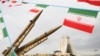
"What's more dangerous than a warship is the weapon that can send it to the bottom of the sea," he said, referring to Iran's missiles.
His comments come a day after Trump hinted at the possibility of military action if diplomacy fails.
"I don't think they want the consequences of not making a deal," Trump told reporters aboard Air Force One on February 16.
"We could have had a deal instead of sending the B-2s in to knock out their nuclear potential. And we had to send the B-2s," he added, referring to the bombing of Iranian nuclear facilities in June 2025.

On February 13, the US president said regime change in Iran would be the "best thing that could happen."
Directly addressing Trump, Khamenei said the president "will not be able to" overthrow the Islamic republic.
Trump said he would be "indirectly" involved in the Geneva talks. This marks the second round of negotiations this year between Tehran and Washington, following talks earlier this month in Muscat.
Iran has stated it is willing to submit to a stringent inspection regime of its nuclear facilities in exchange for the lifting of US sanctions. It has also sought to present its sanctions-hit economy as a lucrative investment opportunity for American firms.
However, Tehran has rejected the possibility of negotiating over issues such as its missile program and support for proxies in the region -- red lines the Trump administration insists must be addressed.
The talks were held at the Omani consulate, with mediators exchanging messages between Iranian Foreign Minister Abbas Araqchi and US Special Envoy Steve Witkoff.
Closing The Strait Of Hormuz
With the United States bolstering its military presence on in the Arabian Sea, the Islamic Revolutionary Guards Corps (IRGC) on February 16 kicked off naval drills in the Strait of Hormuz. Iranian media reported the aim was to test the operational readiness of the IRGC Navy against "possible security and military threats."
On February 17, state media announced the temporary closure of parts of the strait for "security precautions."
As tensions with the West escalate, Tehran often threatens to disrupt the strait -- a global chokepoint through which more than 20 percent of the world’s oil supply passes daily.