




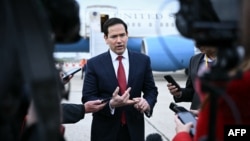
PARIS -- The United States expects to wrap up its military operation in Iran within "weeks, not months" and believes it is possible to achieve its goals without ground troops, US Secretary of State Marco Rubio said on March 27.
Rubio, speaking in the French capital after a meeting with the other Group of Seven (G7) foreign ministers, also said Iran may seek to set up a toll system for passage through the Strait of Hormuz as the US-Israeli war approached its fifth week.
“We are on or ahead of schedule…and expect to conclude it…in a matter of weeks, not months,” he said of the military campaign.
“We’re going to destroy their navy…their air force…their ability to make missiles and drones…and dramatically reduce missile launchers," Rubio said, adding: “We can achieve all of our objectives without any ground troops…this is not going to be a prolonged conflict.”
Referring to US troops dispatched to the region, he said the deployments were meant "to give the president maximum optionality and maximum opportunity to adjust the contingencies, should they emerge."
Rubio's remarks came as Iran warned of new attacks across the Middle East and urged civilians to avoid areas near US forces, a day after US President Donald Trump extended a deadline for Tehran to open the Strait of Hormuz, a crucial oil-and-gas transport route from the Persian Gulf to global markets, until April 6.
In a statement, the G7 foreign ministers and the European Union's top diplomat called for an immediate halt to attacks against civilian infrastructure in the US-Israeli war with Iran.
"There can be no justification for the deliberate targeting of civilians in situations of armed conflict as well as attacks on diplomatic facilities," they said. The G7 comprises the United States, Britain, Canada, France, Germany, Italy, and Japan.
Iran made no move to open the Strait of Hormuz. In a statement on March 27, the Islamic Revolutionary Guards Corps (IRGC) said it would keep the waterway closed and any potential attempts at transit involving the Unites States, Israel, or their allies would face "harsh measures."
Following the IRGC's warning, media reported that three vessels of various nationalities were turned back from the Strait of Hormuz on March 27.
The Strait of Hormuz accounts for around one-fifth of global oil shipments and the effective closure of it by Iranian forces has become a central issue of the conflict, which started with US-Israeli strikes on Iran on February 28.
Rubio said that Iran may decide to set up a toll system for the strait, calling that "unacceptable" and stressing that European and Asian countries that benefit from trade through the waterway should help ensure free passage when the conflict is over.
“We’re not asking anybody to join the war," Rubio said, adding that "countries that are most impacted [by closure of the strait]…need to be ready to do something about it.”
A day earlier, Trump for a second time postponed threatened attacks on Iranian power plants if it does not reopen the key waterway, citing what he said was a request from Tehran. He set a new deadline of 8 p.m. Eastern time on April 6.
Last weekend, Trump said the United States would "obliterate" Iran's power plants if Tehran keeps blocking the Strait of Hormuz after 48 hours. He later extended the deadline until March 27, then extended it another 10 days.
On March 27, Trump said Iran is "on the run" and that talks with Tehran were still ongoing.
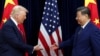
"We're negotiating now, and it would be great if we could do something, but they have to open it up," Trump told a Saudi-backed investment forum in Miami, referring to the Strait of Hormuz.
US Special envoy Steve Witkoff said the Trump administration is "hopeful" that "there will be meetings this week."
"We have a 15-point deal on the table that the Iranians have had for a bit of time. We expect an answer from them, and it would solve it all," he said at the Miami investment forum.
Senior Iranian officials have denied Tehran is in negotiations with Washington, but Iran said on March 25 that it was reviewing a 15-point US proposal and put forward what it said were five conditions that needed to be met in order for the conflict to end.
The US plan reportedly repeated Washington's demands for Iran to dismantle its nuclear facilities, limit its missile capabilities, and end its support for regional proxy forces.
Rubio said on March 27 that the United States had not yet received a response from Iran, and suggested contacts had been indirect.
"We've had an exchange of messages and indications from the Iranian system, whatever's left of it, about a willingness to talk about certain things," he said. "We're waiting for further clarification about...who is it that we will be talking to, what will we be talking about, and when will we be talking."
Informally, Tehran has responded sharply to the 15-point plan, saying the US conditions were excessive and that it will end the war when it chooses and if its conditions are met, insisting on its right to freely develop its ballistic missile program.
Trump said on March 26 that he believed Iran was seeking negotiations because of its "present" to the United States, which he said allowed 10 oil tankers to pass through the Strait of Hormuz.
Tehran has suggested that ships from "non-hostile" nations would have clear passage through the Strait of Hormuz. However, even if some vessels are allowed through, the overall uncertainty has made it difficult to secure insurance, effectively preventing ships from using the waterway.
With the war showing few signs of easing after almost four full weeks, the fighting has continued to cause casualties and damage across the Middle East.
In a social media post on March 27, Iranian Foreign Minister Abbas Araqchi said Tehran would exact a "HEAVY price for Israeli crimes," after what he said were strikes on "2 of Iran's largest steel factories, a power plant, and civilian nuclear sites among other infrastructure."
The Atomic Energy Organization of Iran said the Chondab heavy-water reactor and a production facility in Ardakan for yellowcake, which is used to manufacture nuclear fuel elements, were targeted.
The Israeli military confirmed the attack on the Arfakan site in Yazd province. The International Atomic Energy Agency (IAEA) said no increase in off-site radiation levels was reported.
Following air strikes on various parts of Iran over the previous 24 hours, the authorities of Iran's Qom Province on March 27 reported at least three attacks on residential buildings in the Pardisan neighborhood of Qom city.
Morteza Heydari, a spokesman for the Qom governorate, told the IRGC-affiliated Tasnim news agency that 18 people had been killed and 10 injured following the reports.
Separately, two Israeli soldiers -- both aged 21 -- were killed in Lebanon, according to a statement released by the Israeli military late on March 26.
The deaths brought the number of Israeli troops killed in the recently launched ground operations in southern Lebanon to four, according to military figures.
Israeli media reported one of the soldiers was killed in a rocket attack by Hezbollah, an Iran-backed group based in Lebanon that's deemed a terrorist organization by Israel and the United States. The second soldier was killed in an exchange of fire with fighters from the Shi'ite group, local media reported.
Citing information provided by the Iranian Red Crescent, the International Federation of Red Cross and Red Crescent Societies has reported more than 1,900 people have been killed since the beginning of the war, adding that at least 20,000 more have been injured. RFE/RL cannot independently verify the figures.

