




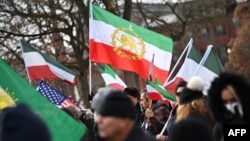
The death toll and number of arrests rose further in Iran as protests sparked by the country's worst economic crisis in years continued for an eighth straight day on January 4.
Driven by anger over soaring prices, inflation, and a plunging currency, the demonstrations swept across Iran after shopkeepers in Tehran went on strike earlier in the week over high prices and economic stagnation.
Iranian President Masud Pezeshkian tried to defuse the protests by promising "new decisions" to improve the economy, but the demonstrations soon expanded to include broader issues.
Economic woes have compounded years of political and environmental crises in Iran, including a severe drought in Tehran, a city of around 10 million people.
Death Toll Rises
Videos posted online and obtained by RFE/RL's Radio Farda showed that protests continued in the Iranian cities of Tehran, Yasuj, and Fardis, while fires burned in the streets of Mashhad and Mahallat on January 3.
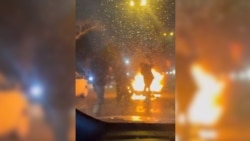

The largest protests in the country for three years have resulted in multiple deaths and arrests, with numbers reported differently by state media and rights groups.
According to a toll based on official reports, at least 12 people have been killed, including members of the security forces, while the Norway-based human rights group Hengaw said it had verified reports of at least 17 deaths since the start of the protests.
The US-based Human Rights Activists News Agency (HRANA), said at least 16 people had been killed and 582 arrested.
"At least 174 locations in Iran have witnessed protests, street gatherings, or trade strikes over the past seven days," HRANA said in a report published online on January 3.
"These protests have been reported across 25 provinces, and during this period, 18 universities have also seen student protest activities," it added.
RFE/RL could not independently verify the reports.
Tehran, Washington Exchange Threats
In recent days, US President Donald Trump and top Iranian officials have exchanged threats as demonstrations turned deadly and continued to escalate.
Trump said in a January 2 post on Truth Social that Washington is "locked and loaded" to respond if Iranian security forces kill more protesters.
On January 4, Trump reiterated the threat, telling reporters that Iran would get "hit very hard" if more protesters die during demonstrations.
"We're watching it very closely," he told reporters aboard Air Force One.
Iran's Supreme Leader Ayatollah Ali Khamenei sent a defiant response.
"What matters is that when a person realizes the enemy is arrogantly trying to impose something on the country, on the officials, on the government, and on the nation, one must stand firmly against the enemy and bare one's chest in resistance," Khamenei said on January 3.

The rebuttal from Tehran to Trump, who said in his comments that if Iranian authorities kill "peaceful protesters, which is their custom, the United States of America will come to their rescue," has been particularly forceful.
"The American people should know -- Trump started this adventurism. They should be mindful of their soldiers' safety," Ali Larijani, the secretary of Iran's Supreme National Security Council, wrote on X earlier in the week.
However, Saeed Bashirtash, an exiled Iranian activist, told Radio Farda that such "threats to react are more like bluffs."
"Iranian people welcome Trump's warning, because they will feel they face less threat when they take to the streets. It's very positive [because] the Islamic republic will be very careful about killing people," he added.
Another Iranian exile, veteran dissident Mehran Barati, told Radio Farda that despite the defiant language, there were "cracks inside the regime including Islamic Revolutionary Guards Corps (IRGC), army, and political leadership."
In comments sent to Radio Farda on January 2, a State Department spokesperson said Washington would "continue to put maximum pressure on the regime."
The inflamed language comes just six months after a 12-day war in June, when Israeli and US jets pounded Iranian nuclear and military sites.
Trump welcomed Israeli Prime Minister Benjamin Netanyahu at his Mar-a-Lago residence in Florida on December 29, when he suggested he would back new Israeli strikes against Iran's ballistic missile program.
Speaking on January 4, Netanyahu said that his government stood in solidarity with the people of Iran, adding that "it is very possible that we are standing at a moment when the Iranian people are taking their destiny into their own hands."
"We stand in solidarity with the struggle of the Iranian people and with their aspirations for freedom, liberty and justice," Netanyahu said at the weekly cabinet meeting.

