


Exhausted, Divided, And Waiting: Iranians On A Month Of War
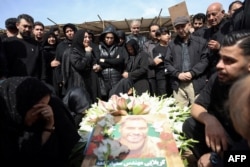
Continuing US-Israeli air strikes have left parts of Tehran in rubble and the nerves of many in the capital frayed.
As the war nears the one-month mark, US Central Command (CENTCOM) says over 10,000 targets have been struck across Iran. According to the US-based human rights group HRANA, at least 1,464 civilians -- including at least 217 children -- have been killed in Iran since fighting began on February 28.
RFE/RL's Radio Farda gathered testimonies from Iranian civilians about daily life amid the air strikes. Reaching ordinary Iranians remains very difficult amid the Iranian government's ongoing Internet blackout, which has now lasted more than 600 hours.
To read the full report, click here.

IRGC Announces Arrests Of 103 On Charges Of 'Collaborating With The Enemy'
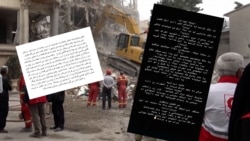
The Intelligence Organization of Iran's Islamic Revolutionary Guards Corps (IO-IRGC) said that it has arrested 103 people on charges of "collaborating with the enemy" since the beginning of the US-Israeli war with Iran.
In a statement released on March 26, the security agency of the IRGC -- which the United States has designated as a terrorist organization -- claimed that 13 of the detainees had planned to "sabotage, make the streets unsafe, and attempt to attack checkpoints," and that it had arrested 90 others on charges such as sending images to media outlets opposed to the Islamic republic.
The security agency also announced that it was taking legal action against 16 people for using the Starlink satellite Internet device and 400 people "who sold filter circumvention tools" in the past month. The IO-IRGC described sellers of VPNs and similar tools as "sellers of cyber evasion tools," using language that portrays them as aiding illegal activity.
Since hostilities began on February 28, Iran's security, judicial, and law enforcement institutions have published numerous reports of widespread arrests of citizens on similar charges. For example, the National Security Forces Command announced on March 24 that 466 people had been arrested on charges of "online activities aimed at undermining national security," claiming these individuals were in contact with "enemy" networks and intended to create internal instability.
State media have also reported the arrest of more than 1,000 people on similar charges during this period.
Due to the Internet shutdown in Iran and widespread disruption in communication channels, the only source of this type of news is government-affiliated media. It is not possible to independently verify its details.
Iran Says At Least 18 Killed In Attack On Qom
The authorities of Qom Province said that at least 18 people were killed in an air strike on residential buildings in the Pardisan neighborhood of Qom city on March 27.
Following air strikes on various parts of Iran over the past 24 hours, at around 3 a.m. local time, an attack on at least three houses in Pardisan was reported.
Morteza Heydari, the deputy political and security officer for the Qom governorate, told the Tasnim news agency, which is affiliated with the Islamic Revolutionary Guards Corps, that 18 people had been killed and 10 injured in the attack.
Heydari said "three residential houses" had been targeted in the attack but did not give the identities of those killed.
The Israeli military, which usually reports few details about targets in the days following such strikes, has not yet commented on this attack.
Heydari said the search and investigation operation to find other possible bodies is continuing and it is possible that the number of casualties could rise.
Qom is a significant religious center in Iran and one of the world's most important Shi'ite pilgrimage sites. The region is also strategically important due to its industrial and nuclear facilities.
UN Human Rights Commissioner Condemns Minab School Attack
The United Nations high commissioner for human rights, Volker Turk, issued a statement on March 27 urging parties in armed conflict to shield and protect children and educational institutions from harm.
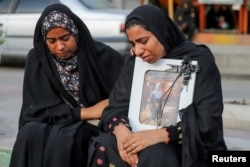
Addressing the Human Rights Council in a video statement, Turk highlighted the recent bombing of Shajareh Tayyebeh Elementary School in Minab, Iran, an attack that reportedly killed 168 students, teachers, staff, and family members.
"The images of bombed-out classrooms and grieving parents showed clearly who pays the highest price for war: civilians with no power in the decisions that led to conflict," he said. "That is why we have the laws of war: to protect children and other civilians caught up in conflict, as well as schools and all civilian infrastructure."
He said that in the case of this strike, which took place on February 28, the first day of the US-Israeli war with Iran, "the onus is on those who carried out the attack to investigate it promptly, impartially, transparently and thoroughly, to determine the facts and lay the basis for accountability."
"There must be justice for the terrible harm done," he added.
A US investigation into the strike in Minab is ongoing, although preliminary assessments indicated that US forces were likely responsible.
Turk also spoke out against strikes on populated, civilian areas. "In Iran, as the conflict has progressed, US and Israeli attacks have increasingly struck densely populated residential areas and destroyed civilian infrastructure," he said.
"Homes, medical facilities, schools, courts, transport networks, and energy installations have been hit across all 31 provinces of the country. According to the Iranian authorities, more than 1,900 civilians have been killed and tens of thousands injured."
Turk "urges all sides to halt further escalation and return to negotiations as the only the path to last peace," the UN Human Rights Council said in its post of the statement on X.
Iran Internet Blackout Hits Day 28 Amid Crackdown On Starlink Users
The Internet blackout in Iran continues into its 28th day, according to NetBlocks, a web-outage monitor.
"The Internet blackout in Iran is now in its 28th day after 648 hours, with Iranians having spent more than half the year to date cut off from international networks," NetBlocks said in a post on X on March 27.
This is Iran's second major digital blackout in 2026 -- the first one began on January 8 as nationwide protests sparked by poor economic conditions engulfed the country.
Internet traffic is at around 1 percent of normal traffic, isolating the majority of Iran's some 90 million people.
Meanwhile, the US-based Human Rights Activists News Agency (HRANA), citing Iranian media, reported the arrest of six citizens in the central Yazd Province over what was described as "using Starlink equipment and sending news to foreign media outlets."
Additionally, 61 bank accounts tied to these individuals have been frozen, HRANA reported on March 26.
Rubio Arrives At G7 In France, Set To Press Allies On Iran
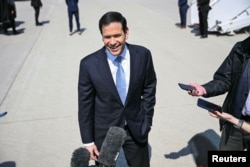
PARIS -- US Secretary of State Marco Rubio arrived in France early on March 27, joining G7 foreign ministers and allied representatives who have already gathered for the second day of a high-stakes meeting overshadowed by tensions over Iran, Ukraine, and global security.
Rubio is set to attend formal sessions of the G7 Foreign Affairs Ministerial in Cernay-la-Ville, near Paris. This will be his first face-to-face engagement with key allies since President Donald Trump intensified Washington’s messaging on Iran.
The gathering, hosted nearby in the Vaux-de-Cernay Abbey under France’s rotating G7 presidency, brings together top diplomats from Britain, France, Germany, Italy, Canada, the European Union, and Japan, along with guest countries, including Ukraine.
Ahead of his departure for Paris on March 26, Rubio signaled that a central message for allies would be the urgency of reopening the Strait of Hormuz, a critical global transit route effectively blocked by Iran.
"It's in their interest to help," Rubio told reporters.
To read the full report, click here.
2 Israeli Soldiers Killed In Lebanon, Bringing Force's Total To 4
Two Israeli soldiers -- both aged 21 -- were killed in Lebanon, the Israeli military said on March 26.
The deaths bring the number of Israeli troops killed in the recently launched ground operations in southern Lebanon to four, according to military figures.
Israeli media reported that one of the soldiers was killed in a rocket attack by the Iran-backed Hezbollah militia. The second soldier was killed in an exchange of fire with fighters from the Shi'ite group, local media reported.
Meanwhile, security sources said an Israeli air strike with three missiles targeted a building in Beirut's southern suburbs, a Hezbollah stronghold.
With reporting by dpa and Reuters
US Considers Sending 10,000 Additional Troops To Middle East: WSJ
The Pentagon is considering sending up to 10,000 additional ground troops to the Middle East to give US President Donald Trump more military options, even as he is pushing a 15-point peace plan that has been delivered to the regime in Tehran, The Wall Street Journal reported on March 26.
The WSJ cited Defense Department officials with knowledge of the planning as saying the force would be in addition to the approximately 5,000 Marines and the thousands of elite paratroopers of the 82nd Airborne Division who have already been ordered to the region.
The report said it was not yet clear where in the region the forces would go, but it said they would likely be within striking distance of Iran and Kharg Island, a crucial oil export hub off Iran’s coast.
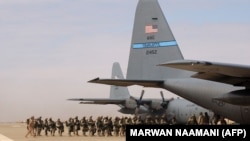
Some observers have speculated that the Trump could order US forces to seize the island as part of efforts to secure shipping through the Strait of Hormuz, which has been largely blocked by Iran.
“All announcements regarding troop deployments will come from the Department of War. As we have said, President Trump always has all military options at his disposal,” Anna Kelly, deputy White House press secretary, was quoted by the WSJ as saying.
A spokesperson for US Central Command, which is responsible for American forces in the Middle East, declined to comment, the report said.
Iran's Bans Sports Teams From Traveling To 'Hostile' Countries For Matches
Iran's Sports Ministry has banned national and club sports teams from playing in countries it deems hostile to the Islamic republic, Iranian media reported on March 26.
The ministry said the move was due to concerns over the safety of its athletes amid the US-Israeli war with Iran that has spread to other parts of the region.
"The presence of national and club teams in countries considered hostile and unable to ensure the security of Iranian athletes and team members is prohibited until further notice," the ministry said.
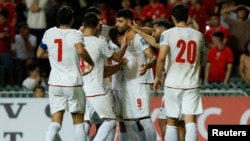
Iran's soccer team has qualified for this year's World Cup, which is being jointly hosted by the United States. Canada, and Mexico. However, its participation in the world's most popular sporting event has been in doubt since the conflict with US and Israeli air strikes began on February 28.
US President Donald Trump has said that while Iran's team was welcome to play in the United States, it might not be appropriate for their "life and safety."
Iran's football federation is in talks with FIFA, soccer's governing body, about moving its World Cup matches to Mexico from the US venues at which it is scheduled to play. The possibilities of such a switch have been played down by World Cup officials so far.
The Iranian national team is currently in Turkey preparing for exhibition matches, called "friendlies," against Nigeria on March 27 and Costa Rica on March 31.
With reporting by Reuters
Rubio Speaks With Iraqi Kurdistan PM, Offers Condolences For Peshmerga Killed In Iran Air Strike
US Secretary of State Marco Rubio on March 26 held a phone conversation with Iraqi Kurdistan Regional Government Prime Minister Masrour Barzani, the State Department said, adding that he offered condolences to families of Kurdish Peshmerga fighters killed in an Iranian missile attack.
A statement said Rubio expressed his "gratitude" to Kurdish authorities for enabling oil from Iraq, including from Iraq's Kurdistan, to reach global markets.
He "offered his condolences to the families of the Peshmerga killed in an Iranian missile attack on March 24 and wished a speedy recovery to those injured."
In the attack, at least six Peshmerga fighters were killed and 30 wounded when a rocket blasted their base near Irbil in Iraqi Kurdistan -- an attack Iraqi Kurds blamed on Iran or Iran-backed militias.
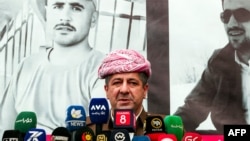
"The secretary strongly condemned the continued attacks by Iran and Iran-aligned Iraqi terrorist militias against US citizens and energy infrastructure across Iraq," he added.
Masrour Barzani is son of the powerful Kurdish figure of Masud Barzani, leader of the Kurdistan Democratic Party (KDP) since 1979.