




Iran's Revolutionary Guard: Hormuz Reopens When US Accepts Iran’s Demands
Iran’s powerful elite military branch said the Strait of Hormuz would not be reopened until the United States accepted all of Tehran's demands.
The comment by Hussein Mohebi, a spokesman for the Islamic Revolutionary Guards Corps (IRGC), was the latest defiant message from Iranian officials, as efforts to negotiate an end to the more-than-five-month-old, US and Israeli-led war grind on.
Iran has shut down the critical waterway, crimping a major source of oil tanker traffic for global markets. Tehran has used the shutdown as an essential card in its negotiations with Washington.
Iran and Oman, whose territorial waters sit on the southern side of the strait, have been holding talks to create a tolling system to charge passing ships.
Mohebi was quoted by Iranian state TV on August 9 as saying the IRGC would keep the waterway closed.
"Our current strategy is to maintain this strait until the enemy accepts all our conditions,” he was quoted as saying. “The strait is now actually a theater of war for us and not just a waterway.”
Iran’s foreign minister, meanwhile, said there were no direct talks with Washington ongoing, only via intermediaries.
Speaking to the Mehr news agency, Abbas Araqchi accused Washington of violating an interim deal the two sides signed in June.
Araqchi also said that Iran and Oman were in the "final stages" of their negotiations over transit for the strait.
In an interview with Fox News broadcast August 8, US Vice President JD Vance said Washington's goal was "to see the same amount of oil and gas come out of the Gulf that you saw before the conflict started."
"That is what the Iranians have told us that they are going to do," he was quoted as saying
"But you know, we don't trust them.”
With reporting by RFE/RL’s Radio Farda, Reuters, AFP
Iranian Official Says Images Of New Supreme Leader To Be Released
A top Iranian official has said images of Mojtaba Khamenei --the man who became Iran’s supreme leader following the death of his father in an Israeli air strike -- will be released in the future.
Khamenei has not been seen in publicly since March when he was announced to be Iran’s next supreme leader.
He’s reportedly suffered serious injuries in the same strike that killed his father, Ayatollah Ali Khamenei, on February 28 -- the first day of the war. Iranian officials have insisted he is alive and capable of performing his official duties.
Khamenei did not attend his father’s funeral in early July furthering speculation about his condition. Iranian officials said he did not attend out of security concerns.
In comments to the Mizan news outlet on August 9, Qasem Qoraishi, a top official with the Basij organization said footage of Khamenei will be released in future, showing him “among the people and out in streets, as well in meetings with the commanders of armed forces.
Qoraishi did not elaborate; Mizan, the news outlet for Iran’s judiciary, provided no further details.
Basij is a volunteer paramilitary militia affiliated with the elite military unit, the Islamic Revolutionary Guards Corps.
Another official news outlet, the Mehr News Agency released a short report on August 9 saying Khamenei had met with Pezeshkian, discussing a range of subjects including the US-Israeli war. The conflict, in its fifth month, is in a lull for the moment.
No photographs, audio, or video were released.
Last week, Pezeshkian said that communication with Khamenei was very "difficult at the moment.”
Iran-Allied Houthis Hit Saudi Refinery, Threaten To Widen Middle East Conflict
Iran-backed Houthi rebels in Yemen struck an oil refinery in Saudi Arabia, threatening to bring in members of a new Saudi-based military alliance into the conflict, and also attacked a Yemeni-government controlled port city as a 2022 UN-brokered truce in the war-torn country further frayed.
The rebels on August 9 said they attacked Saudi Aramco's refinery in the city of Jazan, with the Saudi Energy Ministry saying a fire had broken out at the site but was later extinguished with no injuries, without giving a cause.
Two days earlier, Saudi Arabia signed a defense pact with Turkey and Pakistan in response to growing regional dangers developing out of the US-Israeli war with Iran.
The alliance stipulates that an armed attack against any of the three would be regarded as an attack on all, similar to NATO’s Article 5.
Turkey and Pakistan did not immediately comment following the latest strikes.
Meanwhile, at least 11 people were killed and 20 injured in a Houthi drone and missile strike on the port of Mokha near the important Strait of Bab al-Mandab, Yemeni government military sources told news agencies.
The attack further endangered a 4-year-old UN-brokered truce between the Houthis and the Saudi-backed, internationally recognized government of Yemen.
Yemen, the poorest country in the Middle East, descended into civil war in 2014 when the Houthis seized the capital, Sanaa, ousting the internationally recognized government. The Tehran-allied group now controls much of the northwest, including Red Sea ports like Hodeidah that are lifelines for food and fuel.
Sunni-led Saudi Arabia and Shi'ite-majority Iran have long been bitter rivals seeking geopolitical and religious influence in the Middle East.
The rebels have announced a maritime blockade of Saudi Arabia, hitting Saudi tankers in the Red Sea and the kingdom's oil infrastructure, in parallel with Iran's blockade of the Strait of Hormuz.
Trump Suggests Economic, Not Military, Pressure Now Favored Against Iran
US President Donald Trump appeared to back off threats of immediate military action against Iran, despite ongoing disputes with Tehran over the Strait of Hormuz, suggesting he would allow economic pressure to force the Islamic republic to make a long-elusive peace deal.
“We are low-keying it," Trump told news outlet Axios in a brief phone conversation on August 9, using a term generally referring to restrained action.
"We are only semi-negotiating with them. We are just watching Iran with its huge inflation and the fact they have no money," he was quoted as saying. Axios added that Trump did not make any further military threats during the interview.
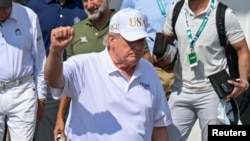
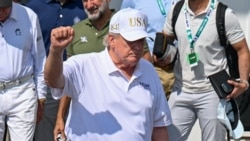
Trump said Iran is “in very bad shape” economically, with no money to pay its troops, and that the US naval blockade has intensified the economic crisis being endured by the country’s government.
According to Axios, he said that, with oil prices falling from recent highs, the American people are feeling less pain from the war -- which, according to many polls, remains highly unpopular with the US public.
"It will work out. It always works out. It's like a chess game," Trump said of the off-and-on negotiating process with the regime in Tehran.
Since the start of the US-Israeli war with Iran, Trump has toggled between threats of massive military strikes and a potential long-term peace deal. He has often insisted that a permanent peace agreement was imminent, only to have Tehran deny such progress, leading to tit-for-tat attacks by both sides.
'Locked And Loaded'
On August 1, Trump said he had decided to "hold off" on any new attacks on Iran, saying a deal with Tehran was near.
"The U.S.A. is locked and loaded and ready to go against the Islamic Republic of Iran, at levels of Military Terror, Strength, and Power not seen since World War II. Despite this, we have just been asked by Iran, and other Middle Eastern Countries, to hold off any attack in that the perimeters of a deal has been agreed to," Trump posted on Truth Social.
"This would include the Immediate, Complete, and Total OPENING OF THE HORMUZ STRAIT, and an end to Iran's nuclear threat."
"Based on this request, I have agreed, for the future benefit of the WORLD and, likewise, the survival of a successful and prosperous Iran, to cancel the attack, subject to being able to rapidly make a DEAL," he wrote, adding that Israel joins him in this "commitment."
According to Iranian media, military sources in Iran denied Trump's claim that Tehran had asked Washington to refrain from launching new attacks.
On August 9, amid US remarks that a deal was close to allow the opening of the Strait of Hormuz, Iran’s powerful elite military branch said the waterway would not be reopened until the US accepted all of Tehran's demands.
Iran has shut down the critical waterway, crimping a major source of oil tanker traffic for global markets. Tehran has used the shutdown as an essential card in its negotiations with Washington.
Although Trump initially said the elimination of Tehran's nuclear threat was the major aim of the US-Israeli war with Iran, which began on February 28, in recent weeks he has focused on the free flow of traffic through the important Strait of Hormuz, through which some 20 percent of the world's oil and natural gas supplies transited prewar.