



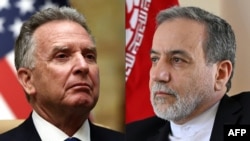
US and Iranian officials are meeting in Geneva, Switzerland, on February 17 for a second round of negotiations over a deal aimed at curbing Tehran's nuclear program and averting war.
The sides held indirect talks earlier this month in Oman, the first since Israel and the United States bombed Iran's key nuclear sites during a brief conflict in June.
The talks come amid a major American military buildup in the Middle East. Tensions have been building after mass nationwide protests in Iran last month, during which authorities launched a brutal crackdown that rights groups say killed thousands of people.
Iranian Foreign Minister Abbas Araqchi is holding talks in Geneva with White House special envoy Steve Witkoff and US President Donald Trump's son-in-law Jared Kushner, with Omani representatives acting as mediators.
"I am in Geneva with real ideas to achieve a fair and equitable deal. What is not on the table: submission before threats," Araqchi said on X on February 16 as he arrived for talks with Rafael Grossi, head of the International Atomic Energy Agency.
Tehran has said it is willing to accept restrictions on its nuclear program in exchange for relief from crippling US economic sanctions, but it will not relinquish its right to enrich uranium.
Washington has sought to expand the scope of the talks to include restrictions on Iran's ballistic missiles program and ending Tehran's support for armed groups in the Middle East -- issues that Tehran considers nonstarters.
The United States and Iran will have to overcome deep mistrust and animosity to strike a deal. Another barrier is the increased political costs of an agreement for both sides.
"Today, any positive concession to the Islamic republic would effectively be rewarding a regime that in recent weeks has killed several thousand Iranians," Ali Vaez, director of the Iran Project at the Brussels-based International Crisis Group, told RFE/RL’s Radio Farda.
For Iran, "reaching an agreement with a president who has not only carried out military strikes against Iran's nuclear facilities but has even threatened military intervention in Iran's internal affairs is difficult," he said.
Negotiating a new comprehensive nuclear deal will be extremely difficult, experts say.
To avoid a war, Vaez said, "the only viable short-term path is a largely symbolic understanding that buys time and potentially creates better conditions for more detailed and technical negotiations in the future."
US Secretary of State Marco Rubio, speaking in Hungary on February 16, said Trump has "made clear he prefers diplomacy and an outcome of negotiated settlement."
"It's been very difficult for anyone to do real deals with Iran because we're dealing with radical Shi'a clerics who are making theological decisions, not geopolitical ones. But, let's see what happens. I hope it works out," Rubio added.
The negotiations in Geneva come after repeated threats from Trump of military action against Tehran, first over Iran's brutal crackdown on protests, and then more recently over the country's nuclear program.
Western countries have long suspected Iran of seeking a nuclear weapon, while Tehran insists its program is for civilian purposes only.
World powers struck a landmark nuclear deal with Tehran in 2015 to prevent an Iranian bomb. Western economic sanctions were eased at the time, but Iran began reneging on commitments after Donald Trump, in his first term as US president, withdrew from the agreement in 2018 and re-imposed sanctions.
On February 13, the US president said regime change in Iran would be the "best thing that could happen."
He also confirmed that a second aircraft carrier, the USS Gerald R. Ford, would soon join a "massive" US armada in the Arabian Sea.