



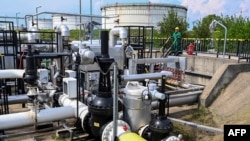
European Union ambassadors have given a green light to a 90 billion euros ($106 billion) loan for Ukraine for this and next year after Hungary and Slovakia lifted their vetoes following the resumption of operations on the Soviet-era Druzhba pipeline, which carries Russian oil -- exempt from EU sanctions -- through Ukraine to Central Europe.
The group announced the decision on April 22, saying it would become official once oil transiting through the pipeline was flowing into the region. The meeting also approved a 20th sanctions package on Russia over its full-scale invasion of neighboring Ukraine.
"The oil started pumping at 11:30 CET. That means that the oil should reach the Hungarian and Slovak borders by the end of the day or early tomorrow," a European official told RFE/RL.
Ukrainian President Volodymyr Zelenskyy said a day earlier that Ukraine had completed repair work on a section of the pipeline that had been damaged by a Russian air strike.

However, he also warned that "no one can currently guarantee that Russia will not repeat attacks on the pipeline infrastructure."
The oil deliveries ground to a halt at the end of January after damage caused by Russian air strikes. Moscow has targeted Ukrainian energy infrastructure as part of its war strategy.
Both Hungary and Slovakia have for months accused Kyiv of stalling to repair it for political reasons with Budapest opting to block a raft of Ukraine-related measures -- including the loan but also more EU sanctions on Russia -- until the Druzhba was up and running again.
Ukraine rejected the accusations but also lashed out at the EU, accusing it of "blackmail" by urging it to quickly repair the damaged pipeline.
Money To Fix Druzhba Pipeline
In March, the European Commission announced that it sent financial aid to restore Druzhba and dispatched a team of experts to inspect the damaged part, although that team reportedly never left Kyiv.
The latest move puts an end to a long-running saga over the loan that initially was agreed by EU leaders, including Hungary and Slovakia, at a summit in Brussels in December 2025.
Leaders opted for a loan backed by the EU budget instead of a much-publicized "reparation loan" using Russian assets currently frozen inside the bloc as collateral. Belgium vetoed that initiative as most of the assets sit in the Brussels-based financial markets company Euroclear.
The funds will now be raised by EU countries jointly borrowing on financial markets, backed by what Brussels calls EU budget "headroom," meaning the gap between the bloc's maximum borrowing capacity under its long-term budget, which runs until 2027, and its actual spending levels.
The Czech Republic, Hungary, and Slovakia all secured carve-outs, so this is a deal involving 24 EU countries, not 27, but the trio still had to approve using the EU budget to back the loan.
The EU is now hopeful the first batch of the loan can be delivered to Ukraine by the end of April or early May.
Last year, the International Monetary Fund estimated Ukraine would need around 135 billion euros in financing for 2026 and 2027, with Brussels committed to cover the largest share of that.
The headline item of the new sanctions package is the proposal to introduce a maritime service ban on all Russian oil products which would prevent EU economic operators from providing services to any vessel transporting these products from Russian ports.
In practice, this removes the current oil price cap - imposed by the Group of Seven (G7) -- by completely stopping EU vessels from transporting Russian oil while non-EU boats could still continue but would not be able to rely on EU port services or insurance.
This move is however contingent on a prior agreement by the so-called “Price Cap coalition” - an informal group consisting of the G7 countries, all EU member states, and Australia.
With soaring energy prices due to the month-long closure of the Strait of Hormuz, few EU member states are now keen to also target Russian oil to further drive-up costs for consumers. This means that the entire maritime ban most likely could be used only once the blockade of the strait is over.
The sanctions package also lists 45 Russian shadow fleet vessels, boats with murky insurance and ownership used by the Kremlin to circumvent the oil cap, taking the number of boats no longer allowed to be serviced at EU ports to nearly 700. Sanctions will also be imposed on Russian icebreakers helping the transport of Russian oil.
One new feature of these sanctions is that the club for the first time ever is using its anti-circumvention tool (ACT) prohibiting EU companies from exporting certain items to Kyrgyzstan. These items include Computer Numerical Control (CNC) that can be used notably for drones.
In an explainer note on the sanctions issued by the European Commission, seen by RFE/RL, the EU had observed an almost 800 percent increase in exports of these products from the EU to the Central Asian country in 2025 and that exports from Kyrgyzstan to Russia of these items for the same period shot up by 1,200 percent.
In the initial European Commission proposal for the sanctions, obtained by RFE/RL, the Georgian port of Kulevi was due to be slapped with a transaction ban while an Armenian bank, OJSC Unibank, was proposed for blacklisting as well.
Both Tbilisi and Yerevan did in the meantime, however, give sufficient proof to Brussels that the port and the bank weren’t involved in sanctions circumvention benefiting Moscow any longer.